
-
by sayum
29 August 2026 3:15 PM







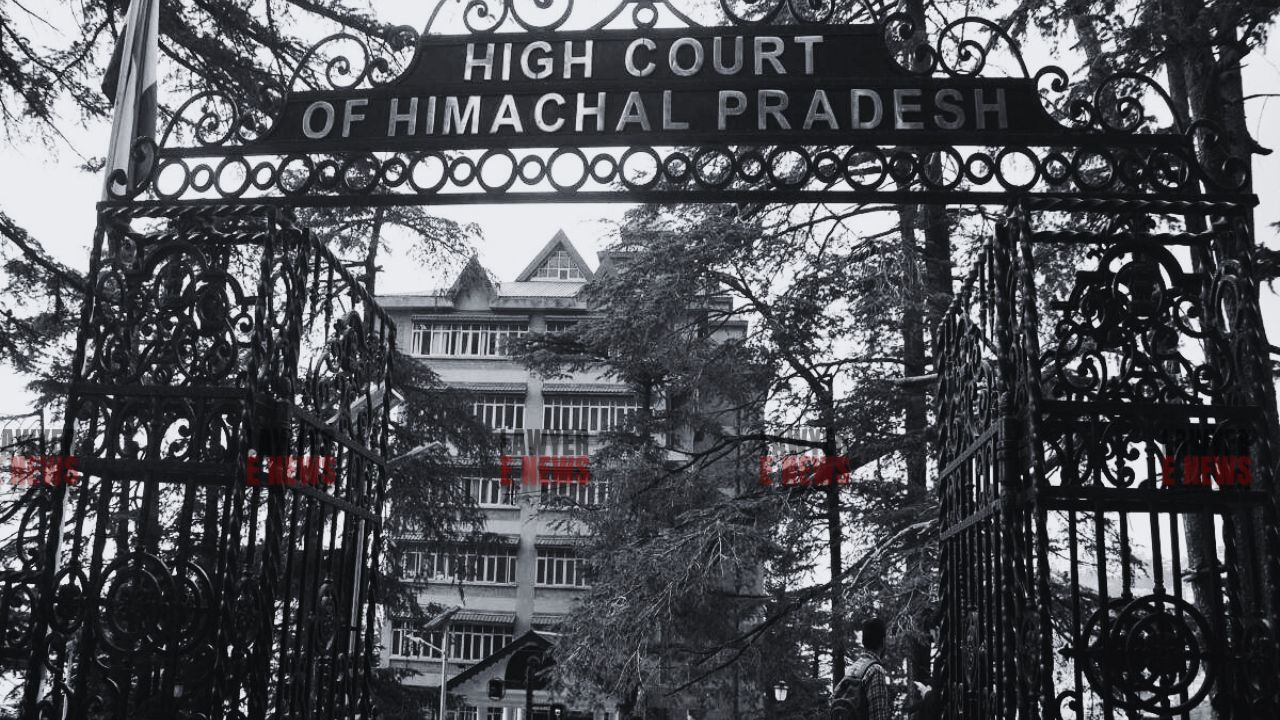
"There is no averment that the accused had encroached upon the land with an intent to commit an offence or intimidate, insult or annoy any person in possession; therefore, the ingredients of Section 447 of IPC were not satisfied." Himachal Pradesh High Court, in a significant ruling dated April 1, 2026, held that mere unauthorized possession or encroachment upon government land does not amount to criminal trespass under Section 447 of the Indian Penal Code unless it is accompanied by a specific intent to commit an offence, intimidate, insult, or annoy.
A single-judge bench of Justice Rakesh Kainthla observed that without averments establishing this requisite mental state, the fundamental "ingredients of Section 447 of IPC were not satisfied," thereby upholding the acquittal of a man accused of encroaching upon Reserved Forest land.
The prosecution alleged that the accused, Kalyan Singh, had encroached upon over 30 bighas of Reserved Forest land by constructing a house and planting an apple orchard. Based on a police complaint and a subsequent land demarcation report, he was charged under Section 447 of the IPC and Section 26 of the Indian Forest Act, 1927. The Judicial Magistrate First Class at Rajgarh acquitted the accused in 2014, prompting the State of Himachal Pradesh to file the present appeal challenging the acquittal.
The primary question before the court was whether unauthorized entry and possession of government land inherently satisfies the ingredients of criminal trespass under Section 447 of the IPC. The court was also called upon to determine the evidentiary validity of a land demarcation conducted in the absence of the accused, and whether an offence under the Indian Forest Act can be sustained without proving the official notification declaring the land as a Reserved Forest.
Analyzing the substantive law on criminal trespass, the court emphasized that Section 441 of the IPC requires an entry upon property in the possession of another with the specific intent to commit an offence, or to intimidate, insult, or annoy. Relying on the Supreme Court's pronouncements in the cases of Mathri v. State of Punjab and Rajinder v. State of Haryana, the bench reiterated that the natural consequence of an entry causing annoyance is insufficient; the primary aim of the entry must be to cause such annoyance or intimidation. The court noted that the police complaint merely alleged encroachment without asserting any unlawful intent.
"There is no averment that the accused had encroached upon the land with an intent to commit an offence or intimidate, insult or annoy any person in possession; therefore, the ingredients of Section 447 of IPC were not satisfied."
Turning to the evidentiary value of the land demarcation, the court found the process severely flawed and legally unsustainable. The demarcating officer admitted during cross-examination that he was not competent to carry out the demarcation, could not recall if three permanent fixed points were taken, and had not issued any notice to the accused. Citing the procedural safeguards laid down by the High Court in State of H.P. v. Laxmi Nand and State of H.P. v. Joginder Singh, the bench ruled that a demarcation report failing to describe the prescribed procedure and conducted entirely behind the back of the accused cannot be relied upon to establish encroachment on government land. "In the absence of the proper demarcation, it was not established that the orchard and house were raised on the government land, and the learned Trial Court had rightly discarded the prosecution’s case that the accused had encroached upon the government land."
"The demarcation was conducted in the absence of the accused... where the demarcation was conducted in the absence of the accused, the same cannot be relied upon to convict him."
The court also scrutinized the charges framed under Section 26 of the Indian Forest Act, 1927, which penalizes prohibited acts in reserved forests. The bench outlined that under Sections 4 and 6 of the Act, the State Government must issue and publish a mandatory notification declaring a specific area as a Reserved Forest. Upon reviewing the evidence, the court found that the prosecution relied on a notification that did not mention any Khasra numbers corresponding to the disputed land. Without documentary proof establishing the specific tract as a legally notified forest, the statutory offence could not be attracted.
"Therefore, there is no evidence that the land was within the Reserved Forest, and no offence punishable under Section 26 of the Indian Forest Act was made out."
Finally, addressing the scope of its appellate jurisdiction, the court referred to the Supreme Court's directives in Surendra Singh v. State of Uttarakhand and State of M.P. v. Ramveer Singh. The bench affirmed that an appellate court should only interfere with a judgment of acquittal if the trial court's findings are patently perverse, based on a misreading of material evidence, or if no reasonable person could have arrived at such a conclusion. Finding no such perversity, the High Court held that the trial court took a highly reasonable and legally sound view based on the deficient evidence presented by the prosecution.
"Where two views are possible, i.e., one consistent with the acquittal and the other holding the accused guilty, the appellate Court should refuse to interfere with the judgment of acquittal."
The High Court ultimately dismissed the State's appeal, confirming the acquittal of the respondent. The court directed the respondent to furnish bail bonds in compliance with Section 437-A of the Code of Criminal Procedure, 1973 (Section 481 of the Bharatiya Nagarik Suraksha Sanhita, 2023) to ensure his appearance before the Supreme Court in the event of a further appeal by the State.
Date of Decision: 01 April 2026