-
by sayum
24 August 2026 10:50 AM







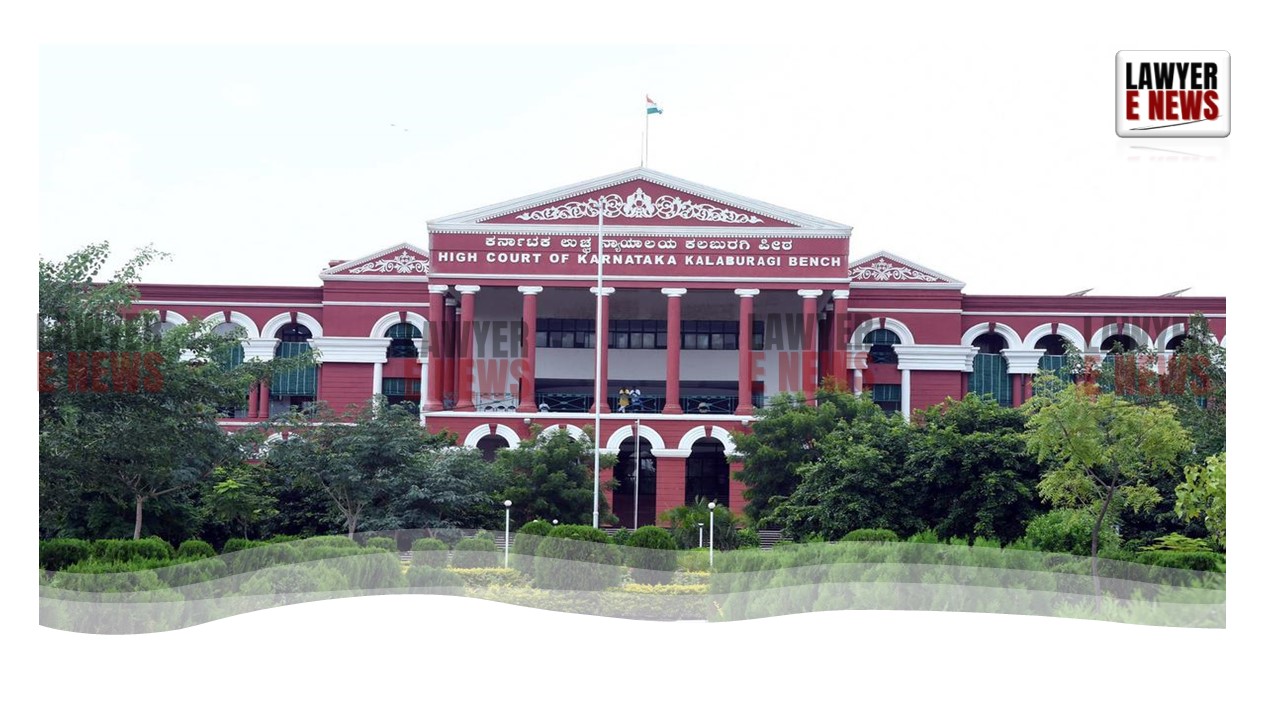
In a significant reaffirmation of the strict evidentiary standards required under the Prevention of Corruption Act, 1988, the High Court of Karnataka at Bengaluru, on 13th January 2026, dismissed a criminal appeal filed by the State under Section 378(1) and (3) CrPC, challenging the acquittal of a Village Accountant accused of demanding and accepting a bribe for a khata change.
The Court, presided over by Justice G. Basavaraja, held that "presumption under Section 20 of the PC Act arises only after the prosecution proves the foundational facts of demand and acceptance beyond reasonable doubt", and not merely upon the recovery of money or a positive chemical test. The appeal was filed against the trial court’s judgment dated 31.05.2014, which had acquitted the accused.
"If Two Views Are Possible, Appellate Court Cannot Interfere" — Trial Court’s Assessment Found Sound, Not Perverse
Referring to landmark precedents including Chandrappa v. State of Karnataka, (2007) 4 SCC 415, and H.D. Sundara v. State of Karnataka, (2023) 9 SCC 581, the High Court reiterated that in appeals against acquittal, unless the view of the trial court is “patently perverse, based on misreading of evidence, or omits material evidence,” the High Court must not substitute its own conclusions.
"The acquittal of the accused further strengthens the presumption of innocence," the Court observed, adding that “the appellate court can interfere only if the only conclusion possible from the evidence is that the accused is guilty.”
Alleged Demand of ₹7,000 Bribe for Khata Change
The accused was a Village Accountant in Kollegal Taluk, alleged to have demanded ₹7,000 from the complainant for effecting mutation (khata) changes in respect of land in Survey Nos. 1043 and 971. A trap was laid on 21st October 2009 by the Lokayukta Police, during which the accused was allegedly caught accepting the bribe.
A charge-sheet was filed under Sections 7 and 13(1)(d) read with Section 13(2) of the Prevention of Corruption Act, 1988, and the case was tried by the District & Sessions Judge, Chamarajanagar, who ultimately acquitted the accused.
Court: Pendency of Official Work Not Established, Demand Not Proved
The High Court upheld the trial court's meticulous assessment that the prosecution failed to prove that any official work was pending with the accused on the date of trap.
“Mere delay in khata change cannot be attributed to the accused alone, especially when the complainant failed to furnish necessary documents like partition deed and genealogy on time,” the Court noted.
The Court emphasized that the application for khata change was filed in September 2008, but mutation was completed as early as August 2009, well before the alleged bribe demand in October 2009. Notably, the mutation entries were already made on 30.08.2009, and the names of the complainant and his family members were reflected in the revenue records, making any claim of pendency untenable.
Voice Recorder Evidence Unreliable, No Spectrographic Test Conducted
The Court also rejected the use of voice recordings allegedly capturing the bribe conversation. Citing Subash Chand Chauhan v. CBI, it held that:
“If the tape recorder is not subjected to voice spectrography with the sample voice of the accused, no reliance can be placed on such evidence.”
The prosecution failed to collect the accused’s voice sample, and no spectrographic analysis was conducted, rendering the voice recording inadmissible and legally inconsequential.
Confessional Statement (Exhibit P5) Held Inadmissible – Hit by Sections 25 & 26 of Evidence Act
The trial court had relied on Uddi Achut Ramaiah v. State of A.P., 1997 SCC (Crl) 129, to rule that a written explanation obtained from the accused post-arrest (Ex.P5) — where he admitted to “making a mistake” and promised not to repeat it — was inadmissible in law, being inculpatory in nature and obtained while in police custody.
The High Court agreed, stating that the document was legally irrelevant, and could not be used to prove demand or acceptance of bribe.
Witness Testimony Marred by Contradictions, Lack of Independent Corroboration
The Court found the testimony of PW1 (complainant) and PW4 (his aunt) to be inconsistent and uncorroborated. The complainant's timeline of demand — first ₹8,000, later reduced to ₹7,000 — was found inconsistent with documentary evidence and contradicted by other prosecution witnesses.
The evidence of PW3 (shadow witness) and PW2 (panch witness) also lacked clarity, especially regarding the actual demand and reason for payment. The prosecution failed to explain why no independent witnesses were secured for corroboration — a key omission in trap cases under the PC Act.
Presumption Under Section 20 PC Act Not Triggered Without Proof of Demand
Citing Meena v. State of Maharashtra, (2000) 5 SCC 21, and State of Karnataka v. K.T. Hanumanthaiah, the Court emphasized that:
“Even for the presumption under Section 20 of the PC Act to arise, the prosecution must first prove demand and acceptance of illegal gratification.”
The trial court had rightly held that mere recovery of tainted currency and positive phenolphthalein tests do not satisfy the essential ingredients of the offence, particularly in the absence of independent corroboration.
Acquittal Upheld, Appeal Dismissed
Summing up the deficiencies in the prosecution’s case, the High Court ruled:
“Mere filing of complaint, registration of FIR, recovery of amount and conduct of trap are not sufficient to establish guilt unless supported by clear proof of demand, acceptance and pending official favour.”
The Court found no perversity or illegality in the trial court’s reasoning and held that the prosecution failed to prove its case beyond reasonable doubt.
Accordingly, the State’s appeal was dismissed, and the acquittal of Sri K. Prabhakar was upheld.
Date of Decision: 13th January 2026