
-
by sayum
28 August 2026 2:11 PM







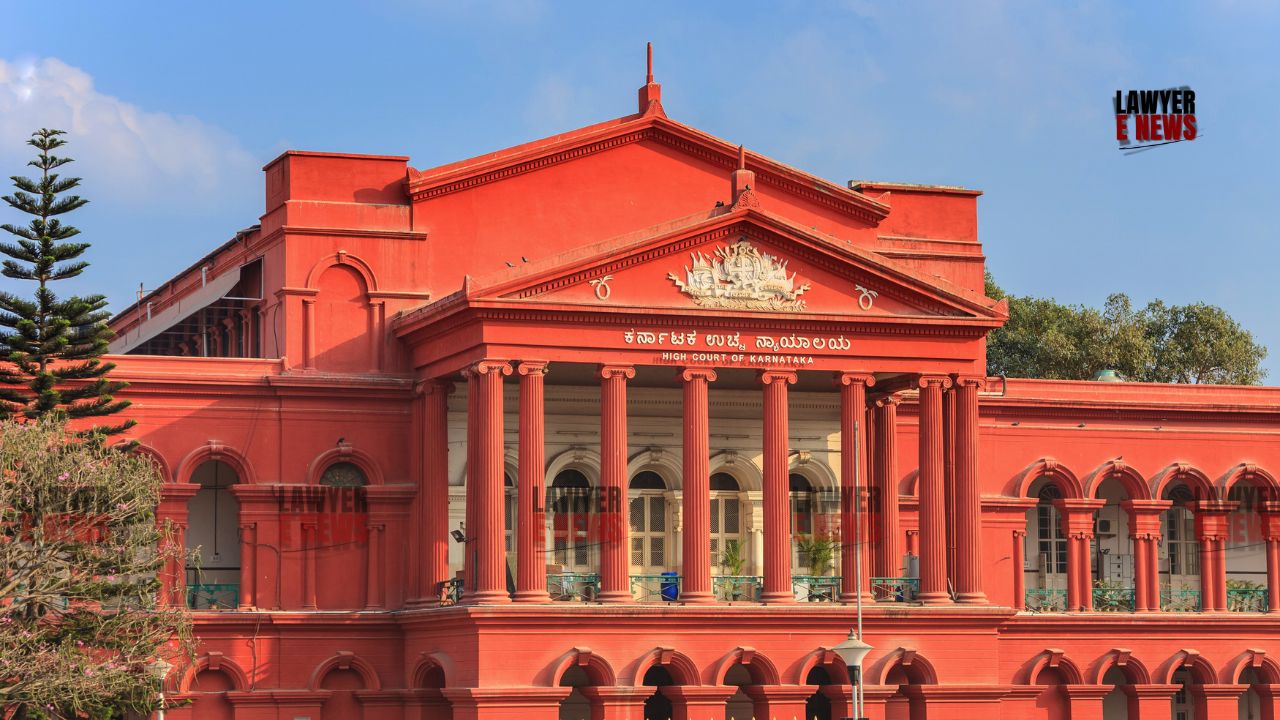
"Once part of the endorsement was accepted, there cannot be rejection of remaining part of the endorsement, particularly when the signatures were admitted and the document was acted upon by receiving further consideration," High Court of Karnataka, in a significant ruling, held that a First Appellate Court cannot reverse a decree for specific performance by ignoring admitted signatures and valid endorsements on a sale agreement.
A bench of Justice H.P. Sandesh observed that when a party admits signatures on a document but claims they were obtained on blank papers, the burden of proving such a claim lies heavily on them, failing which the document's execution stands proved. The Court noted that the First Appellate Court had adopted a perverse approach by directed a mere refund of the earnest money despite the plaintiff proving the entire transaction.
The appellant, V. Chandrashekar, filed a suit for specific performance based on a sale agreement dated July 11, 1999, for agricultural land in Huskur Village. While the Trial Court originally decreed the suit in favor of the plaintiff, the First Appellate Court reversed the decision, directing the defendants to only refund the amount of Rs. 77,500 with interest. The plaintiff approached the High Court in a second appeal, contending that the subsequent sale of the property to a third party was a collusive attempt to defeat his rights under the original agreement.
The primary question before the court was whether the Lower Appellate Court was justified in reversing the Trial Court's findings and dismissing the suit for specific performance despite the vacillatory statements of the defendants. The court was also called upon to determine whether an adverse inference should be drawn against a defendant who fails to subject themselves to cross-examination and whether the rejection of part of a signed endorsement while accepting another part constitutes a legal error.
Admission Of Signatures Precludes Plea Of Blank Paper Creation
The Court emphasized that once the signatures on the sale agreement and subsequent endorsements are admitted, the defense that the document was created using blank papers loses its credibility. The bench noted that defendant No. 1 had categorically admitted during cross-examination that signatures found on the document were his, yet he simultaneously claimed they were obtained for unrelated water charges. The Court found these "contra evidences" and vacillatory statements sufficient to disprove the defendants' version of events and uphold the genuineness of the agreement.
Court Rejects Splitting Of Endorsements Signed By Parties
The bench took a stern view of the Appellate Court’s decision to accept only a small portion of a payment endorsement while rejecting the larger portion regarding a payment made to a third party. The Court observed that when the Courts below accepted a part of the endorsement signed under the document, they committed an illegality in rejecting the remaining part of the same endorsement. It was noted that the payment of Rs. 45,000 made through a cheque belonging to the plaintiff was corroborated by the testimony of the recipient, which the defendants could not successfully controvert.
"When there was a clear admission except to the last shara and the defendant once denies the same, the same was not sent to the handwriting expert disputing the same; mere denial is not enough."
Adverse Inference Drawn Against Party Eschewing Cross-Examination
The High Court highlighted a significant procedural lapse where the Second Defendant filed a written statement but failed to subject herself to cross-examination. The Court held that the Trial Court and Appellate Court were not justified in ignoring this conduct, as it necessitates the drawing of an adverse inference. By avoiding the witness box, the defendant failed to substantiate the pleadings made in the written statement, which further strengthened the plaintiff's case for specific performance.
Subsequent Sale Deed Held To Be Collusive And Sham
In analyzing the transaction with the third defendant, the Court found that the subsequent sale deed was executed with a clear intention to avoid the agreement already in existence in favor of the plaintiff. The Court noted that the sale consideration mentioned in the alleged prior agreement of the third defendant was inconsistent and falsified by the evidence on record. The bench concluded that the defendants had colluded with each other to "knock off" the property and defeat the legitimate claim of the plaintiff.
Scope Of Interference Under Section 100 CPC In Perverse Findings
The Court addressed the arguments regarding the scope of a second appeal, noting that while the High Court generally does not interfere with findings of fact, it is duty-bound to do so if the reasoning of the lower courts is found to be perverse. Referring to Supreme Court precedents, Justice Sandesh stated that if conclusions are contrary to mandatory provisions of law or based on a misappreciation of documentary evidence, the High Court must exercise its powers under Section 100 of the CPC to correct the error.
"In order to understand a document, a reader should not go by its title. It is the Courts responsibility to examine the documents contents and the intention of the parties."
The High Court allowed the second appeals and set aside the judgment of the First Appellate Court. The decree of the Trial Court was restored, and the suit for specific performance was decreed in favor of the plaintiff. The Court directed the defendants to execute the sale deed in favor of the plaintiff, granting the appellant liberty to enforce the agreement through the process of law should the defendants fail to comply.
Date of Decision: 12 June 2026





