-
by sayum
24 August 2026 3:22 PM







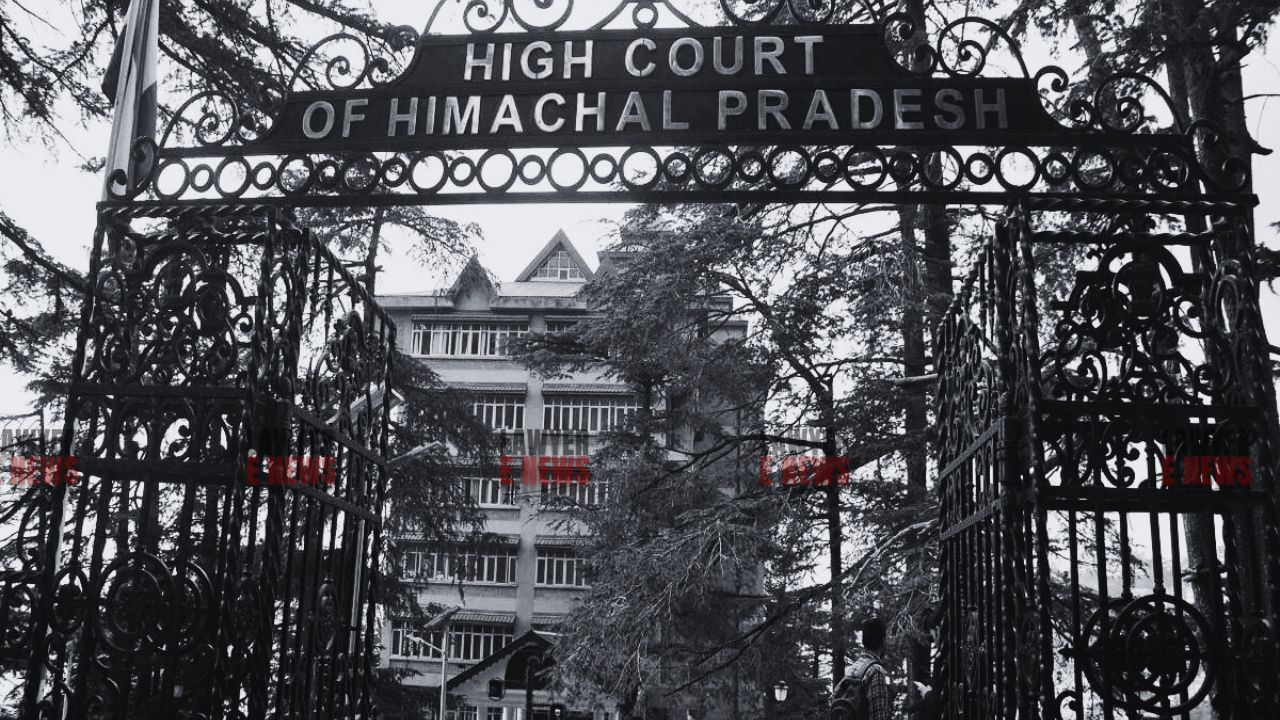
“It is improbable that a person of ordinary prudence would repay a loan but fail to retrieve the signed blank papers” — with this piercing observation, the Himachal Pradesh High Court dismissed a second appeal filed under Section 100 of the Code of Civil Procedure, affirming the concurrent findings of two lower courts that decreed specific performance of an agreement to sell land for ₹2,00,000.
Justice Bipin Chander Negi, who held that no substantial question of law arose in the matter. The appellant-defendant had admitted to signing the agreement but alleged that the signatures were obtained on blank papers as security for a repaid loan — a defence the Court found wholly unsubstantiated and improbable.
“Self-Serving Assertions Without Proof Cannot Override Documented Execution of Agreement” — Court Disbelieves ‘Blank Paper’ Defence
The High Court endorsed the findings of the Trial Court and First Appellate Court that the plaintiff had successfully proved the execution of an agreement to sell dated 13.04.2015 and payment of ₹1,80,000 as earnest money.
Rejecting the appellant's defence, the Court noted:
“The defendant, while admitting his signatures on Exhibit P3/PW1, set up a specific defence that these signatures were obtained on blank papers… It is improbable that a person of ordinary prudence would repay a loan but fail to retrieve the signed blank papers, and thus an adverse inference must be drawn against the defendant on this account.”
The Court characterised the claim as “a self-serving assertion”, lacking any supporting oral or documentary evidence. The defendant, apart from tendering his own affidavit, failed to produce any corroborative witness or record to prove that such a loan transaction took place or that signed papers were misused. This absence of evidence, coupled with the improbability of his version, led the Court to uphold the lower courts’ conclusion that the agreement was genuine and voluntarily executed.
“Readiness and Willingness Proven — Plaintiff Was Present with Consideration, Defendant Was Not”: Specific Performance Justified
Justice Negi also affirmed that the plaintiff had met the statutory requirement of readiness and willingness under the Specific Relief Act. According to the records, the plaintiff attended the Tehsil Complex on the appointed date with the remaining balance consideration of ₹20,000 and other charges. He even swore an affidavit before the Executive Magistrate regarding his presence.
Referring to the evidence, the Court observed:
“The testimony of PW-1, corroborated by affidavit Exhibit P4/PW1 and legal notice Exhibit P5/PW1, establishes that the plaintiff presented himself at the Tehsil Complex… but the defendant failed to appear.”
The defendant did not provide any explanation for his absence or his failure to execute the sale deed. The Court thus concluded that it was the defendant, not the plaintiff, who breached the contract:
“The plaintiff has throughout been ready and willing to perform his obligations, and it is the defendant who is in breach of the contract.”
“No Substantial Question of Law Exists When Findings Are Based on Credible Evidence” — Section 100 CPC Appeal Fails
The second appeal was filed under Section 100 of the CPC, which restricts appellate jurisdiction to substantial questions of law. Justice Negi, after reviewing the entire record and reasoning of the courts below, concluded:
“In the aforesaid facts and attending circumstances, there arises no question of law, much-less a substantial question of law for consideration of the Court. Therefore, the appeal is dismissed being devoid of any merit.”
Both the Trial Court and First Appellate Court had relied upon the testimonies of the plaintiff (PW-1), a marginal witness (PW-2), and the scribe (PW-3), who confirmed the terms of the agreement and the payment of earnest money. The defendant’s failure to disprove the agreement or his inability to explain the continued possession of the document by the plaintiff added to the weight of the plaintiff’s case.
The High Court found the findings of fact to be consistent, credible, and legally sound, thus not warranting interference in second appeal.
With this decision, the Himachal Pradesh High Court has once again underlined that defences premised on blank paper misuse must be backed by strong, cogent evidence, especially where the execution of an agreement is proven through witnesses and admission of signatures. The Court’s sharp observation — that no prudent person would repay a loan but leave signed blank papers unrecovered — sets a clear message for civil litigants seeking to evade contractual obligations through unproven defences.
Date of Decision: 12 November 2025