-
by sayum
25 August 2026 6:19 AM







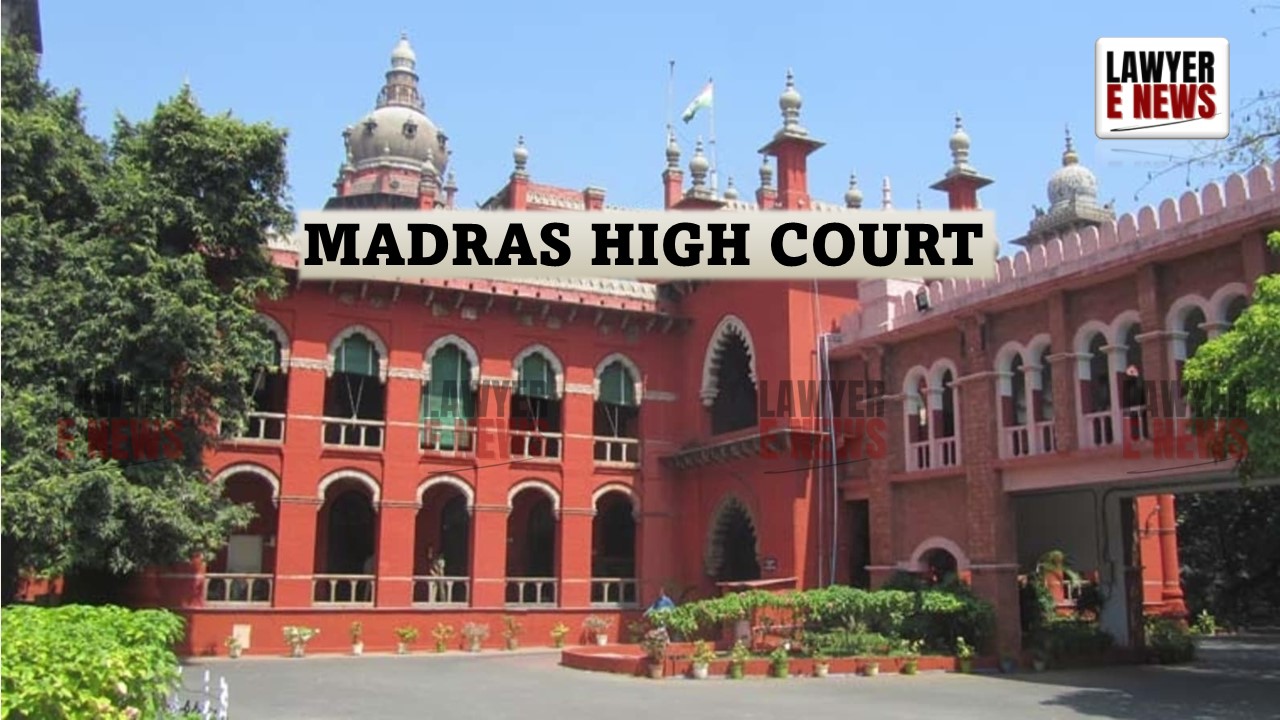
“Power Under Article 215 Must Be Exercised Sparingly, Not to Circumvent Statutory Limitation ….Statutory Limitation Under Section 20 of Contempt of Courts Act Cannot Be Rendered Otiose by Resorting to Article 215 of the Constitution” — Madras High Court
In a sharply reasoned judgment that reinforces judicial discipline over contempt proceedings, the Madras High Court on 18th September 2025 dismissed Contempt Petition No. 2936 of 2025, filed by Lakshmanan, holding that it was barred by limitation under Section 20 of the Contempt of Courts Act, 1971, and that “no exceptional circumstances exist to invoke extraordinary jurisdiction under Article 215 of the Constitution of India.” The Bench comprising Justice S.M. Subramaniam and Justice Mohammed Shaffiq underlined that “the constitutional powers of contempt must operate in harmony with the statutory mandate of limitation.”
The Court's ruling sends a clear message that the High Court's inherent contempt powers are not a backdoor to defeat express limitation periods, especially when the petitioner himself has displayed laxity.
“A Litigant Cannot Sleep Over His Rights and Then Invoke the Majesty of Article 215 to Revive Time-Barred Contempt” — Court Criticises Delay
The case arose from a writ order passed on 08.12.2021 in W.P. No. 26117 of 2021, where the High Court had directed the respondents — Sarayu, IAS, District Collector, Krishnagiri and Subramani, Tahsildar, Denkanikottai Taluk — to complete an enquiry and pass appropriate orders within eight weeks, after granting a hearing to the petitioner.
However, Lakshmanan approached the Court with a contempt petition only in 2025, nearly four years after the deadline fixed by the Court’s original order. The petitioner contended that the failure to comply with the earlier directions amounted to willful disobedience. The Government Pleader, however, objected to the maintainability of the contempt plea on the ground of limitation under Section 20 of the Contempt of Courts Act.
The Court accepted the respondents’ preliminary objection, holding that “the contempt petition deserves to be rejected in limine”, and proceeded to deliver a judgment that is both doctrinally robust and legally instructive.
“Section 20 Imposes a Jurisdictional Bar, Not a Mere Procedural Hurdle” — High Court Rules Delay Fatal
Delving into the statutory framework, the Bench noted that Section 20 of the Contempt of Courts Act, 1971 is not a mere procedural formality but a “mandatory jurisdictional bar”, which states:
“No Court shall initiate any proceedings for contempt, either on its own motion or otherwise, after the expiry of a period of one year from the date on which the contempt is alleged to have been committed.”
The Court held that the cause of action arose in early 2022, after the expiry of the eight-week deadline fixed in the writ order of December 2021. Yet, the contempt petition was filed after more than three and a half years, without any explanation for the delay.
“In the absence of any sufficient reason, the Courts may not be in a position to entertain the Contempt Petition, since the petitioner who obtained the orders of this Court himself was not vigilant in pursuing the remedy.” — observed the Bench.
The Court emphasised that limitation is not a mere technicality, but foundational to the exercise of contempt jurisdiction.
“Constitutional Powers Cannot Be Used to Defeat Legislative Mandate” — Harmonious Construction Emphasised
On the question of invoking Article 215 — which declares every High Court as a court of record with power to punish for contempt — the Court was categorical:
“The general principle of law in this regard is that whenever there is a special Act enacted in respect of limitation, the powers conferred under the Constitution as well as the Special Act are to be read cogently and harmoniously.”
Citing Pallav Sheth v. Custodian, the Court reiterated that the one-year limitation under Section 20 is applicable even when contempt powers are exercised under Article 215. It warned against the casual invocation of constitutional authority to override statutory safeguards: “The High Courts cannot invoke the powers under Article 215 in all cases by entertaining contempt applications beyond the period of one year, so as to dilute or eradicate the law prescribed under Section 20 of the Contempt of Courts Act, 1971.”
It further clarified that only “extraordinary circumstances” involving “gross injustice” or “public importance” may warrant such a constitutional override, but “no such case has been made out in the present petition.”
“Generalisation of Exceptions is Impermissible” — Court Warns Against Misuse of Contempt Powers
The Bench also cautioned against the growing tendency of litigants to file contempt petitions long after the alleged violation, hoping to seek relief under the constitutional umbrella:
“Litigants approach the Court to get justice, that does not mean that all contempt applications have to be entertained after a period of one year... Generalisation in this regard can never be encouraged.”
The Court referred to other precedents, including:
Maheshwar Peri v. High Court of Judicature at Allahabad
Ruksana Begum v. B.P. Varma
State of Kerala v. P.K. Ramachandranan
P. Muruganandam v. J. Thirugnanam
All of which consistently held that Article 215 cannot be invoked routinely to defeat limitation, and the Contempt of Courts Act, 1971 remains the governing framework for such proceedings.
The Court also invoked Lord Denning’s timeless warning from Morris v. Crown Office:
“It is a great power — a power instantly to imprison a person without trial — but it is a necessary power.”
However, the High Court added: “That great power must be exercised with equal responsibility and self-restraint, in accordance with statute.
The Madras High Court’s judgment in Lakshmanan v. Sarayu, IAS & Anr. represents a firm judicial assertion that contempt jurisdiction is not immune to legislative limitation. The ruling reaffirms that statutory limitation under Section 20 of the Contempt of Courts Act acts as a substantive fetter, and Article 215 cannot be stretched to revive stale claims, unless justice itself is at stake.
By dismissing the contempt petition filed after an inordinate delay, the Court has made it clear that vigilant litigants may invoke the majesty of constitutional courts, but negligent ones cannot bypass clear legal mandates.
“The limitation prescribed under Section 20 is to be scrupulously followed in all cases, and the provisions are to be read harmoniously along with Article 215 of the Constitution of India.”
Date of Decision: 18 September 2025