
-
by sayum
26 August 2026 1:49 PM







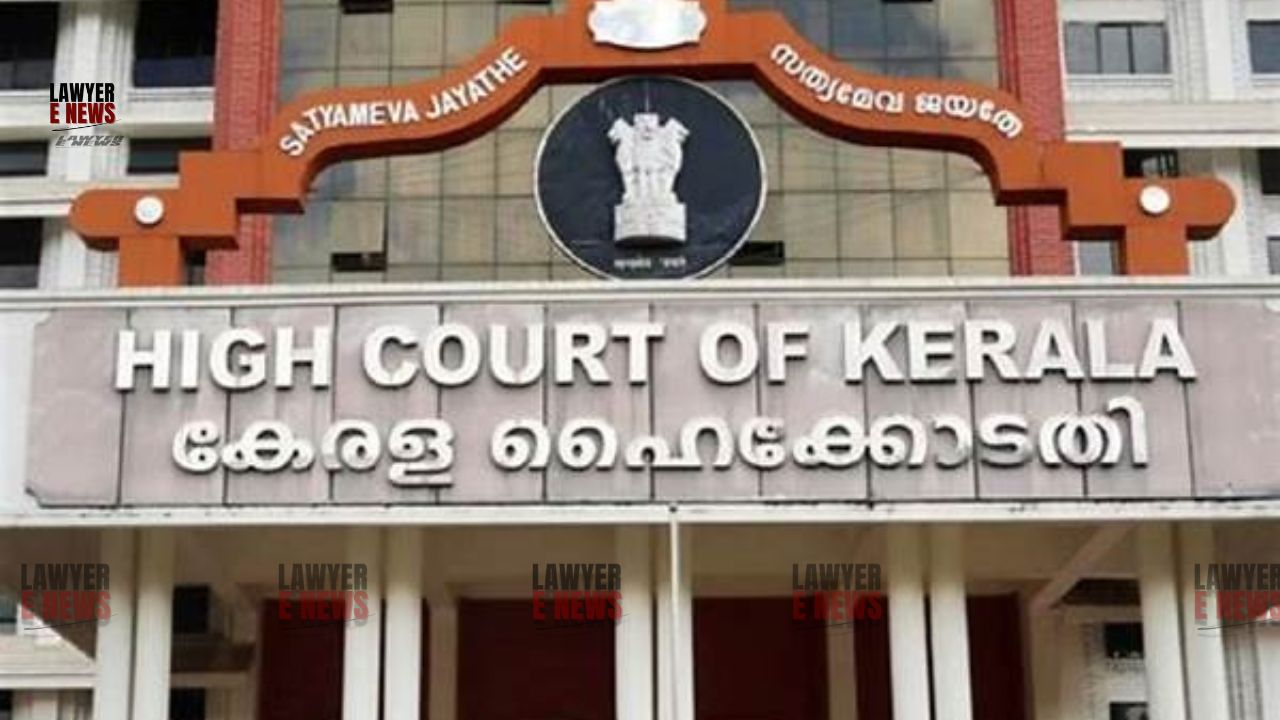
In a significant reaffirmation of judicial restraint under Article 227 of the Constitution, the Kerala High Court upheld the Kerala Administrative Tribunal’s direction to the State to implement its own earlier order granting notional re-fixation of pay to a retired Administrative Assistant who had been retrospectively promoted. Division Bench comprising Justice Anil K. Narendran and Justice Muralee Krishna S. held that the Tribunal's directive, which asked the State to act on Annexure A2 sanction order, was entirely consistent with legal and administrative principles and did not warrant supervisory interference.
The Court stressed: “The supervisory jurisdiction under Article 227 is not appellate in nature… this Court cannot interfere unless there is a manifest error, or the reasoning is palpably perverse or patently unreasonable.”
“Tribunal Was Right to Direct Implementation of Sanctioned Order—Refusal to Act on Government’s Own Approval Cannot Be Justified Through Technical Objections”: High Court Upholds Pay Refixation Directive
The case arose from a petition filed by the State of Kerala and its Education Department authorities, challenging an order of the Kerala Administrative Tribunal (KAT) dated 12.09.2023, whereby it directed the State to implement its own prior sanction (Annexure A2) that allowed notional re-fixation of pay with effect from 01.11.1971 following a retrospective promotion granted to the respondent, Lawrence T., a retired Administrative Assistant from the General Education Department.
The Tribunal had held that while re-option under old pay revisions could not be granted due to absence of revised pay scales, the pay refixation already sanctioned must be implemented, since no action had been taken despite the issuance of the Government Order.
The High Court, while examining the challenge, made it clear that its role under Article 227 is not to re-evaluate facts or revisit administrative reasoning, unless there is a “gross and manifest failure of justice” or “flagrant abuse of law.”
The respondent, Lawrence T., retired on 31.05.1999. However, his promotion to the cadre of Upper Division Clerk (UDC) was retrospectively reassigned to take effect from 01.11.1971 by a government order issued in 1989. Following this, the government, through Annexure A2 (dated 27.05.2019), granted permission to re-fix his pay notionally from the date of retrospective promotion. The sanction, however, came with a stipulation that the arrears from 1971 to 1979 would be notional, i.e., not payable in cash.
Pursuant to this, the respondent submitted a re-option request for the 1973, 1978, and 1983 pay revisions on 30.06.2019. However, the request was rejected on 14.07.2021 (Annexure A4) on the ground that it was not filed within the prescribed time (three months from the date of sanction), and that no retrospective revision of pay scale was involved.
Aggrieved by this, the respondent approached the Kerala Administrative Tribunal, which, after noting the limited scope for re-option, nonetheless directed that Annexure A2—which had been validly issued and remained unimplemented—must be enforced within two months.
The key issue before the High Court was whether the Tribunal had exceeded its jurisdiction by directing the implementation of a government order that had been challenged indirectly on procedural grounds, such as alleged delay in exercising re-option.
Justice Muralee Krishna S., writing for the Bench, underscored the scope of Article 227, reiterating:
“This Court cannot sit in appeal over the findings recorded by the Tribunal. The correctional jurisdiction under Article 227 is limited to situations involving manifest error, patent perversity or breach of natural justice.”
In applying this principle to the facts at hand, the Court noted:
“The Tribunal accepted the petitioners’ contention that the respondent was not entitled to re-option since no change in pay scale occurred prior to his date of option. However, it correctly found that the sanctioned notional refixation as per Annexure A2 had not been implemented, despite a clear administrative directive.”
Rejecting the petitioners’ argument that allowing the Tribunal's order would lead to “a flood of similar applications” and a “financial burden on the exchequer”, the Court held:
“Fear of administrative burden cannot justify the failure to implement an already sanctioned benefit. The order passed by the Tribunal only seeks compliance with what the State has already approved.”
Further, the Court highlighted the perversity in penalising the retired employee for administrative delays:
“The respondent had submitted his re-option in time, but the same was not acted upon by the authorities within the stipulated time frame. Penalising him for the delay attributable to the administration is wholly unjust.”
Kerala High Court concluded:
“We find no ground to hold the Tribunal’s order as perverse or illegal. The direction to implement Annexure A2 is neither unreasonable nor inconsistent with legal principles.”
Upholding the Tribunal's findings, the Kerala High Court dismissed the original petition filed by the State. It ruled that the Tribunal’s direction merely enforced a standing government order (Annexure A2), and did not amount to granting any fresh benefit or altering policy decisions.
The judgment in State of Kerala & Ors. v. Lawrence T. provides a significant reaffirmation of judicial discipline under Article 227. The Court’s refusal to overturn a justified administrative order—especially one benefiting a retired employee whose rights were acknowledged but withheld on technicalities—demonstrates the judiciary’s role in upholding lawful entitlements against bureaucratic inertia.
This decision stands as a reminder that sanctioned administrative decisions carry the force of law, and cannot be arbitrarily ignored or buried under procedural arguments. When authorities grant a benefit like notional pay refixation, they are bound to act on it, and the High Court will not rescue them from their own lawful orders through supervisory intervention.
Date of Decision: 28 October 2025





