
-
by sayum
26 August 2026 1:49 PM







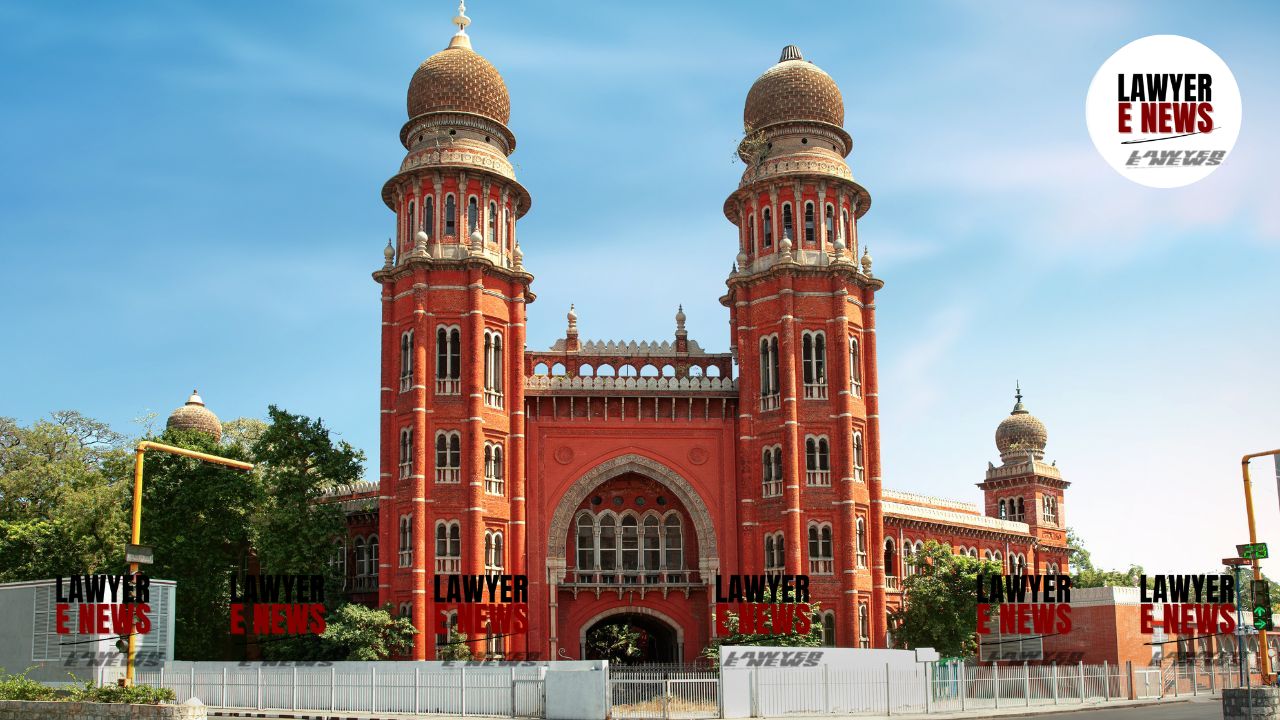
"Improper presentation with deficit court fee does not stop the clock under Section 34(3); once limitation lapses, the Court loses all jurisdiction" – In a critical pronouncement for arbitration jurisprudence and procedural rigor, the Madras High Court has held that a petition under Section 34 of the Arbitration and Conciliation Act, 1996, filed without the full court fee, cannot be treated as a valid filing for the purpose of limitation. The Court ruled that the payment of the full court fee beyond the prescribed 120-day limitation period is not condonable, and consequently, dismissed the arbitration petition at the very threshold.
Justice N. Anand Venkatesh categorically held:
“Improper presentation of the petition by paying deficit Court fee does not arrest the limitation period prescribed under Section 34(3)... unless the deficit Court fee is paid within the limitation period... If the limitation period is crossed, an application filed thereafter to condone the delay... cannot even be entertained.”
This ruling sharply clarifies the strict statutory mandate of Section 34(3), reinforcing the inflexible deadline for challenging arbitral awards and setting a strong precedent for courts across India.
“Court’s Power to Condon Delay Under Section 34(3) Is Exhaustive — 120 Days, Not a Day More”
The case arose from a petition filed by M. Gajendran and M.G. Vasantha Kumar seeking to challenge an arbitral award dated 27.04.2023. Although the petition was initially presented on 24.07.2023, it was filed with a court fee of only ₹10, against the required fee of ₹1,01,000.
Additionally, the original arbitral award was not filed at the time of initial presentation. It was only during re-presentation on 23.06.2025, a staggering 690 days later, that the petition was completed with the original award and full court fee.
The petitioners sought condonation of this 690-day delay in both representation and court fee payment.
However, the Court held that the initial filing was non est in the eyes of law, as it lacked the essential statutory requirements of court fee and award submission, thus failing to stop the limitation clock.
“If such presentation of the petition has to be regularized, the deficit Court fee must be paid within the limitation period prescribed under Section 34(3)... In the absence of the same, the Court cannot condone the delay,” the Court observed.
“Negligence of Counsel Cannot Override Statutory Limitation” – Court Expresses Disappointment, But Denies Relief
The petitioners contended that their original advocate had taken full fee but failed to file the petition properly, an act amounting to professional misconduct. However, the Court made it unequivocally clear that such lapses, however unfortunate, cannot enable a court to override the hard limit set by Section 34(3).
“This Court can only express its anguish and disappointment... but it cannot act beyond the scope of Section 34(3) of the Arbitration and Conciliation Act.”
The judgment suggests that the proper remedy lies in initiating professional misconduct proceedings before the Bar Council, but not in seeking condonation under an inapplicable statute.
Filing With Photocopy of Award May Not Be Fatal — But Deficit Court Fee Is
Interestingly, the Court distinguished between the absence of a signed original award and the payment of full court fee. On facts, the petitioners claimed that a copy of the award had been filed along with the petition on 24.07.2023.
While noting that a photocopy of the award, if authenticated, might suffice for limited purposes, the Court reiterated that filing with deficit court fee continues to be a fatal defect unless rectified within the 120-day statutory limit.
Relying on a Full Bench decision of the Delhi High Court in Pragati Construction Consultants v. Union of India (2025 (3) CTC 433) and Division Bench ruling in Waaree Energies Ltd. v. Sahasradhara Energy, the Court held:
“All the above judgments make it clear that filing of a petition with deficit court fee cannot be construed as proper presentation of the petition… the Court is divested of its power to condone the delay…”
Northern Railway Case Distinguished – No Relief Where Court Fee Is Paid After 120 Days
The petitioners relied heavily on Northern Railway v. Pioneer Publicity Corp. (2017) 11 SCC 234, where the Supreme Court held that Section 34(3) applies to initial filing, not re-filing. However, Justice Anand Venkatesh decisively held that the Northern Railway ruling does not apply to cases of deficit court fee.
“The issue in Northern Railway was not non-payment of court fee... the Court fees payable by the applicant was not paid within the prescribed period of limitation as fixed under Section 34(3)... Hence, it is not applicable.”
He further noted that courts in Veeyar Engineers, Waaree Energies, and Simplex Infrastructure Ltd. had consistently upheld the inviolability of the 120-day window under Section 34(3).
“Floodgates Must Be Closed — ADR Mechanism Cannot Be Derailed by Lax Procedure”
Invoking the larger public policy and structural integrity of the Arbitration and Conciliation Act, the Court remarked:
“Entertaining such petitions will pave the way for litigants to merely file some sheets of paper... and thereafter endlessly extend the limitation prescribed... this will dilute and wash away the principle underlying ADR Mechanism.”
The ruling reinforces the sanctity of timelines in arbitration — a critical feature designed to uphold speed, finality, and efficiency in dispute resolution.
Judicial Discipline Prevails Over Equitable Sympathy
Despite the unfortunate circumstances of the petitioners having been allegedly misled by their previous counsel, the High Court reaffirmed that statutory limits are not elastic. Section 34(3) allows a maximum of 120 days — three months plus a 30-day grace period — beyond which courts are powerless to act.
The applications for condonation were therefore dismissed, and the arbitration petition rejected at the SR stage itself.
“Applicants have lost their valuable right to challenge the award… but this Court cannot rewrite the statute.
Date of Decision: 23 October 2025





