
-
by sayum
26 August 2026 1:49 PM







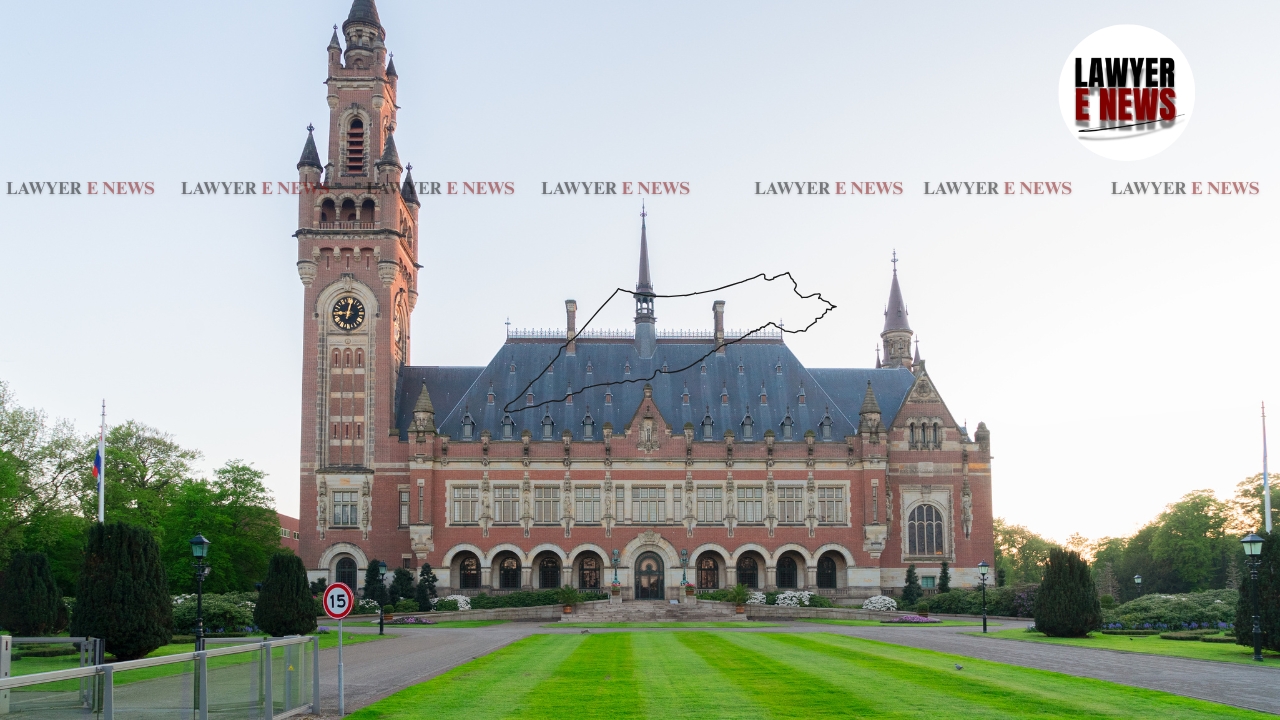
“Urgency must be balanced with procedural fairness—but cannot override the right to a timely defence,” observed the International Court of Justice in a pivotal procedural ruling in the case of Application of the Convention on the Prevention and Punishment of the Crime of Genocide in the Gaza Strip (South Africa v. Israel).
On 20 October 2025, the ICJ issued an Order extending the time-limit for Israel to submit its Counter-Memorial in the case filed by South Africa under the Genocide Convention. The Court fixed 12 March 2026 as the new deadline, partially acceding to Israel’s second request for extension—while also reserving future decisions on the subsequent procedure.
“Judicial Economy and Procedural Equality Are Not Mutually Exclusive”: ICJ Balances Delays Against Due Process
The Court, through President Judge Yuji Iwasawa, made it clear that it weighed the submissions of both parties carefully. The Order references Article 48 of the ICJ Statute and Articles 44(3) and 44(4) of the Rules of Court, which empower the Court to regulate the procedural calendar of contentious cases.
Israel had earlier been granted an extension by Order dated 14 April 2025, which postponed its filing deadline from 28 July 2025 to 12 January 2026. In a new letter dated 14 October 2025, Israel’s Co-Agent again approached the Court seeking a further five-month extension, citing unresolved evidentiary issues and competing legal obligations arising out of the parallel advisory proceedings concerning General Assembly Resolution 79/232, which seeks the Court’s opinion on the legal consequences of Israel’s occupation of Palestinian territory.
Israel argued that certain documents referenced in South Africa’s Memorial via hyperlinks were not annexed or properly submitted, leaving “the nature and scope of the evidence contained in the Memorial still unknown.” The Co-Agent further noted the significant diversion of resources to prepare submissions requested by the Court in the advisory proceedings—an unprecedented overlap in high-profile litigation before the ICJ.
“A Second Bite at the Same Cherry Must Be Justified”: South Africa Opposes Extension, Citing Urgency and Equality
South Africa, in its 20 October 2025 response, objected to the further extension, asserting that the reasons now cited by Israel were not new, and had already been considered during the first extension. Its Agent emphasized that “an extension had already been granted on the same grounds as those raised by Israel in its current request.”
The Government of South Africa argued that further delay would be “irreconcilable with the urgency of the case and the principle of equality between the Parties.” It also firmly rejected the notion that the scope of its Memorial had changed, asserting that the evidentiary issues raised by Israel could be addressed “at the appropriate stage of the proceedings.”
In particular, South Africa stressed that any procedural accommodations must not result in undue delay in adjudicating what it considers to be an urgent matter of international humanitarian concern, involving ongoing armed conflict in the Gaza Strip.
The ICJ’s Procedural Compromise: Extension Granted, But With Reservation of Future Procedure
Ultimately, the ICJ partially accepted Israel’s request, granting an additional two-month extension—less than the five months sought. The new deadline for the Counter-Memorial is now 12 March 2026.
While the Court gave no elaborate reasoning in the Order, it made it clear that the views of both parties were taken into account, and that it was exercising its discretion to ensure fairness in adversarial preparation without indefinitely stalling the proceedings. The Court also made an important procedural point:
“Reserves the subsequent procedure for further decision.”
This phrasing signals that the ICJ retains full control over the timing and format of later stages in the case, including the possible fixing of dates for oral hearings, admissibility challenges, or other procedural motions.
The ICJ’s 20 October 2025 Order in South Africa v. Israel reflects a careful balancing act between procedural fairness and judicial urgency in one of the most high-profile and politically sensitive cases in recent years. While the Court acknowledged Israel’s logistical and evidentiary concerns, it did not allow these to indefinitely forestall the case. South Africa’s emphasis on urgency was taken seriously, as reflected in the partial rather than full extension.
The Court's decision also implicitly reinforces a growing expectation that States appearing before the ICJ must be prepared to litigate efficiently, even in complex, multiparty, and politically charged cases.
With the Counter-Memorial now due on 12 March 2026, the spotlight will remain on The Hague as the world watches how the ICJ navigates this unprecedented legal confrontation over allegations of genocide in the context of an ongoing military conflict.
Date of Decision: 20 October 2025





