-
by sayum
25 August 2026 4:32 AM







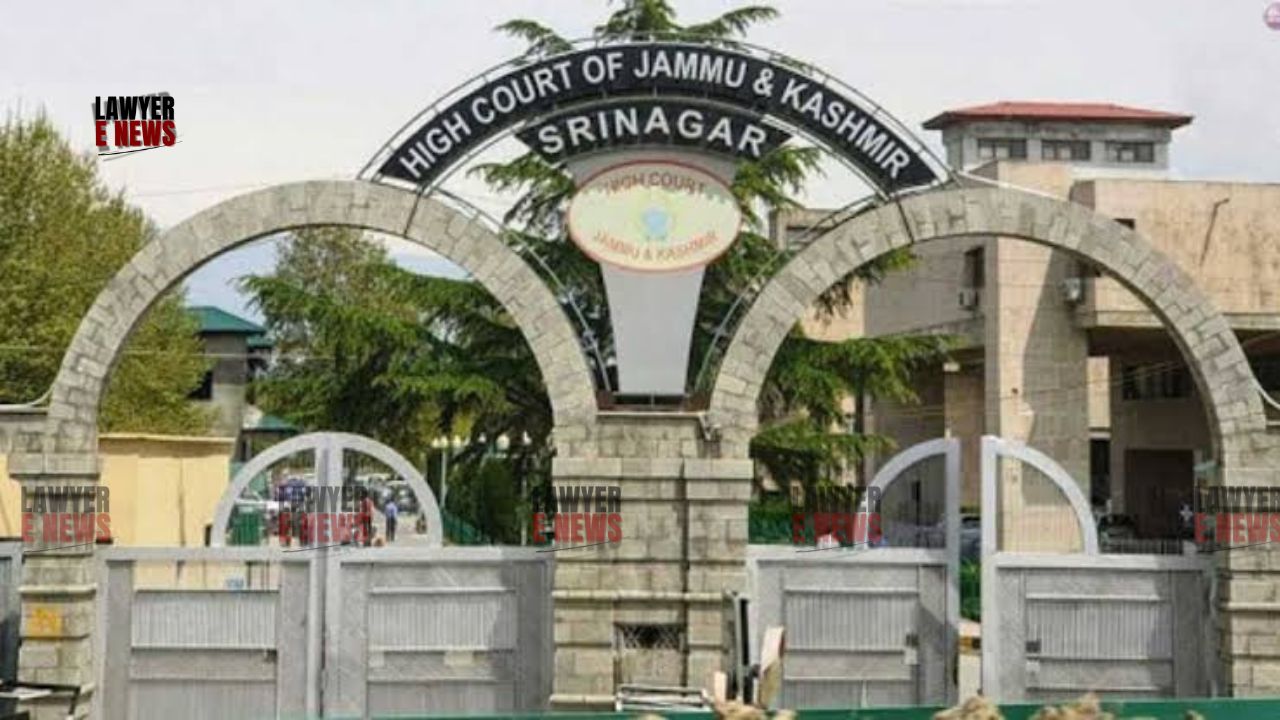
“A person undertaking an activity involving hazardous exposure to human life is liable under law of torts, irrespective of any negligence” – High Court of Jammu & Kashmir and Ladakh at Jammu, in a decisive reaffirmation of tort law principles, dismissed an appeal by the UT of J&K and upheld compensation awarded to a farmer whose wheat crop was destroyed by a fire caused by a short-circuit from an overhead electric line.
Justice Sindhu Sharma and Justice Shahzad Azeem found no error in the writ court’s direction for the State to pay ₹50,400 along with 6% interest to the petitioner-farmer, whose field had caught fire after a spark from a low-tension (LT) three-phase power line passing directly above it.
“The damage caused to the wheat crop by the short circuit in the Phase III LT Line is not denied,” noted the Court. “Only point for consideration is as to whether the appellants are liable to pay compensation for the loss suffered by the respondent.”
The Court held emphatically that the Electricity Department, being engaged in the inherently dangerous activity of transmitting high-voltage electricity, bears strict liability for any damage caused, regardless of negligence or fault.
“The very nature of electricity transmission creates a foreseeable risk — and risk brings liability”
The State had attempted to defend itself by claiming that a windstorm caused the short-circuit, suggesting the fire was the result of a natural calamity and not administrative lapse. However, the Court rejected this, observing:
“The respondents did not substantiate the assertion of the windstorm which resulted in the short circuit.”
Importantly, the Bench held that proof of negligence is not necessary in such cases, citing the long-standing doctrine of strict liability, under which entities engaged in hazardous activities are held liable solely based on the danger inherent in their operations.
“Any omission in preventing the discharge of high voltage electric energy by anyone engaged in the activity of supplying such energy is, under law of torts, liable to be compensated for the damage caused, because of the uncontrolled escape of such energy,” observed the Court. “The basis of such liability is a foreseeable risk inherent in the very nature of such activity.”
“Even if all precautions are taken, supplier remains liable under strict liability – negligence is not the threshold”
The High Court fortified its reasoning by citing the Supreme Court’s authoritative judgment in M.P. Electricity Board v. Shail Kumar, AIR 2002 SC 551, where it was held:
“Even assuming that all such measures have been adopted, a person undertaking an activity involving hazardous or risky exposure to human life, is liable under law of torts to compensate for the injury suffered... irrespective of any negligence or carelessness.”
The Court emphasized that strict liability operates independently of fault. While negligence-based liability arises only when precautions are not taken, strict liability holds the operator accountable even if all reasonable measures were in place.
“In cases of strict liability,” the Court wrote, “the defendant is held liable irrespective of whether he could have avoided the particular harm by taking precautions.”
This principle was earlier affirmed in Gittan Ram v. State, AIR 2013 J&K 83, which the Bench cited approvingly to highlight that the transmission of electricity inherently triggers a duty to ensure zero escape of energy, and failure to do so, regardless of external causes, renders the supplier liable.
“A live wire, a single spark, and a harvest lost – law imposes absolute accountability”
The facts of the case underscored the vulnerability of ordinary citizens to the risks created by public utilities. Ved Parkash, a small farmer, had harvested his wheat crop and stacked it in the field when, due to sparking from the overhead electric line, the crop caught fire and was completely destroyed.
The State did not deny the incident but argued that no fault could be attributed to the department. However, the revenue authorities themselves had assessed the crop loss at ₹50,400, which, coupled with the lack of evidence of any natural disaster, strengthened the petitioner’s claim.
The Court concluded that the Department’s duty was absolute, and failure to prevent such an incident, even if caused by a natural event, did not absolve it from liability.
“Liability to compensate for the damage caused because of such activity is known as ‘Strict Liability’,” declared the Court. “The operator of the activity is held liable irrespective of its having taken precaution to avoid harm.”
“No error, no exception – once the energy escapes, the supplier pays”
Upholding the writ court’s direction for compensation, the Division Bench stated:
“In view of the settled proposition of law, we do not find any error of law or fact has been committed by the Writ Court while passing the impugned order under challenge. Accordingly, the appeal is dismissed.”
With this judgment, the High Court strengthened the principle that entities handling dangerous materials or forces such as electricity are under a non-delegable duty to safeguard lives and property, and failure to do so results in strict and automatic liability.
A Reminder That Power Carries Responsibility – Especially When It Sparks Destruction
This ruling from the High Court of Jammu & Kashmir and Ladakh underscores a crucial legal tenet: where public utilities engage in inherently dangerous activities, the cost of damage is theirs to bear, not the victim’s. The law demands not just caution, but accountability — and where power lines cross farms, one spark is enough to trigger legal liability.
“Strict liability does not ask whether the State was careful. It only asks whether the activity was dangerous — and whether someone suffered because of it.”
Date of Decision: 12 November 2025