-
by sayum
19 August 2026 10:42 AM







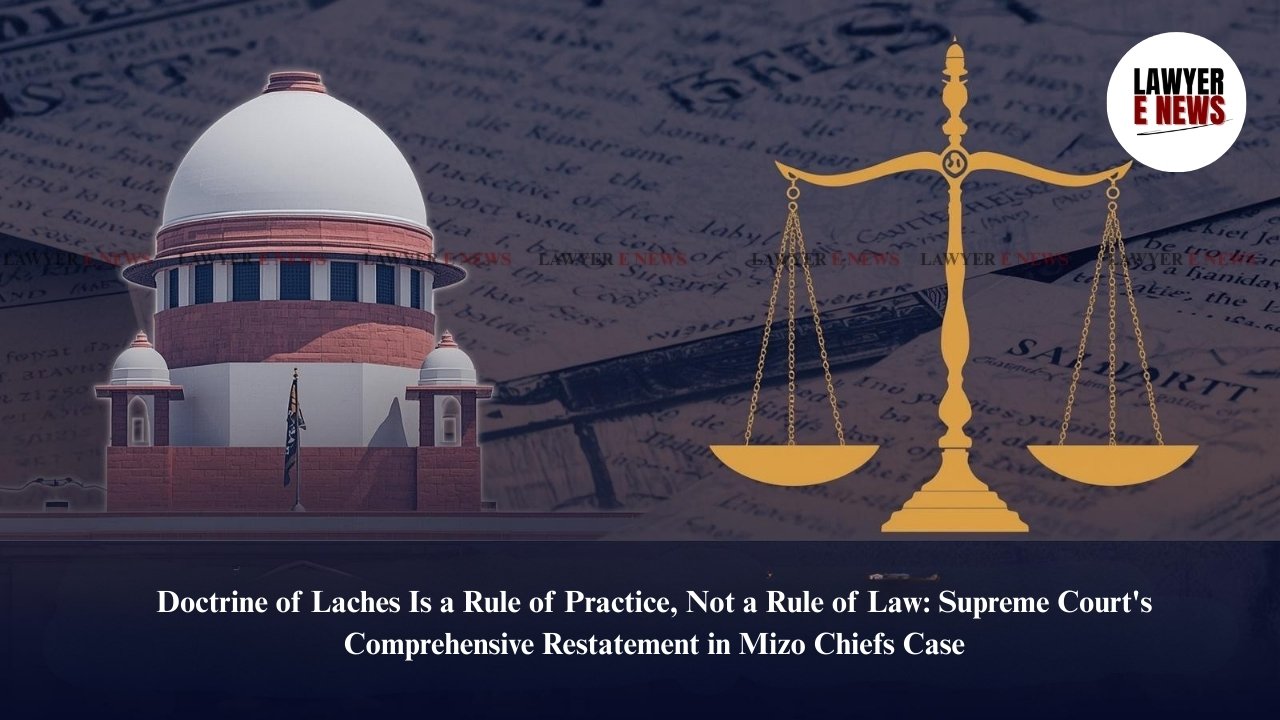
"It would be legally untenable for this Court to rest a decision of such magnitude on the fragile foundation of such flimsy submissions and woefully inadequate proof", In a significant ruling touching upon tribal land rights, constitutional history, and the doctrine of delay and laches under Article 32 of the Constitution, the Supreme Court of India on March 13, 2026, dismissed a writ petition filed by the Mizo Chief Council, Mizoram, on behalf of tribal chieftains of the erstwhile Lushai Hills district and their legal heirs. The petition, pending since 2014, sought compensation for vast tracts of land — effectively the entire territorial expanse of present-day Mizoram — claimed to have been acquired by the State without due compensation following the abolition of the chieftainship system in 1954.
Justices J.B. Pardiwala and R. Mahadevan found that while the petition was not barred at the threshold by delay and laches, the Mizo Chiefs had failed to establish the foundational requirement of any proceeding under Article 32 — proof of a fundamental right and its violation.
Background of the Case
The roots of this dispute lie buried deep in the administrative and cultural history of the Lushai Hills district, now the State of Mizoram. Historically, Mizo society was organised around the institution of chiefs, who administered their territorial domains known as "Ram." The petitioner asserted that these chiefs were the absolute, hereditary owners of their Rams and exercised executive and judicial authority over them, receiving customary tributes called "Fathang" from villagers in exchange for allotting farmland. The British annexed the Lushai Hills in the 1890s, retaining the chieftainship system for administrative convenience, though fettering it with supervisory powers vested in a Superintendent. The chiefs entered into boundary agreements called "Ramrilekha" demarcating their territorial authority.
Post-independence, the erstwhile State of Assam enacted the Assam Lushai Hills District (Acquisition of Chief's Rights) Act, 1954, under which a notification dated March 23, 1955 declared that the rights and interests of the chiefs in their Rams stood transferred to and vested in the State. A total compensation of Rs. 14,78,980 was paid to the chiefs. The petitioner contended this compensation was limited to Fathang and entirely excluded the value of the land itself. After decades of representations and two inconclusive rounds before the Gauhati High Court — on both occasions the State assured an amicable settlement that never materialised — the Mizo Chief Council approached the Supreme Court directly under Article 32 in 2014. The Lushai Chief Association also intervened, supporting the petitioner's cause.
Legal Issues
The Court framed two primary issues for determination: first, whether the writ petition was barred by the doctrine of delay and laches given the nearly six-decade gap between the 1955 notification and the 2014 petition; and second, whether any fundamental rights of the Mizo Chiefs — specifically the right to property guaranteed under Articles 19(1)(f) and 31 of the Constitution as they stood prior to their repeal — had been violated.
Observations and Judgment
On Delay and Laches Under Article 32: A Flexible, Not Mechanical Rule
The Court undertook an exhaustive survey of the jurisprudence on the doctrine of delay and laches as applicable to petitions under Article 32, beginning with the Privy Council's celebrated formulation in Lindsay Petroleum Co. v. Prosper Armstrong Hurd (1874) and traversing through a series of Constitution Bench decisions of the Supreme Court itself.
Commencing with the landmark Constitution Bench decision in Tilokchand and Motichand v. H.B. Munshi (1969), which first applied the doctrine of laches to Article 32 petitions by a 4:1 majority, the Court noted a clear judicial consensus that the remedy under Article 32, though a fundamental right itself, is not immune from principles of equity and reasonable procedure. The Court observed that four of the five judges in Tilokchand agreed that stale claims ought not to be entertained, anchoring this principle in three policy rationales: the law aids the vigilant, not those who slumber over their rights; actions of the Court cannot harm innocent third parties whose rights have crystallised by reason of delay; and finality and certainty in legal matters must be maintained.
The lone dissent in Tilokchand came from K.S. Hegde, J., who warned that treating the Article 32 remedy as discretionary would "pull down from the high pedestal now occupied by the fundamental rights to the level of other civil rights." The Court, however, noted that subsequent jurisprudence had largely allayed these concerns.
Surveying decisions from Rabindranath Bose (1970), R.S. Deodhar (1974), Joginder Nath (1975), and Aflatoon (1975), the Court identified three primary inquiries that consistently govern the doctrine's application: whether there has been an inordinate delay; whether the petitioner has offered a cogent and satisfactory explanation; and whether entertaining the belated claim would unsettle settled matters and prejudice third-party rights. Crucially, in G.P. Doval (1984), the Court recognised that extenuating circumstances arising from the petitioner's own status — such as economic vulnerability — could also validly explain delay, signalling that the doctrine cannot be mechanically applied to those facing genuine impediments in accessing justice.
The Court drew on the Constitution Bench decisions in Assam Sanmilita Mahasangha (2015) and the Section 6A of the Citizenship Act case (2024) to crystallise two important mitigating circumstances where laches would not be strictly applied: where the claim affects the public at large, and where the constitutionality of a statute is challenged. In the Section 6A case, Surya Kant, J. had articulated the principle that "oppressive laws should not persist solely because they have been tolerated by society for a certain period."
Synthesising this body of law, the bench laid down that the doctrine of laches in Article 32 proceedings operates as a flexible rule of practice anchored in judicial discretion, not a rigid rule of law. The Court held decisively that "the operative test is not one of 'unreasonable delay' but of 'unexplained delay'."
"The State Cannot Be Permitted to Benefit from Its Own Lethargy"
The Court added an important dimension on the question of the State's own conduct contributing to delay. It held that "situations frequently arise where the delay in invoking Article 32 is at least in part attributable to the State's own conduct, such as prolonged administrative indecision or inertia. In such scenarios, the State cannot be permitted to benefit from its own lethargy by weaponising the doctrine of laches against a petitioner."
Applying this principle to the facts, the Court found that on two occasions before the Gauhati High Court, the State of Mizoram had categorically assured that it was considering the chiefs' claims for compensation and would pass appropriate orders. The High Court had disposed of those matters on the basis of these assurances. The Chief Minister of Mizoram had also, on at least two occasions, written to the Prime Minister espousing the chiefs' cause. The Court held that this conduct could "reasonably have led the chiefs to hope that a resolution was forthcoming, thereby dissuading them from initiating litigation." The Court also took note of the unique historical circumstances — the region's transition from Assam to Union Territory to full statehood, and the two-decade long insurgency — which would have presented "formidable practical hurdles" to pursuing legal remedies.
"To Shut the Doors on Them at This Third Instance Would Be Highly Unjust"
Weighing the totality of circumstances, the Court declined to dismiss the petition at the threshold. It observed that though the delay was undeniably inordinate and the explanation not unequivocally convincing, "it is evident from the record that the State of Mizoram has held out hope for an amicable settlement and never outrightly rejected the grievances of the chiefs." The combination of continuous representations by the chiefs and the State's sympathetic stance had understandably pushed the chiefs toward administrative resolution rather than adversarial litigation. On two prior occasions the Gauhati High Court had left the avenue open for the chiefs to pursue legal remedies in the future.
"The Petitioner Has Woefully Failed to Discharge Their Burden of Proving Title"
Having concluded that the petition was maintainable, the Court turned to the merits. It reiterated the settled principle that to claim relief under Article 32, the petitioner must establish the existence of a fundamental right and its actual or threatened breach. Since the impugned actions occurred before the Constitution (Forty-Fourth Amendment) Act, 1978, which prospectively removed property from the list of fundamental rights, the right to property under Articles 19(1)(f) and 31 was firmly in existence at the relevant time.
However, the Court held that to establish a violation of the right to property, the petitioner had to succeed on two distinct fronts: first, prove clear title of the Mizo Chiefs over the subject lands; and second, upon establishing such title, prove deprivation without lawful authority or without adequate compensation.
On the question of title, the petitioner had primarily relied on accounts and writings of British officials and scholars to establish that the Mizo Chiefs were absolute owners of the Ram. The Court found this approach legally untenable. "Upon a meticulous perusal of the said material, it is, at the very outset, highly ambiguous whether these texts unequivocally recognise the Mizo Chiefs as the absolute owners of the land. Furthermore, even assuming that such an interpretation could be culled from these writings, the petitioners have advanced no compelling justification as to why such writings and accounts should be elevated to the status of conclusive evidentiary proof."
"Nothing in the Boundary Paper Even Remotely Suggests the Conferment of Absolute Ownership"
The Court examined the boundary papers or Ramrilekha that the Chiefs had entered into with British officials and found that nothing contained therein "even remotely suggests the conferment or recognition of absolute ownership of land." The respondents' material, on a prima facie examination, indicated that title to the land never vested in the Chiefs during the British administration. The Court noted that neither side had presented a "continuous, documented chain of events that would clearly map out the status of the land at different periods," but given the sheer magnitude of the petitioner's claim — effectively the entire territory of present-day Mizoram — a far deeper historical investigation was reasonably expected.
On the claim that the compensation paid was "illusory," the Court found the pleadings superficial. The petitioner had "entirely failed to traverse the plethora of legal precedents rendered by this Court that delineate the parameters for determining when compensation becomes legally illusory," and had not explained how this claim interacted with the broader constitutional framework of property rights or reconciled with other legislation in force in the then State of Assam.
The Court also rejected the argument that the Mizo Chiefs stood on a par with rulers of erstwhile Princely States and were discriminatorily denied privy purses. It held that privy purses were the product of "specific, pre-constitutional political and contractual arrangements negotiated between those rulers and the Government" and could not be elevated to the status of a constitutionally enforceable right applicable to all erstwhile rulers. Since the petitioner had failed to establish a violation of fundamental rights, the Court declined to adjudicate the vires of the Act, 1954 or the legality of the 1955 notification.
The Supreme Court's judgment in the Mizo Chief Council case is a significant contribution to Indian constitutional jurisprudence on two counts. First, it crystallises the doctrine of delay and laches in Article 32 proceedings — holding that the test is not of unreasonable delay but of unexplained delay, and that the State cannot weaponise delay it has itself contributed to through prolonged inaction and false assurances of settlement. Second, the judgment underscores that the width of Article 32's remedial scope does not dispense with the fundamental requirement of evidentiary rigour. Sweeping historical claims of proprietary title over vast territorial expanses cannot be sustained on ambiguous colonial accounts alone, especially when boundary documents on record directly contradict the claim of absolute ownership. The petition was dismissed.
Date of Decision: March 13, 2026