-
by sayum
09 August 2026 1:53 PM







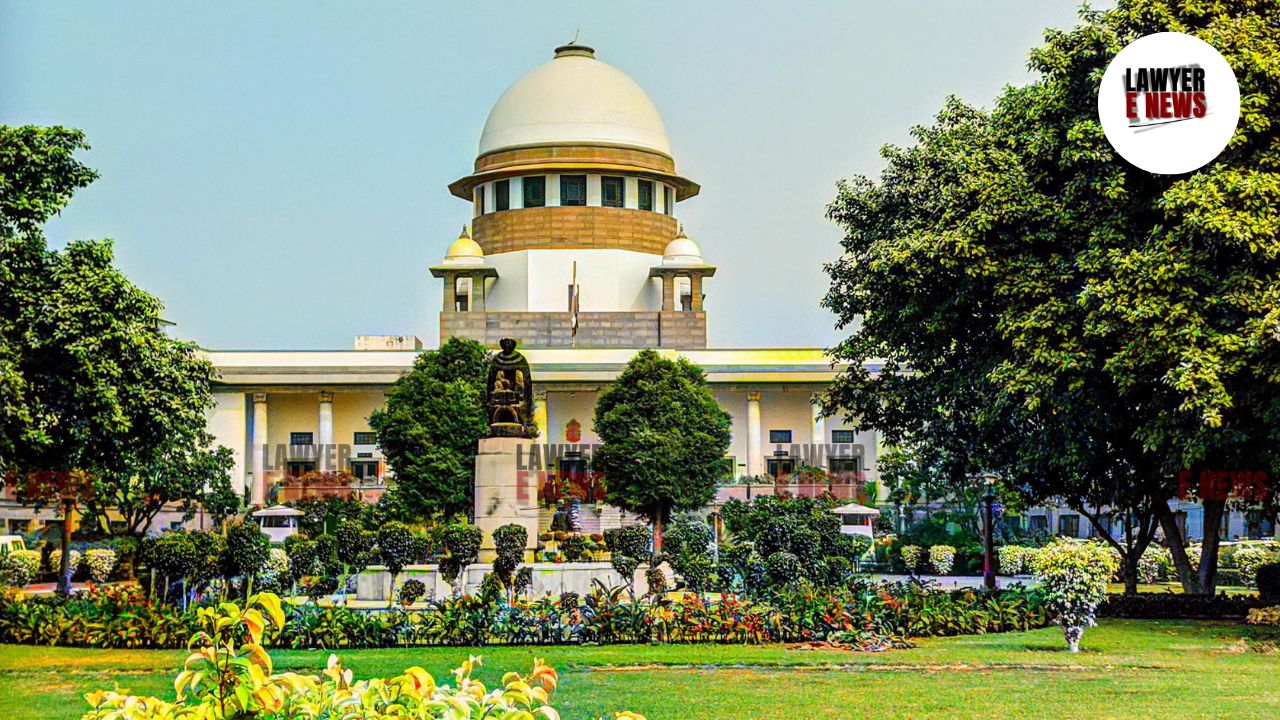
“High Court Ignored Settled Law On Deemed Notice; Reversal Of Ejectment Decree Is Legally Unsustainable”: On 16th July 2025, the Supreme Court of India emphatically reinstated a landlord’s right to evict a defaulting tenant, after reversing a High Court order that had quashed an ejectment decree based solely on a claim of non-service of notice.
The judgment authored by Justice Sanjay Karol, with Justice Joymalya Bagchi on the bench, underlined the importance of Section 27 of the General Clauses Act, 1897 in establishing “deemed service” of notices sent through Registered Post.
Highlighting the error committed by the High Court, the Court observed: “We are of the view that the High Court was plainly in error… The impugned order was passed without consideration of Section 27 of the General Clauses Act, which provides that if services are made through Registered Post, it is deemed to have been made in accordance with law.” [Para 15]
Supreme Court Condemns Judicial Interference When “Deemed Service” Was Established
The case stemmed from a long-pending landlord-tenant dispute in Hathras, where the landlord filed an ejectment suit due to persistent non-payment of rent from June 1999 to September 2000. Notices for termination of tenancy were sent via Registered Post. The postal returns bore the endorsement “ND” (Not Delivered), which became the sole ground for the High Court to set aside the decree.
Disapproving of this approach, the Supreme Court reiterated the principle of deemed service, quoting established precedent:
“In order to comply with the statutory requirement, all that is within the landlord's domain is to post a pre-paid registered letter containing the correct address and nothing further. It is then presumed to be delivered under Section 27 of the General Clauses Act.” [Para 14.1, quoting M/s. Madan & Co. v. Wazir Jaivir Chand, (1989) 1 SCC 264]
The Court added that the High Court’s presumption that “ND” invalidated service ran contrary to binding precedent.
High Court Misapplied Revisional Jurisdiction Under CPC, Supreme Court Notes
Beyond the deemed service doctrine, the Supreme Court criticized the High Court’s invocation of revisional powers without any valid legal basis. The Court stressed that the High Court's power under revision is limited to cases of jurisdictional error, procedural impropriety, or denial of opportunity—not to correct factual findings where proper process was followed.
Quoting from Ram Murti Devi v. Pushpa Devi (2017) 15 SCC 230 and Hari Shankar v. Rao Girdhari Lal Chowdhury, AIR 1963 SC 698, the Court observed:
“Wherever the court comes to the conclusion that the unsuccessful party has not had a proper trial according to law, then the Court can interfere. But, in our opinion, the Court ought not to interfere merely because it thinks that possibly the Judge who heard the case may have arrived at a conclusion which the High Court would not have arrived at.” [Para 16]
Noting that the tenant was given multiple opportunities before the Trial Court, the Court found no irregularity to justify High Court’s interference.
Tenant’s Multiple Defaults and Dilatory Tactics Noted by Supreme Court
The Court meticulously traced the factual chronology of the case, highlighting how the tenant had failed to deposit rent, evade written statement filing, invoked meritless interim applications, and continued in possession without payment for over two decades.
Reinstating the Trial Court’s decree, the Supreme Court recorded:
“The case continued with the tenant neither having deposited the rent nor handed over the possession of the suit property to the landlord.” [Para 7]
The Trial Court had decreed ejectment and awarded mesne profits along with 9% annual interest, which the Supreme Court restored in full.
Clarification On Deemed Service In Landlord-Tenant Cases
Importantly, the Court reiterated the law that actual delivery of notice is not mandatory once the landlord has dispatched notice via Registered Post to the correct address:
“It is then presumed to be delivered under Section 27 of the General Clauses Act. Irrespective of whether the addressee accepts or rejects… acceptance or refusal can be treated as service on, and receipt by the addressee.” [Para 14.1]
Referring to authoritative precedents like C.C. Alavi Haji v. Palapetty Mouhammed, (2007) 6 SCC 555 and Vishwabandhu v. Srikrishna, (2021) 19 SCC 549, the Court emphasized the settled jurisprudence across multiple enactments like the Negotiable Instruments Act, Rent Control statutes, and Civil Procedure Code.
Supreme Court Restores Ejectment Decree, Orders Compliance
Allowing the appeal, the Supreme Court restored the ejectment decree with explicit directions:
“The tenant is directed to hand over vacant and peaceful possession of the suit property to the landlord within three months… and also clear all arrears of rent/occupational charges, mesne profit as also arrears of tax (water, house or otherwise).” [Para 17]
The Court also directed the Allahabad High Court to ensure compliance via its Registrar General.
This judgment reaffirms landlords’ rights against defaulting tenants and upholds the validity of deemed service through Registered Post, removing any ambiguity created by High Court’s contrary view.
Date of Decision: 16 July 2025