-
by sayum
04 August 2026 11:10 AM







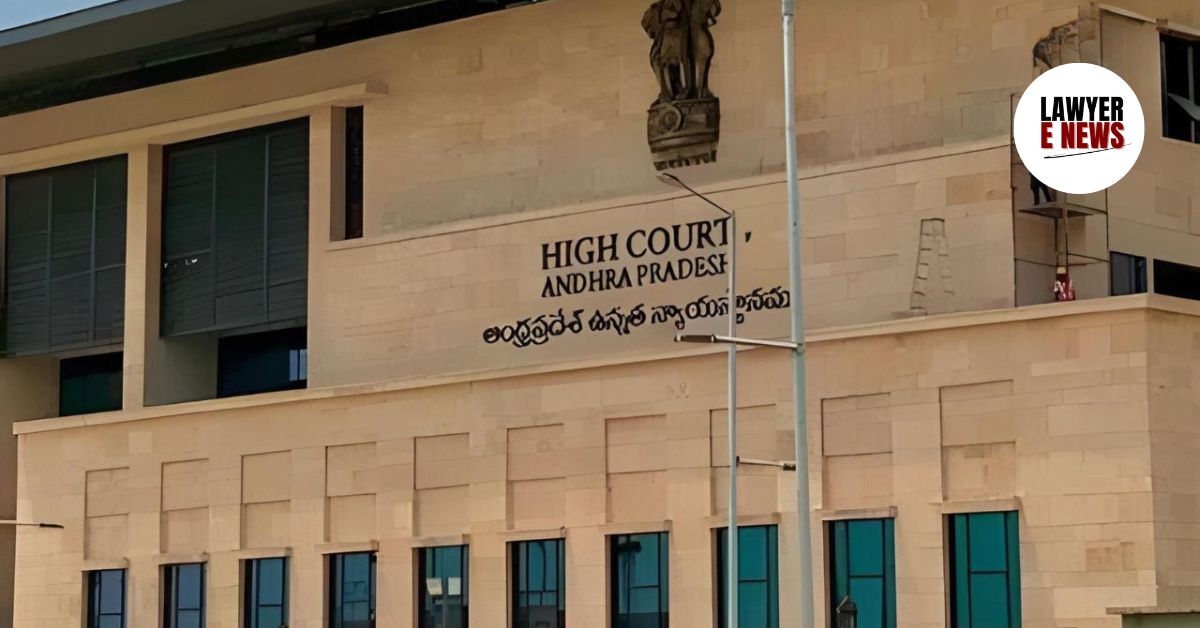
"Even After This Much of Legal Battle, the Individual Cannot Get Anything Relating to the Death of His Own Sister" – Andhra Pradesh High Court passed a compelling judgment concerning the rights of a declared legal heir to receive death benefits of a deceased government-aided school teacher. Justice Dr. Venkata Jyothirmai Pratapa ruled in favor of the petitioner, directing the authorities to release the long-pending dues of the deceased, whose legal heir status had already attained judicial finality. The Court categorically rejected the administration’s justification that no benefits were due based on recollections and unsupported claims, stating that such a stand was “not tenable.”
Legal Heir Recognition Ignored for Decades
The case revolved around the death of Smt. D. Teresamma, who died in harness while serving as a Secondary Grade Teacher at St. Anthony Elementary School, Visakhapatnam, on August 30, 1988. The petitioner, her brother Darana Harry, produced a legal heir certificate granted by the II Additional District Judge, Visakhapatnam, in SOP No. 583 of 1993, recognizing him as the rightful legal heir.
Despite this, the petitioner received none of her death benefits, which included gratuity, provident fund, pay arrears, and group insurance. Notably, her husband and mother-in-law had unsuccessfully challenged the heirship in A.S. No. 869 of 1998, an appeal that was dismissed with the following conclusion:
“In view of the report received from the Lower Court to the effect that the petitioner failed to establish the will set up by him… the appeal does not survive and it is accordingly dismissed as having abated.”
Further litigation ensued when the petitioner filed O.S. No. 327 of 2003 seeking reconstruction of his sister’s service register. That suit was decreed in his favor in 2010, followed by execution proceedings in E.P. No. 123 of 2011, which too were allowed. Yet, the authorities continued to delay action.
At the heart of the matter were two legal points: entitlement of a declared legal heir to receive service-related death benefits and the state’s reliance on unverified recollections to deny the same.
Rejecting the counterarguments raised by the respondents, the Court observed:
“Despite this much of legal battle, the individual cannot get anything relating to the death of his own sister.”
The respondents had argued that most payments were made and that the service register had been lost. The Court, however, took serious note of the casual manner in which the claims were brushed aside, quoting from a letter dated 14.05.2018 issued by the school authorities:
“This information is gathered from our memory and some information given by other teachers... the Service Register was submitted to the DEO’s Office which was misplaced…”
Justice Pratapa was unimpressed:
“The information… is not supported by any scrap of paper… and is not tenable.”
While the Court accepted that the petitioner was not eligible for family pension under Rule 50(5) of the Andhra Pradesh Revised Pension Rules, 1980—which restricts eligibility to spouse, children, and parents—it held firmly that all other service-related death benefits were payable.
Legal Heir’s Rights Must Prevail Over Bureaucratic Excuses
Directing the authorities to act decisively, the Court ordered:
“The respondent Nos. 1, 3, 4 shall ensure that respondent No.2 reconstructs the service register within one month… If not, in the absence of any proof of payments, the respondents are directed to treat the petitioner’s claim as correct and pay the death benefits… within a period of two months.”
The Court reiterated that a legal heir recognized by a competent court could not be denied rights on administrative presumptions or lost records.
“Admittedly, the petitioner was declared as legal heir… Hence, he is entitled on all scores to receive such amounts which are due to his sister.”
The Andhra Pradesh High Court’s decision sends a strong message: rights declared by a court cannot be overridden by official inertia or unverified recollections. While denying the family pension on statutory grounds, the Court upheld the petitioner’s entitlement to all other service-related death benefits and condemned the prolonged failure to act.
Date of Decision: 09.05.2025