-
by sayum
29 August 2026 3:15 PM







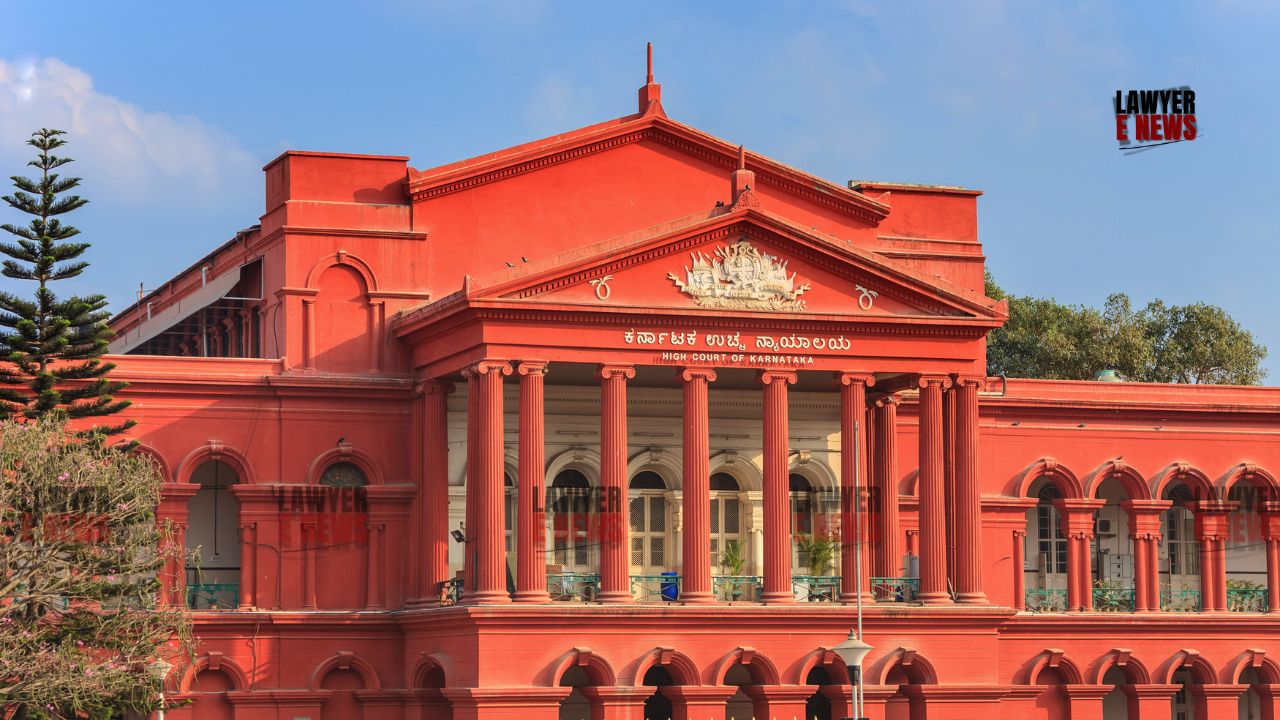
The High Court of Karnataka, in a significant ruling dated March 27, 2026, held that a police officer accused of illegal confinement is entitled to anticipatory bail when no overt act of fatal physical assault is attributed to him and the charge sheet has already been filed. A single-judge bench of Justice M.G.S. Kamal observed that "at this juncture there appears to be no requirement of any custodial interrogation," while granting relief to a Police Inspector whose alleged illegal detention of a man preceded the victim's subsequent murder at a private rehabilitation centre.
Background of the Case
The appellant, the Station House Officer of Vivekanagara Police Station, was arraigned as an accused in a case involving the death of a man named Darshan. The deceased was allegedly kept in illegal police confinement for over two days without being produced before a Magistrate, before being transferred to a rehabilitation centre at the behest of his mother. At the rehabilitation centre, the owner and staff allegedly tortured the deceased to death, prompting an investigation by the Criminal Investigation Department (CID) under the Bharatiya Nyaya Sanhita, 2023, and the Scheduled Castes and Scheduled Tribes (Prevention of Atrocities) Act, 1989. The appellant approached the High Court under Section 14A(2) of the SC/ST (POA) Act after a Special Court rejected his anticipatory bail plea.
Legal Issues
The primary question before the court was whether a police officer accused of illegal confinement under the BNS and the SC/ST (Prevention of Atrocities) Act is entitled to anticipatory bail when the fatal assault occurred subsequently at a separate location. The court was also called upon to determine if custodial interrogation of the officer was necessary to prevent evidence tampering after the filing of a detailed charge sheet by the CID.
Court's Observations
The court perused the CID investigation report and noted that the allegations against the appellant were strictly limited to the unauthorized detention of the deceased from November 13 to November 15, 2025. The bench emphasised that the severe physical torture leading to the victim's death on November 26, 2025, was independently perpetrated by the owner, manager, and inmates of the rehabilitation centre, who were arraigned as accused numbers one through nine. "Except the illegal confinement of deceased Darshan between 01.30 a.m. of 13.11.2025 and 08.30 p.m. of 15.11.2025, allegations primarily have been attributed to the owner, Manager and inmates of the said Rehabilitation Center."
Addressing the prosecution's apprehension that the appellant, being a police officer, could tamper with evidence or influence witnesses, the court highlighted that the investigation was already complete. The bench observed that the crucial documentary evidence, specifically the CCTV footage from the Vivekanagara Police Station where the illegal confinement allegedly occurred, had already been recovered and forwarded to the Forensic Science Laboratory. "Investigation has been conducted by CID headed by Deputy Superintendent of Police and a detailed charge sheet has already been filed."
Assessing the statutory framework under Section 482 of the Bharatiya Nyaya Sanhita, 2023, and the provisions of the Scheduled Castes and Scheduled Tribes (Prevention of Atrocities) Act, 1989, the court concluded that the facts did not warrant the appellant's arrest for further questioning. The bench recognized the appellant's legitimate apprehension of imminent arrest given the severe charges, which included Sections 118(2), 127(2), 258, and 120(1) read with Section 3(5) of the BNS, but ruled that his cooperation could be secured without keeping him in custody. "At this juncture there appears to be no requirement of any custodial interrogation of the accused No.10-appellant."
Consequently, the High Court set aside the trial court's order and allowed the criminal appeal. The bench directed that the appellant be enlarged on bail in the event of his arrest, subject to executing a personal bond of rupees one lakh with two sureties. The court further mandated the appellant to obtain regular bail within ten days, report daily to the Deputy Superintendent of Police (CID) for fifteen days, and strictly refrain from tampering with prosecution witnesses or leaving the trial court's jurisdiction without prior permission. "Considering his background and the nature of allegations made against him, this Court is of the considered view that the accused No.10-appellant herein is entitled to be enlarged on bail."
The High Court allowed the criminal appeal, setting aside the Special Court's order that had previously denied pre-arrest bail to the police officer. The ruling underscores that even in serious cases invoking the SC/ST Act and the BNS, anticipatory bail may be granted to a public servant if the investigation is complete, digital evidence is secured, and no direct act of fatal violence is attributed to the applicant.
Date of Decision: 27 March 2026