-
by sayum
09 August 2026 1:53 PM







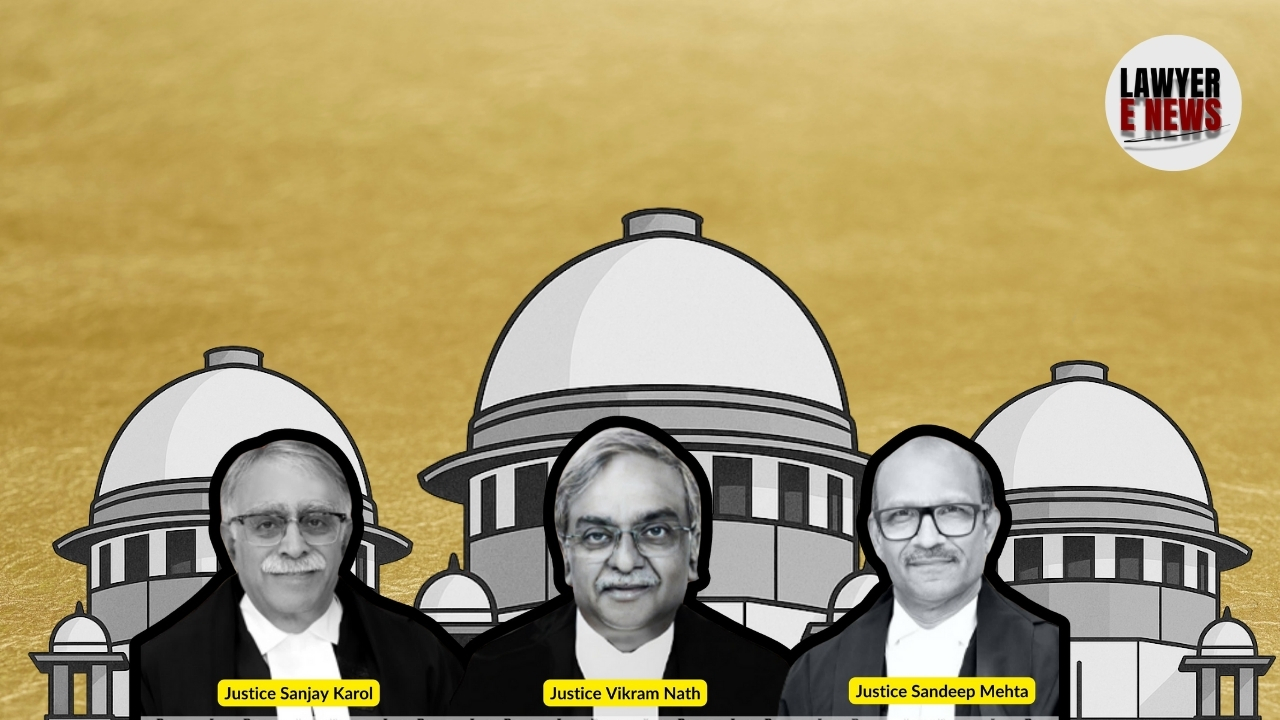
“No Judicial Officer Shall Be Condemned Unheard”, On 18th July 2025, the Supreme Court of India delivered a significant verdict, setting aside adverse strictures passed by the Rajasthan High Court against a subordinate judicial officer. A Bench comprising Justices Vikram Nath, Sanjay Karol, and Sandeep Mehta unequivocally declared that judicial officers cannot be personally criticised in judicial orders without being granted an opportunity to explain themselves. “Such condemnation in absentia,” the Court stated, “is contrary to the foundational principles of natural justice and judicial discipline.” Allowing the appeal filed by the Judicial Officer, the Supreme Court expunged the adverse observations and issued far-reaching directives concerning the procedural conduct in bail matters.
High Court’s Remarks Without Hearing Judicial Officer Violates Natural Justice
The Supreme Court began its analysis by emphasising the well-established constitutional principle that “no one should be condemned unheard.” The High Court had, in a bail cancellation proceeding, passed strong remarks against the appellant-Judicial Officer, alleging negligence, indiscipline, and disobedience of judicial precedents. The apex court categorically found this approach impermissible, observing:
“Such remarks were passed without even putting the Judicial Officer on notice, depriving him of an opportunity to clarify his conduct. This is a direct affront to the natural justice principle audi alteram partem.”
In unequivocal terms, the Court said, “The very architecture of judicial accountability requires that before forming opinions regarding misconduct or dereliction, a judicial officer must be heard in their defence.”
Established Judicial Discipline: Critique Orders, Not Individuals
Reiterating established norms on judicial restraint, the Supreme Court observed:
“Criticism must always target the reasoning and outcome of orders, not the personal conduct or integrity of judicial officers, especially in the absence of an inquiry or opportunity of hearing.”
Relying extensively on the seminal judgment In Re: ‘K’, A Judicial Officer, (2001) 3 SCC 54, the Court reminded all High Courts of the caution required while commenting on subordinate judiciary. The Court quoted with approval the principle laid down:
“A member of subordinate judiciary, himself dispensing justice, should not be denied the minimal natural justice of being heard before facing personal criticism.”
The Supreme Court further cited Sonu Agnihotri v. Chandra Shekhar (2024), reinforcing that appellate courts can criticise erroneous orders but must refrain from making personal accusations or casting aspersions on a judge’s conduct without due process.
“Judicial Missteps Must Be Corrected, Not Publicly Vilified”
The apex court pointed out that the appellant, while granting bail, had seemingly misapplied the principle of parity, relying on a High Court order which itself was based on an incomplete record. However, the Court clarified:
“To err is human. Errors in judicial orders are subject to appellate correction, not public vilification. Personal condemnation is corrosive to the morale of judicial officers and undermines the dignity of the institution.”
The Court added, “An inadvertent error by a judge working under the pressures of a heavy docket cannot be equated to misconduct warranting strictures without hearing.”
Reliance on Reversed Precedent Invalidates High Court’s Criticism
A pivotal factor in the Supreme Court’s decision was that the High Court based its condemnation on the decision in Jugal v. State of Rajasthan (2020), which had been subsequently reversed by the Supreme Court in Ayub Khan v. State of Rajasthan (2024).
The Bench noted, “The entire premise of the High Court’s strictures was rendered invalid by the reversal of the Jugal judgment. Judicial observations resting on overruled precedents lack validity and must necessarily be set aside.”
This observation underscored the need for caution while relying on precedents, particularly in cases where judicial officers’ reputations are at stake.
Systemic Reforms: Supreme Court Urges Rule Mandating Disclosure of Criminal Antecedents in Bail Pleas
In a proactive step towards systemic reform, the Supreme Court directed all High Courts to consider adopting procedural rules mandating disclosure of criminal antecedents in bail applications. The Court cited Rule 5 of Chapter 1-A(b), Volume-V of Punjab and Haryana High Court Rules, which requires applicants to disclose any past criminal cases.
The Court advised:
“Every High Court should examine the feasibility of incorporating similar provisions in their Criminal Side Rules to promote transparency in bail proceedings and prevent concealment of vital information.”
It further directed, “A copy of this judgment shall be circulated to all High Court Registrar Generals for necessary consideration.”
Reaffirming Judicial Independence and Protection of Institutional Integrity
Allowing the appeal, the Supreme Court unequivocally set aside the strictures, observing:
“Criticism of judicial orders, if warranted, must be couched in measured language. Personal criticisms against judicial officers in judgments not only violate natural justice but also erode judicial independence.”
The Court clarified that any genuine concerns about a judicial officer’s conduct must be addressed on the administrative side through appropriate channels, ensuring fairness, transparency, and institutional respect.
The concluding lines of the judgment summed up the philosophy guiding the judiciary:
“Judicial accountability must coexist with judicial dignity. Criticism must be corrective, not condemnatory; orders can be reversed, but dignity once eroded is hard to reclaim.”
The appeal was allowed, strictures expunged, and the judgment directed to be circulated for broader judicial introspection and reform.
Date of Decision: 18th July 2025