-
by sayum
19 August 2026 12:01 PM







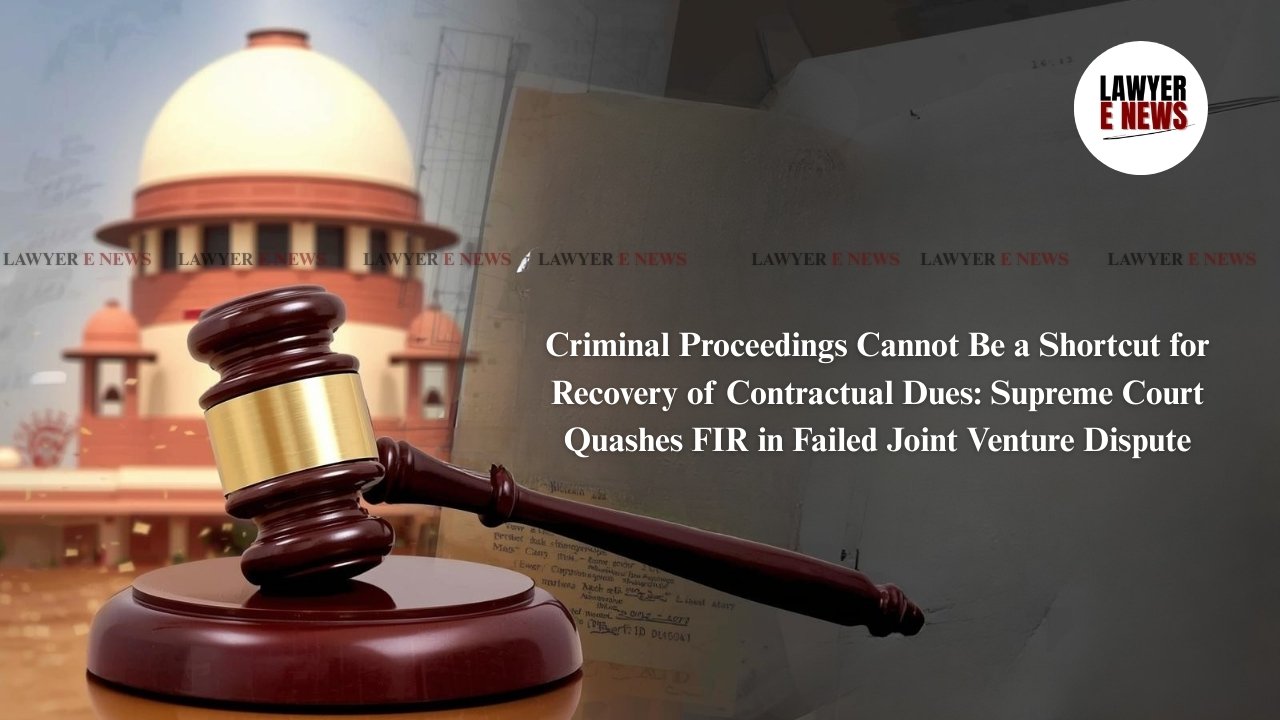
“Where Dispute Is Essentially Civil, Giving It a Cloak of Criminal Offence Is Abuse of Process of Law”, In a decisive reaffirmation of the boundary between civil liability and criminal culpability, the Supreme Court of India quashed an FIR arising out of a failed Joint Venture Agreement for property development, holding that the allegations disclosed “only a civil cause of action.”
The Bench of Justice Pamidighantam Sri Narasimha and Justice Manoj Misra set aside the Allahabad High Court’s order dated 30.07.2021 and quashed FIR No. 0112 of 2021 registered under Sections 406, 420, 467, 468 and 471 IPC. The Court held that permitting criminal proceedings to continue in such circumstances would amount to “abuse of the process of law.”
The ruling is a sharp reminder that criminal law cannot be invoked as a pressure tactic in contractual disputes lacking dishonest intention at inception.
The appellants, Vandana Jain and others, entered into a Joint Venture Agreement dated 16 August 2010 with Motor General Sales Ltd. for development of land situated at Plot No. 61 (Old No. 276A), Azad Nagar, Kanpur. Under the agreement, the land was to be contributed by the appellants as the first party, while the second party undertook to construct residential units at its own cost. Both parties were to have a 50% share in the developed project.
Clause 5 of the JVA provided for payment of Rs. 1 crore as “security for due compliance of agreement,” which was to be adjusted from the first party’s share of sale proceeds. The agreement also contained an arbitration clause mandating resolution of disputes through arbitration.
The project did not materialize. Nearly eleven years later, on 14 March 2021, the second party lodged an FIR alleging false representation regarding title, suppression of litigation, non-refund of security deposit, and forgery of documents including a Tehsildar’s letter.
The Allahabad High Court dismissed the writ petition seeking quashing of the FIR in limine. The matter reached the Supreme Court under Article 136.
“No Specific Statement That No Litigation Was Pending”: Court Rejects Cheating Allegation
The primary allegation under Section 420 IPC was that the appellants falsely represented that the property was free from litigation.
The Supreme Court carefully examined the Joint Venture Agreement and observed:
“It is clear from the afore-extracted clauses that there is no specific statement by the first party as regards no litigation pending.”
The assurances in the agreement were limited to absence of attachment and absence of any restraint order from court or government authority. The Court categorically held:
“The allegation that the accused had falsely represented about there being no litigation qua the land/property is unfounded.”
Crucially, the Court reiterated the settled principle that cheating requires dishonest intention at inception. On the facts, it held:
“This is not a case where something emerged quickly after the agreement to indicate that dishonest intention existed from the beginning.”
With the FIR lodged after eleven years, the Court found no material suggesting fraudulent intent from the inception of the contract.
“No offence of cheating is made out.”
“Security Deposit Was Not Refundable”: No Criminal Breach of Trust
On the allegation of criminal breach of trust under Section 406 IPC, the Court examined Clause 5 of the JVA.
It found that the security amount was not refundable but adjustable against the first party’s share of sale proceeds.
“Clause 5 does not envisage refund of the security money. Rather, it speaks of adjustment of the security deposit from the share of the first party derived from sale proceeds.”
The Court held that non-refund, in such circumstances, could at best give rise to civil consequences:
“The allegation about security money being not refunded would not make out a criminal offence though it may give rise to a civil cause of action.”
There was no entrustment coupled with dishonest misappropriation, and therefore:
“There is no criminal breach of trust.”
“Mere Non-Traceability Does Not Make a Document Forged”: Section 464 IPC Explained
The allegation of forgery under Sections 467, 468 and 471 IPC was based on a letter allegedly issued by the Tehsildar certifying that there was no dispute regarding the property. The complainant contended that the letter was forged because it was not traceable in official records.
Rejecting this contention, the Court observed:
“Merely because a document is not traceable in the records after several years of its issuance, it cannot be said that the document is forged.”
The Court emphasized that forgery requires making of a “false document” within the meaning of Section 464 IPC, involving dishonest or fraudulent intent.
“There appears no allegations that title documents submitted by the accused were forged.”
Thus, the essential ingredients of forgery were not disclosed.
“Recourse to Civil Remedies Was Required”: Criminal Process Held Abusive
On the overall nature of the dispute, the Court held that it was purely contractual. The JVA contained detailed provisions governing rights, obligations, indemnities and even arbitration.
“Insofar as the allegation regarding non-fulfillment of contractual obligations is concerned, recourse to appropriate civil remedy was required.”
The Court was categorical:
“On facts, recourse to criminal proceedings, in our view, is nothing but abuse of the process of law/ court.”
The existence of an arbitration clause, though not by itself decisive, reinforced the contractual character of the dispute.
High Court’s Failure to Examine FIR and Admitted Documents
The Supreme Court expressed disapproval of the High Court’s summary dismissal of the writ petition.
“The High Court, unfortunately, did not take pains to carefully read the FIR and consider the admitted documents including the JVA to find out whether, prima facie, cognizable offence was made out or not.”
Reiterating the law on quashing, the Court clarified that while allegations in the FIR are ordinarily taken at face value, the Court may examine admitted documents referred to therein to determine whether the criminal law has been improperly invoked.
“Impugned FIR Only Discloses a Civil Cause of Action”
Summing up, the Bench concluded:
“We are of the considered view that dispute between the parties is essentially of a civil nature arising from the JVA.”
“The impugned first information report only discloses a civil cause of action.”
The appeal was allowed, the High Court’s order dated 30.07.2021 was set aside, and FIR No. 0112 of 2021 along with all proceedings emanating therefrom were quashed.
The ruling stands as a strong judicial warning against the growing tendency to convert contractual disputes into criminal prosecutions, particularly where no dishonest intention at inception is demonstrated.
Date of Decision: 25 February 2026