-
by sayum
26 August 2026 1:49 PM







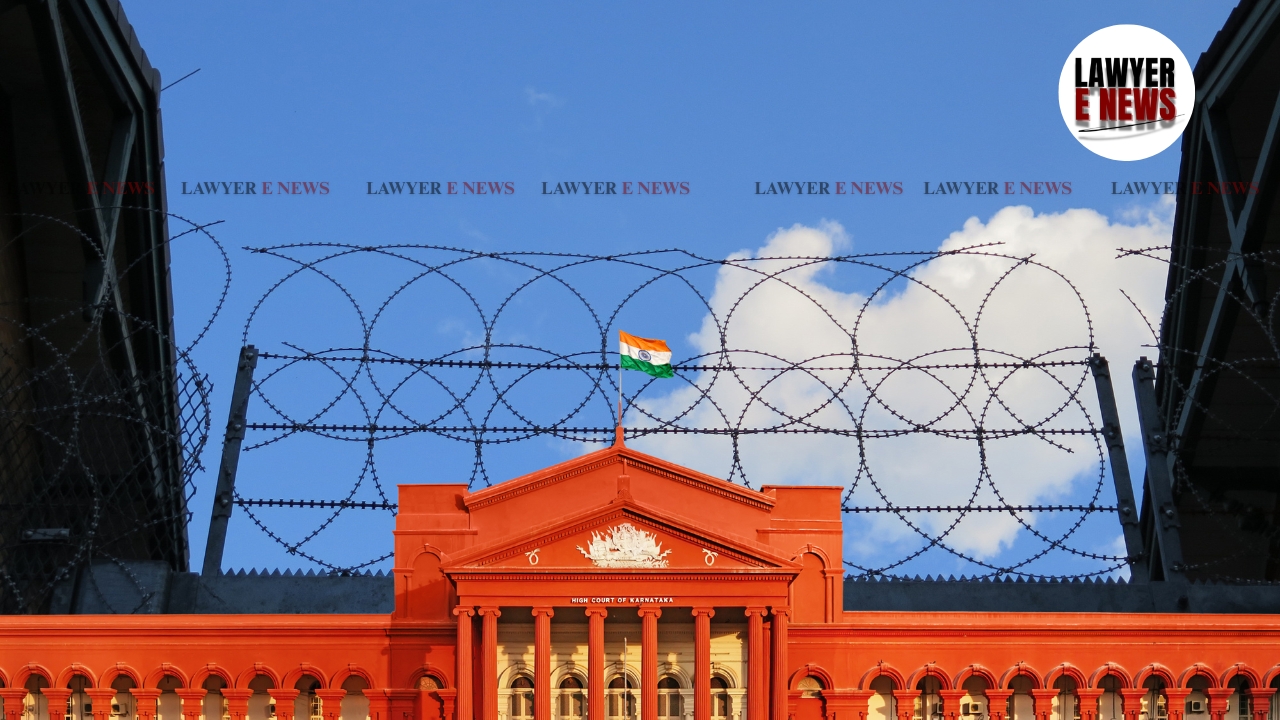
“The Government’s duty to consider the detenue’s representation is not a formality—it is a constitutional mandate that must be honoured independently and substantively,” declared the Karnataka High Court in a powerful ruling, quashing a preventive detention order passed under the Prevention of Illicit Traffic in Narcotic Drugs and Psychotropic Substances Act, 1988 (PIT NDPS Act).
In Amreen v. Commissioner of Police, Bengaluru & Others [WPHC No. 87/2025], the Division Bench comprising Justice K.S. Mudagal and Justice M.G.S. Kamal held that failure to consider the detenue’s representation independently of the Advisory Board’s opinion and failure to inform her of her right to approach the Central Government for relief were fatal constitutional violations under Article 22(5) of the Constitution.
The Court concluded that such procedural lapses rendered the entire preventive detention unlawful, notwithstanding the gravity of allegations or the number of NDPS cases pending against the petitioner.
“Mechanistic Reproduction of Advisory Board Opinion Is Not Independent Satisfaction”: Confirmation of Detention Quashed for Copy-Paste Approval
The petitioner, Amreen, was detained under Section 3(1) of the PIT NDPS Act by the Commissioner of Police, Bengaluru, through an order dated 27 December 2024, citing her repeated involvement in 12 NDPS Act cases across multiple police stations since 2015, allegedly forming part of an organised drug trafficking network operating across Tamil Nadu and Andhra Pradesh.
However, the High Court, while acknowledging the seriousness of the charges, held that the rule of law mandates strict compliance with constitutional and statutory procedures in matters of personal liberty, stating:
“The power of the Government to confirm the detention order under Section 9(f) of the Act is independent of the Advisory Board’s opinion. The use of the word ‘may’ shows discretion must be exercised with application of mind.”
The confirmation order dated 20 March 2025 (Annexure-B) was found to be a verbatim reproduction of a draft based on the Advisory Board’s opinion, with no trace of the petitioner’s representation dated 08.02.2025 being examined.
“There is not even a whisper at least in the proceeding sheet that Respondent No.2 perused or examined the representation,” the Court noted, citing the landmark Supreme Court decision in Gracy v. State of Kerala, (1991) 2 SCC 1.
“A Detenue’s Right to Make Representation Includes the Right to Know Where to Make It”: Failure to Inform of Central Government Remedy Vitiates Detention
Apart from the non-consideration of the representation, the Court found a second constitutional defect in the detention process. The detaining authority failed to apprise the detenue of her right to make a representation to the Central Government under Section 12(1)(b) of the PIT NDPS Act.
The High Court, relying on the Supreme Court’s judgment in Kamleshkumar Ishwardas Patel v. Union of India, (1995) 4 SCC 51, reaffirmed:
“The right to make a representation carries with it a corresponding obligation on the detaining authority to inform the person detained of his right to make a representation… not only to the detaining authority but also to any other authority which is competent under law to revoke the order.”
The Court clarified that Article 22(5) must be read purposively, and any failure to communicate such essential rights undermines the detenue’s ability to seek timely relief, thereby vitiating the preventive detention.
“Even 12 NDPS Cases Can’t Justify Detention if Procedural Safeguards Are Ignored”: Court Reminds State of Rule of Law
Though the State cited twelve NDPS cases—with charges ranging from Section 20(b) to Section 27A of the NDPS Act, several pending trial and some resulting in acquittals—the High Court held that seriousness of allegations does not override procedural protections guaranteed under the Constitution.
The Court cautioned that preventive detention is an extraordinary measure and must be subject to strict judicial scrutiny, particularly when it curtails the fundamental right to personal liberty under Article 21.
“Preventive detention, though preventive, not punitive, cannot be sustained unless there is strict adherence to statutory and constitutional safeguards,” the Court observed.
The Court emphasized that Section 9(f) of the PIT NDPS Act requires the appropriate government to apply independent judgment on whether detention must continue—even if the Advisory Board finds sufficient cause.
“When Representation Is Ignored, Detention Ceases to Be Legal”: Detention and Confirmation Orders Quashed
In its final analysis, the Court held that both the detention order (dated 27.12.2024) and confirmation order (dated 20.03.2025) stood vitiated due to dual violations:
The Bench ruled:
“The order Annexure-B stands vitiated on both grounds. On its quashing, the detention order dated 27.12.2024 loses its existence. Hence, Annexure-A becomes inconsequential.”
Accordingly, the Court ordered:
The Karnataka High Court’s decision in Amreen v. Commissioner of Police, Bengaluru & Others serves as a powerful reminder that the Constitution’s procedural guarantees cannot be bypassed, even in cases involving alleged habitual drug offenders.
The judgment reiterates that preventive detention must not become a backdoor punitive mechanism and reinforces the principle that Article 22(5) is not a paper protection but a substantive right, meant to ensure that the voice of the individual is not silenced without reasoned review.
Date of Decision: 23 October 2025