-
by sayum
27 August 2026 6:51 AM







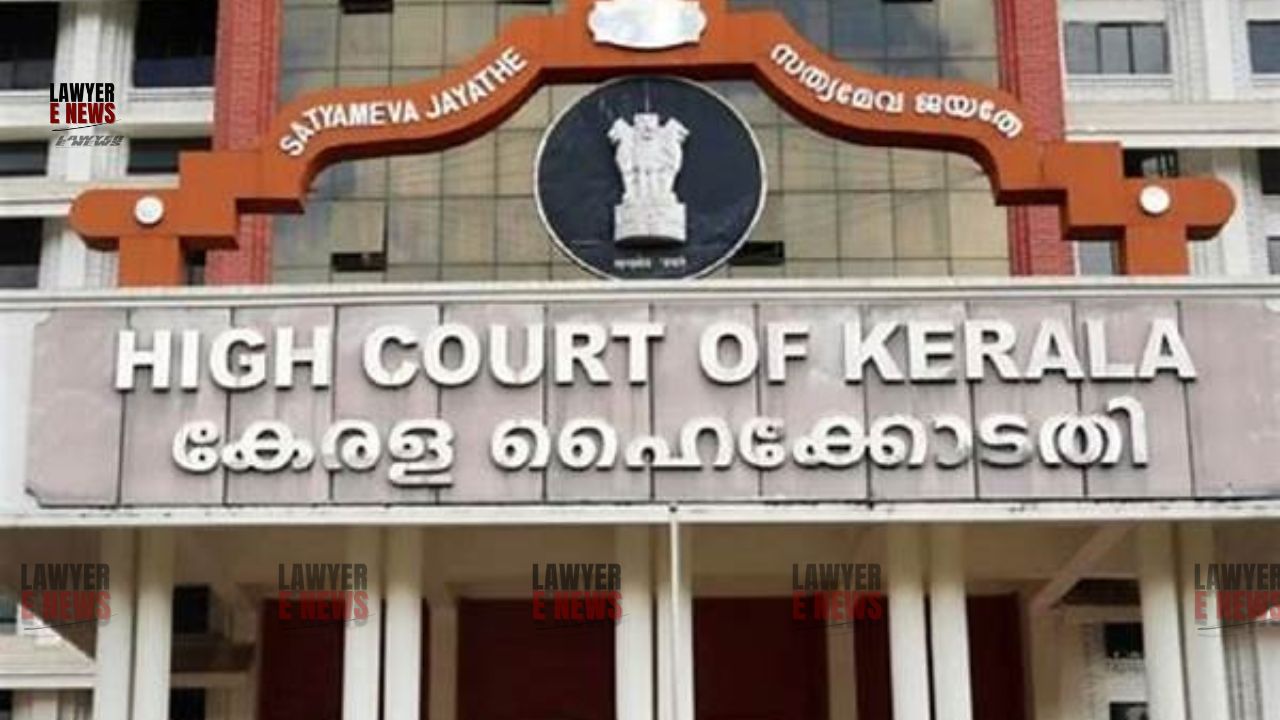
"Public dissent has its rightful place in a constitutional democracy, but without a lawful basis, a venture that satisfies every statutory command cannot be shut down on the basis of public protest." Kerala High Court, in a significant ruling dated April 1, 2026, held that a local Panchayat cannot deny permission to establish an industrial unit merely on the ground of public protests that lack scientific or environmental backing.
A single-judge bench of Justice P.V. Kunhikrishnan observed that once an entrepreneur complies with all statutory prescriptions and secures clearances from authorities like the Pollution Control Board and District Medical Officer, the local body has no power to stifle the venture. The Court noted that allowing unscientific protests to thwart lawful enterprises teaches law-abiding investors the wrong lesson that statutory compliance guarantees no protection.
The petitioners, two entrepreneurs who invested crores of rupees to establish an ultra-modern hot mix plant, approached the High Court challenging the Nellanad Grama Panchayat's refusal to grant them operational permission. Despite obtaining explicit consent from the Kerala State Pollution Control Board and a No-Objection Certificate from the District Medical Officer, the Panchayat repeatedly rejected their application and issued stop memos solely citing objections from a handful of local residents. The matter reached the High Court after the Panchayat, flagrantly disregarding a prior judicial directive to reconsider the application under amended laws, once again rejected the plea on erroneous factual grounds regarding the date of machinery installation.
The primary question before the court was whether a Grama Panchayat retains the statutory power to completely reject an application for establishing an industrial unit under Section 233 of the Kerala Panchayat Raj Act, 1994, following its legislative amendment in 2018. The court was also called upon to determine whether public protest, devoid of scientific or environmental evidence, can serve as a valid legal ground to deny an entrepreneur's constitutional right to conduct lawful business.
On the statutory dilution of the Panchayat's power to refuse permission
Delving into the statutory framework, the High Court extensively analyzed the impact of Act 14 of 2018 on Section 233 of the Kerala Panchayat Raj Act, 1994. The Court observed that the legislature deliberately removed the words "or refusing" from sub-section (4), fundamentally altering the powers of the local self-government body. Consequently, a Panchayat no longer possesses the absolute authority to reject an application for establishing a factory or installing machinery if all statutory clearances are met by the applicant. The Court ruled that the local authority is statutorily bound to grant the permission, though it retains the legal discretion to impose necessary regulatory conditions. "Thus, it is to be inferred and understood that an application filed under Section 233 has to be absolutely or conditionally allowed and cannot be rejected."
On the concept of deemed permission due to administrative delay
Addressing the Panchayat's delayed responses to the petitioners' initial applications, the Court highlighted the strict mandate of Section 236(3) of the Act. Relying on binding precedents like Sudhakaran V. v. Pallichal Grama Panchayat and Abdul Shafeek v. Asamannoor Grama Panchayath, the bench emphasized that a local body must communicate its decision within the prescribed thirty-day statutory window. The Court noted that the Panchayat's failure to issue an order within this timeframe resulted in a deemed permission in favour of the entrepreneur. The subsequent belated issuance of a stop memo by the Panchayat, especially in defiance of a prior stay order by the Tribunal for Local Self Government Institutions, was deemed wholly unsustainable and arbitrary in law.
"The consideration of an application for permission or licence or renewal thereof is available only during the period prescribed for the same and unless the order is communicated within the specified time... the Panchayat cannot exercise jurisdiction to reject the same at a later occasion."
"What was conceived as an economic activity has been reduced to a vast, voiceless structure of concrete and steel due to public protest, which lacks scientific or environmental backing."
On the legal irrelevance of unscientific public protests
The Court expressed deep anguish over the recurring narrative of lawful industrial growth being derailed by baseless local agitation in the state. It observed that while public dissent is an acknowledged and protected facet of a democratic society, extra-legal pressures cannot be allowed to render statutory approvals meaningless. The bench highlighted that the District Medical Officer had explicitly certified the absence of health hazards, and the Pollution Control Board had issued a valid consent to operate after due physical inspection of the premises. In such a scenario, the local representatives' fear of losing their vote bank cannot justify the denial of a citizen's fundamental right to run a legitimate enterprise.
"When permissions granted by competent authorities in strict conformity with the legal framework are rendered meaningless by extra-legal resistance, the credibility of that framework itself comes under strain."
On the invocation of writ jurisdiction despite alternative remedies
Dealing with the respondents' preliminary objection regarding the availability of an alternative statutory remedy, the Court firmly rejected the argument. The bench observed that the entrepreneur had been unfairly made to run pillar to post before local authorities for years, facing repeated administrative rejections despite securing every requisite clearance and a prior High Court directive in their favour. Reaffirming its broad discretionary powers under Article 226 of the Constitution of India, the Court stated that relegating the petitioners to an alternative forum would result in a grave miscarriage of justice. Judicial intervention was deemed absolutely imperative to protect the massive financial investments made, preserve employment generation, and restore faith in the rule of law.
"If this Court does not interfere in this case, invoking the powers under Article 226 of the Constitution of India, it will be an injustice to a genuine entrepreneur who has invested crores of rupees."
Allowing the writ petition, the High Court comprehensively set aside the impugned rejection order passed by the Nellanad Grama Panchayat. The Court issued a categorical direction to the Panchayat and its Secretary to allow the petitioners' application and grant the necessary permission within two weeks, granting them the liberty to impose appropriate and lawful conditions strictly in tune with the amended Section 233 of the Kerala Panchayat Raj Act, 1994.
Date of Decision: 01 April 2026