-
by sayum
29 August 2026 3:15 PM







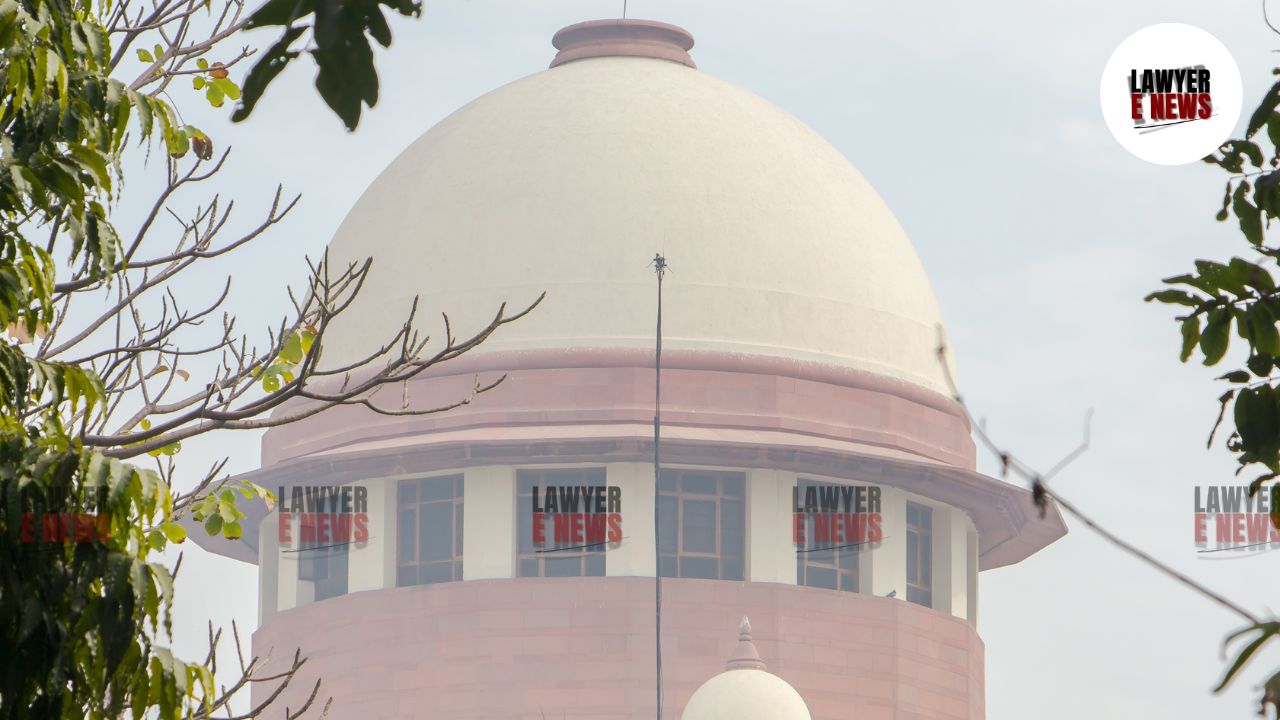
Supreme Court of India has upheld the conviction of Muthupandi under Sections 279 and 304(A) of the Indian Penal Code (IPC) for rash and negligent driving that caused the death of one person and six cattle. However, the Court modified the sentence in light of special circumstances, reducing the three-month simple imprisonment to no imprisonment, and directed that compensation of ₹1,00,000/- with interest be paid to the mother of the deceased under Section 357(3) of the Code of Criminal Procedure (Cr.P.C.).
This judgment brings a measured conclusion to a case stemming from a tragic accident in 2013, where Muthupandi, while driving a lorry, fatally struck the victim Karthik and several cattle. The ruling also reinforces the role of compensation in criminal justice to redress the loss suffered by victims' families.
The case arose from an accident on January 9, 2013, where the appellant, driving a lorry allegedly carrying river sand illegally, hit Karthik and six cows on the Nilakottai-Madurai road near Karigalan Petrol Pump. Karthik died on the spot, and the prosecution charged Muthupandi under Sections 279 and 304(A) of IPC for rash and negligent driving. Additionally, charges under the Mines and Minerals (Development and Regulation) Act, 1957 were included, though the appellant was acquitted of the latter charges.
The trial court convicted Muthupandi, sentencing him to one year of simple imprisonment under Section 304(A) IPC and a fine of ₹5,000/-, along with a ₹1,000/- fine under Section 279 IPC. The Additional Sessions Judge confirmed the conviction, while the Madurai Bench of the Madras High Court reduced the sentence to three months of simple imprisonment.
The Court affirmed Muthupandi’s conviction under Sections 279 and 304(A) IPC. After reviewing the testimony of witnesses (PW-1 to PW-3) and other evidence, the Bench observed that the prosecution had successfully established that the appellant drove in a rash and negligent manner, leading to the death of the deceased and the cattle.
The appellant's claim that the incident occurred due to cattle trampling after being frightened by vehicle lights was rejected based on consistent eyewitness testimonies. The Court held,
"We see no reason to interfere with the conviction under Sections 279 and 304(A) IPC imposed by the courts below."
While upholding the conviction, the Supreme Court modified the sentence. The Bench highlighted several mitigating factors:
Passage of Time: Eleven years had passed since the incident.
Bail Status: The appellant had been on bail throughout the proceedings.
Compensation Deposited: The appellant had voluntarily deposited ₹1,00,000/- as compensation for the deceased’s family.
Shared Negligence: The Court noted that the deceased and witnesses were herding approximately 70 cattle on the road at the time of the incident, which contributed to the dangerous circumstances.
In its judgment, the Court remarked,
"While we do not absolve the appellant from the act of rash and negligent driving, the special facts of this case warrant a lenient view on the sentence."
The sentence of three months simple imprisonment was set aside, and the fines imposed under Sections 279 and 304(A) IPC were also waived. Instead, the Court emphasized compensation as a form of justice.
The Supreme Court directed that the ₹1,00,000/- deposited by the appellant, along with accrued interest, be disbursed to the mother of the deceased, Mrs. Ponnalaghu, as compensation for the loss suffered due to the appellant’s negligence. The Court invoked Section 357(3) Cr.P.C., which empowers courts to award compensation in criminal cases, stating,
"This is on account of the loss suffered by her on account of the act of the appellant, and we pass this order in exercise of powers under Section 357(3) of the Cr.P.C."
The Court directed the Principal District and Sessions Judge, Dindigul, to oversee the disbursement of compensation. Specific instructions included:
Verification of Identity: The Principal District and Sessions Judge must ensure the proper identification of the deceased’s mother, Mrs. Ponnalaghu, before releasing the compensation.
Liaison with Police: The Inspector of Police, Nilakottai Station, was tasked with assisting in locating and verifying the legal heir.
Compliance Report: The Principal District and Sessions Judge must submit a compliance report to the Supreme Court by February 2025.
The Supreme Court partly allowed the appeal with the following orders:
Conviction under Sections 279 and 304(A) IPC was upheld.
The sentence of three months simple imprisonment was set aside.
Fines imposed by the lower courts were waived.
Compensation of ₹1,00,000/- (with interest) was ordered to be paid to the mother of the deceased.
The Court also scheduled a hearing in February 2025 to review compliance with its directions.
This decision highlights the judiciary's nuanced approach in balancing accountability with compassion, especially in cases involving long delays and mitigating circumstances. By prioritizing compensation for the victim’s family, the Court underscored the importance of restorative justice in criminal proceedings.
Date of Decision: December 10, 2024