-
by sayum
29 August 2026 8:36 AM







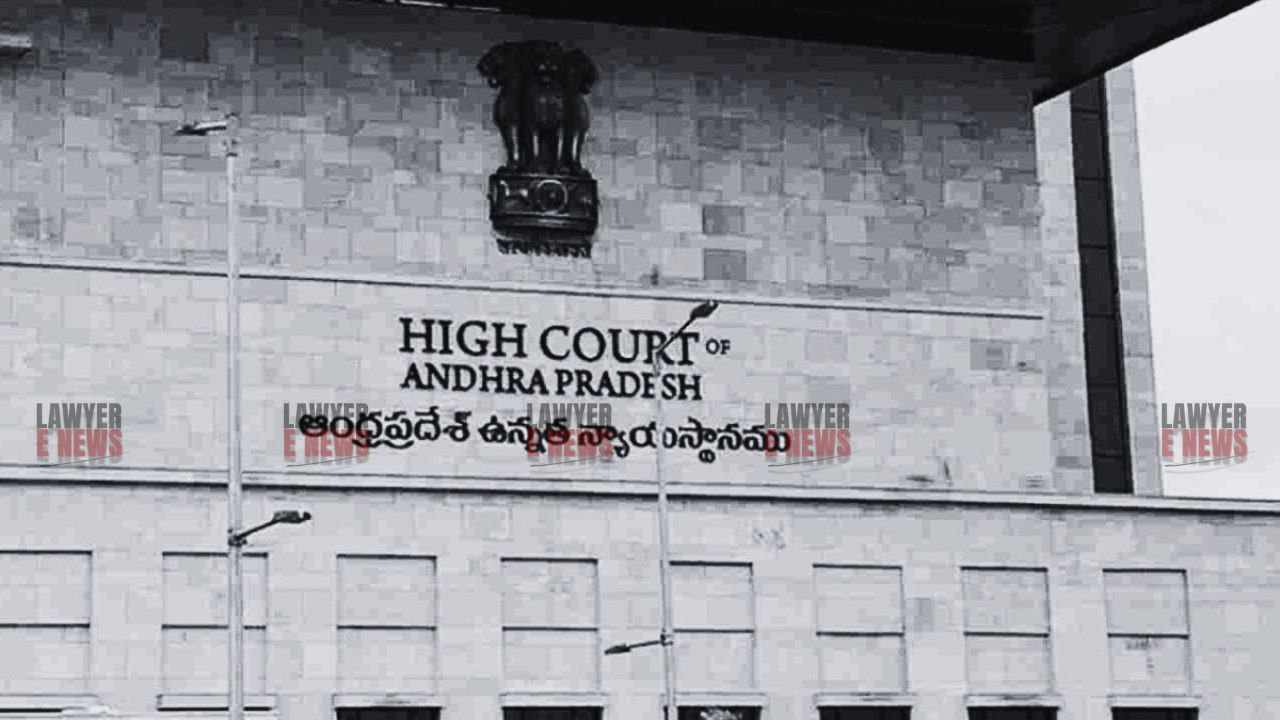
“Criminal and Civil Remedies Can Coexist; Civil Court Must Not Deny Compensation on Ground of Pending or Decided Criminal Case”, In a powerful affirmation of tort remedies coexisting with criminal liability, the Andhra Pradesh High Court at Amaravati in a Common Judgment upheld the maintainability of a civil suit seeking damages for grievous injuries sustained in a physical assault, despite a prior criminal conviction. The Court held that:
“There is no legal embargo for filing of civil suit to claim compensation under the tortious liability relating to the very same incident.”
The bench of Justice Ravi Nath Tilhari and Justice Maheswara Rao Kuncheam ruled in favour of Bhavanam China Venkata Reddy, who was brutally assaulted by the defendant Dantla Subba Reddy on 01.04.2006, and awarded enhanced compensation of ₹8,55,000/-, overturning the Trial Court’s modest award of ₹4,04,000/-.
"Assault Leading to 70% Disability is Not Just a Crime—It is a Civil Wrong That Demands Adequate Reparation"
The Court noted that the plaintiff had suffered subarachnoid and intraventricular hemorrhage, and was rendered 85% disabled, with right-side hemiplegia, loss of vision, and inability to perform manual labour. Despite this, the Trial Court reduced the disability assessment to 40% based on photographs showing the plaintiff walking.
Rejecting this, the Division Bench observed: “The reasoning of the Trial Court in scaling down the percentage of the disability, mainly on the basis of photographs, is not sound as it is not supported by any scientific yardstick.”
Instead, the Court upheld the medical evidence, particularly the Disability Certificate (Ex.A-22) issued by the District Medical Board, and enhanced the functional disability to 50%, stating that:
“The plaintiff is suffering from right hemiplegia and visual impairment, which has severely affected his ability to earn and marry.”
"Existence of Criminal Conviction Does Not Bar Civil Claim for Tortious Act"
Rejecting the contention that the civil suit was barred due to the criminal conviction already being recorded, the Court reaffirmed the duality of remedies:
“Both criminal and civil proceedings arising out of same matter are aptly maintainable. Section 357 CrPC itself contemplates such a parallel remedy.”
Citing the landmark Supreme Court ruling in D. Purushothama Reddy v. K. Sateesh, the High Court elaborated that the civil court must merely take into account any compensation awarded in the criminal case to avoid double recovery, which was not the case here, as:
“The Criminal Court had not awarded any compensation in favour of the plaintiff. Hence, the Trial Court rightly entertained the civil claim.”
"Trial Court Erred in Ignoring Key Heads of Compensation Like Marital Prospects and Attendant Charges"
The High Court identified grave errors in the Trial Court's assessment. Despite 22 days of hospitalization, prolonged post-discharge therapy, and long-term disability, the Trial Court awarded only ₹10,000 towards pain and suffering, and nothing for attendant charges or marital prospects.
The Court rectified this with a detailed recalibration:
₹4,80,000 – Loss of income (₹60,000 x 16 multiplier x 50% disability)
₹1,00,000 – Medical expenses (including bills, travel, hospitalization)
₹50,000 – Pain and suffering
₹75,000 – Attendant charges
₹1,50,000 – Loss of marital prospects
The Court stated: “Marriage or companionship is an integral part of natural human life. The plaintiff, being unmarried and suffering from hemiplegia, deserves to be compensated for loss of marital prospects.”
"Conviction Under Section 326 IPC Strengthens Tort Liability in Civil Court"
The case was rooted in a violent episode between relatives over a property dispute, where the plaintiff was stabbed in the left temporal region by the 1st defendant with a knife. This led to serious neurological damage and lifelong disabilities.
The criminal case—Sessions Case No. 125/2007—resulted in the conviction of the 1st defendant under Section 326 IPC for causing grievous hurt. The conviction was affirmed in Criminal Appeal No. 377/2010, and formed part of the evidentiary basis in the civil suit.
The Court emphasized: “A serious injury not only imposes permanent physical limitations and disabilities but also causes physical and mental stigma to the injured.”
“Assessment of Disability Must Consider Occupation, Age, and Functional Impact, Not Just Medical Percentage”
Applying the ratio of Raj Kumar v. Ajay Kumar and Sidram v. United India Insurance, the Court reiterated that:
“The percentage of permanent disability is not equivalent to the percentage of loss of earning capacity. Courts must assess functional disability in light of age, occupation, and the nature of injuries.”
Despite the medical board certifying 70% permanent disability, the Court balanced photographic evidence with expert opinion to reasonably fix functional disability at 50%.
“Scientific Compensation Assessment Requires Multiplier Method; Courts Should Avoid Arbitrary Awards”
Referring to Sarla Verma, Pranay Sethi, and Atul Tiwari, the Court strongly endorsed the multiplier method for computing future loss of income. It rejected arbitrary lump-sum awards, calling them speculative and inequitable.
“A departure from the multiplier method can be justified only in exceptional cases. None was shown here.”
Trial Court’s Compensation Enhanced by More Than Double
The High Court enhanced the compensation from ₹4,04,000/- to ₹8,55,000/-, with 9% interest per annum from the date of suit (31.03.2009) till realization, and future interest at 6%.
It allowed the plaintiff’s appeal partly, and dismissed the defendants’ appeal in totality.
“Compensation in tort is not bounty. It is the law’s attempt to restore dignity and mitigate harm inflicted due to unlawful actions. The enhanced award does just that.”
Date of Decision: 11th September 2025