-
by sayum
05 August 2026 5:12 AM







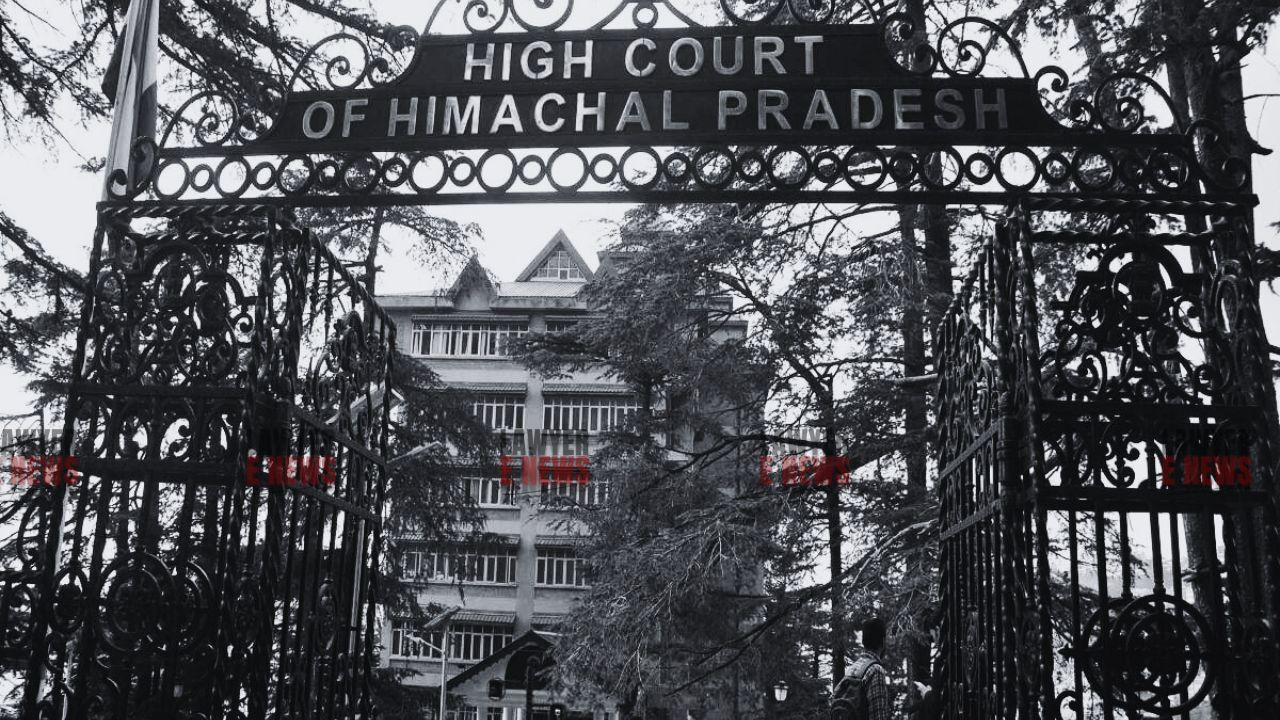
“No Vested Right to Promotion Exists – Only a Right to Be Considered”: Himachal Pradesh High Court, comprising Justice Tarlok Singh Chauhan and Justice Sushil Kukreja, dismissing a constitutional challenge to a state notification that restructured clerical posts in the Revenue Department from district/division cadre to state cadre.
Rejecting the petitioners’ claims that the notification dated 03.10.2023 was unconstitutional and violated Articles 14, 16, and 21 of the Constitution, the Court held that, “Chances of promotion are not conditions of service,” and emphasized that unless mala fides or arbitrariness are shown, administrative decisions such as cadre restructuring fall well within the executive’s policy domain under Article 309 of the Constitution.
The petitioners—clerical employees including Senior Assistants, Steno-Typists, and Junior Office Assistants (IT)—were working in various offices under the Revenue Department across districts and revenue divisions of Himachal Pradesh. Their appointments and promotional avenues were governed by district or division-level cadre rules.
They challenged Notification No. Rev-A(B)1-13/2023 issued by the State Government on October 3, 2023, which converted the aforementioned posts into State cadre positions under the control of the Director of Land Records, alleging that:
Their seniority and promotional avenues would be adversely impacted.
The notification lacked retrospective clarity and had not yet been operationalized with proper modalities.
Their legitimate expectation of promotions under the pre-existing rules had been violated.
They prayed that the notification be quashed or made inoperative vis-à-vis already serving employees, or that their promotions be governed by the earlier district/division level cadre rules.
The petition raised two primary legal contentions:
The impugned notification adversely impacted the petitioners' promotional prospects and seniority.
The State Government lacked competence to issue such a restructuring notification.
The Court, however, systematically dismantled both arguments relying on constitutional principles and a long line of Supreme Court precedents.
On Promotional Chances Not Being a Condition of Service
Reiterating well-established jurisprudence, the Court emphasized: “It is now well settled… that though a right to be considered for promotion is a condition of service, mere chances of promotion are not.” — State of Mysore v. G.B. Purohit, (1967) SLR 753 (SC), quoted in para 7.
“A rule which merely affects chances of promotion cannot be regarded as varying a condition of service.” — Ramchandra Shankar Deodhar v. State of Maharashtra, (1974) 1 SCC 317.
In light of this principle, the Court observed: “There is nothing on record, which may even remotely indicate that chances of promotion in the instant case have been altered arbitrarily, or to prove that the basis of consideration for bringing about the impugned notification has foundation on malafides.” (Para 9)
On Legislative Competence and Executive Authority under Article 309
The Court dismissed the claim that the notification lacked legal authority, observing: “It is always open and within the competency of the State to change the rules relating to a service and alter or amend… the qualifications, eligibility criteria and other conditions of service including avenues of promotion, from time to time, as the administrative exigencies may need or necessitate.” (Para 11)
The Court relied heavily on P.U. Joshi v. Accountant General, (2003) 2 SCC 632, quoting: “Questions relating to… cadres, their creation/abolition, prescription of qualifications and other conditions of service… pertain to the field of policy and within the exclusive discretion and jurisdiction of the State…” (Para 12)
Further citing Union of India v. Pushpa Rani, (2008) 9 SCC 242, the Court reiterated: “Matters relating to creation and abolition of posts, formation and restructuring of cadres… fall within the exclusive domain of the employer.”
The notification, the Court held, was issued for administrative efficiency, integration of ministerial staff, and enhancing transparency in promotions and transfers.
On the Issue of Retrospective Effect
The petitioners also argued that the notification should not be applied retrospectively, fearing loss of seniority. The Court rejected this fear as unfounded, noting:
“The tentative combined seniority list… has been prepared and issued… without disturbing inter-se-seniority.” (Para 3, as referenced in the judgment)
Thus, no accrued right or vested interest of the petitioners had been violated.
On Judicial Review and Executive Policy
Quoting the Supreme Court, the High Court reaffirmed the limited scope of judicial review in service policy matters:
“The Court cannot sit in appeal over the judgment of the employer… The Court has no role in determining the methodology of recruitment or laying down the criteria of selection.” — Pushpa Rani (Para 13)
It concluded: “The Court must, therefore, exercise judicial restraint and should not encroach upon the Executive or Legislative domain…” (Para 14)
Summing up, the Court decisively held that: “Chances of promotion do not constitute conditions of service, and as such, mere alteration of chances of promotion would not per se call for judicial interference.” (Para 9)
The petitioners, it held, failed to prove any infringement of constitutional or vested rights, and the administrative decision of cadre restructuring stood valid both constitutionally and legally.
Accordingly, the writ petition was dismissed, along with all pending applications.
Date of Decision: May 26, 2025