-
by kapil
03 November 2026 9:17 AM







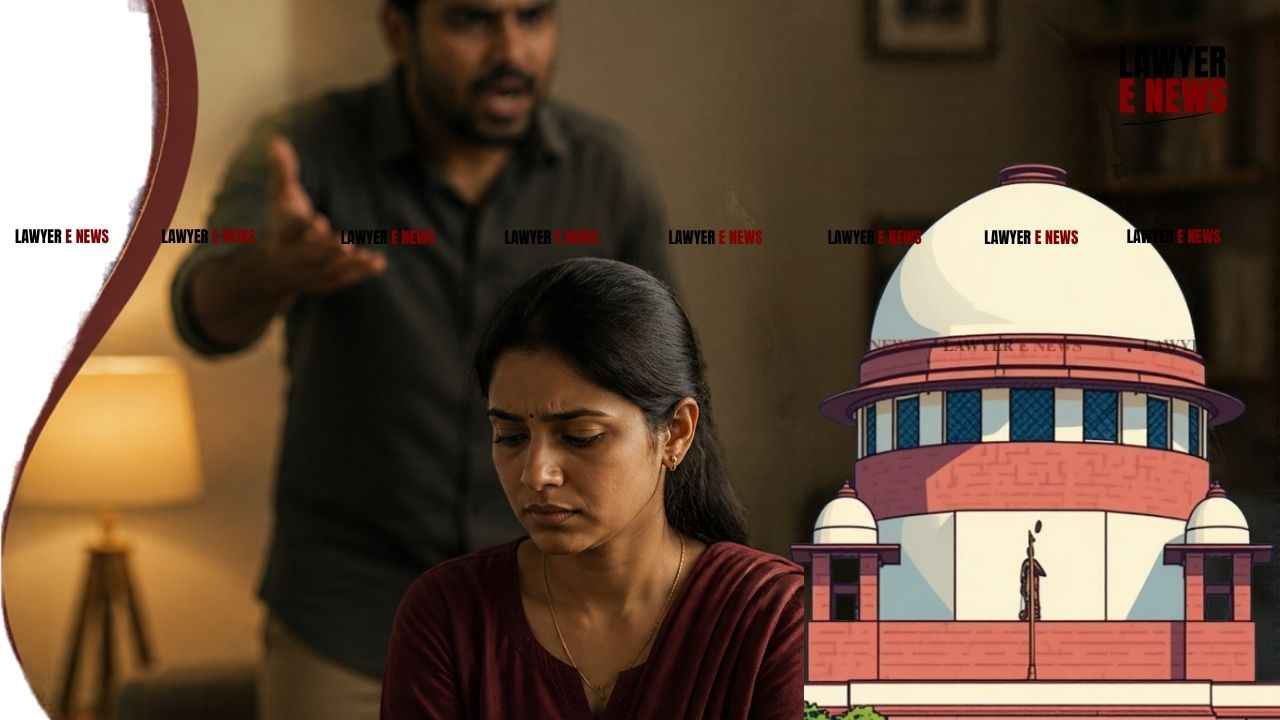
"The allegation that the appellant used to call the deceased 'stupid' and 'useless,' even if accepted prima facie, cannot to any extent qualify as an offence of cruelty or criminal intimidation. At best, it reflects on the temperament of the husband, but it cannot be given a criminal colour so grave as to become the reason for the suicide of his wife." Supreme Court on November 2, 2026, held that a husband's temperamental issues, such as scolding over trifles or calling his spouse "stupid" and "useless", cannot be given a criminal colour to sustain charges of dowry death under Section 304B or cruelty under Section 498A of the IPC.
A Bench comprising Justice B.V. Nagarathna and Justice Manmohan ruled that isolated marital friction and customary festival gift exchanges cannot be weaponized into criminal prosecution when there is no proximate causal nexus to a suicide, setting aside a Bombay High Court order that had declined to quash an FIR against the husband.
The appellant and the deceased married in January 2021 and shifted their matrimonial home to Toronto, Canada, in early 2022. On June 11, 2023, the wife died by suicide by jumping from their 22nd-floor apartment, leaving behind a suicide note stating she felt like a "stupid and useless person" due to her inability to secure employment. Despite Canadian authorities and the coroner closing the case after finding no foul play or domestic dispute history, the deceased's father registered an FIR in Aurangabad alleging dowry harassment, cruelty, and voluntarily causing hurt. The Bombay High Court quashed the proceedings qua the in-laws but refused relief to the husband, leading to the present appeal.
Whether general allegations of temperamental outbursts and customary exchanges of presents satisfy the statutory ingredients of dowry death and matrimonial cruelty under Sections 304B and 498A of the IPC?
Whether the continuation of criminal proceedings based on vague and omnibus assertions constitutes an abuse of process liable to be quashed under Section 482 of the CrPC?
Absence of proximate nexus invalidates dowry death allegations
Analyzing the foundational requirements of Section 304B IPC, the bench reiterated that the prosecution is obligated to establish that the woman was subjected to cruelty or harassment in connection with a dowry demand soon before her death. The court highlighted that until the demise of the wife, no contemporaneous complaint had ever been lodged either with Canadian or Indian authorities.
The bench observed that the suicide note did not contain any reference to the husband or his family, directly attributing her distress to unemployment and academic stress.
Customary gifts on auspicious occasions cannot be branded as dowry
Addressing the complainant's allegation that fifteen tolas of gold and Diwali presents were given as illegal dowry, the Court cautioned against criminalizing traditional familial courtesies. The bench noted that the father had gifted the gold to both his daughter and son-in-law jointly, which constitutes a normal expression of parental love.
The Court held that the prosecution cannot taint isolated customary gift exchanges on festive occasions with a criminal colour, particularly when such events occurred years prior to the suicide.
Marital temperament cannot be equated with criminal cruelty
The Court firmly rejected the prosecution's attempt to construct a case of cruelty under Section 498A IPC or criminal intimidation under Section 504 IPC based on allegations that the husband was short-tempered and called the deceased "useless". The bench underscored that vague and omnibus assertions devoid of specific instances fail to establish the legal threshold of cruelty.
A temperamental issue of a spouse cannot be equated with the offence of criminal intimidation or grievous hurt so as to make him criminally liable for the suicide of his wife, the Court remarked.
Vague and omnibus complaints must be nipped in the bud under Section 482 CrPC
Invoking the landmark precedent in State of Haryana v. Bhajan Lal, the Supreme Court stressed that High Courts must exercise their inherent jurisdiction under Section 482 CrPC to protect innocent individuals from facing unwarranted prosecutions rooted in grief-driven vendettas.
The bench concluded that the father of the deceased, grieving the tragic loss of his daughter, was merely searching for some semblance of reason for her drastic step, which could not justify subjecting the husband to a protracted trial in the complete absence of prima facie material.
The Supreme Court allowed the criminal appeal, set aside the Bombay High Court's order dated January 8, 2025, and quashed FIR No. 212/2023 along with all consequential proceedings pending against the appellant.
Date of Decision: November 02, 2026