-
by sayum
29 August 2026 7:20 AM







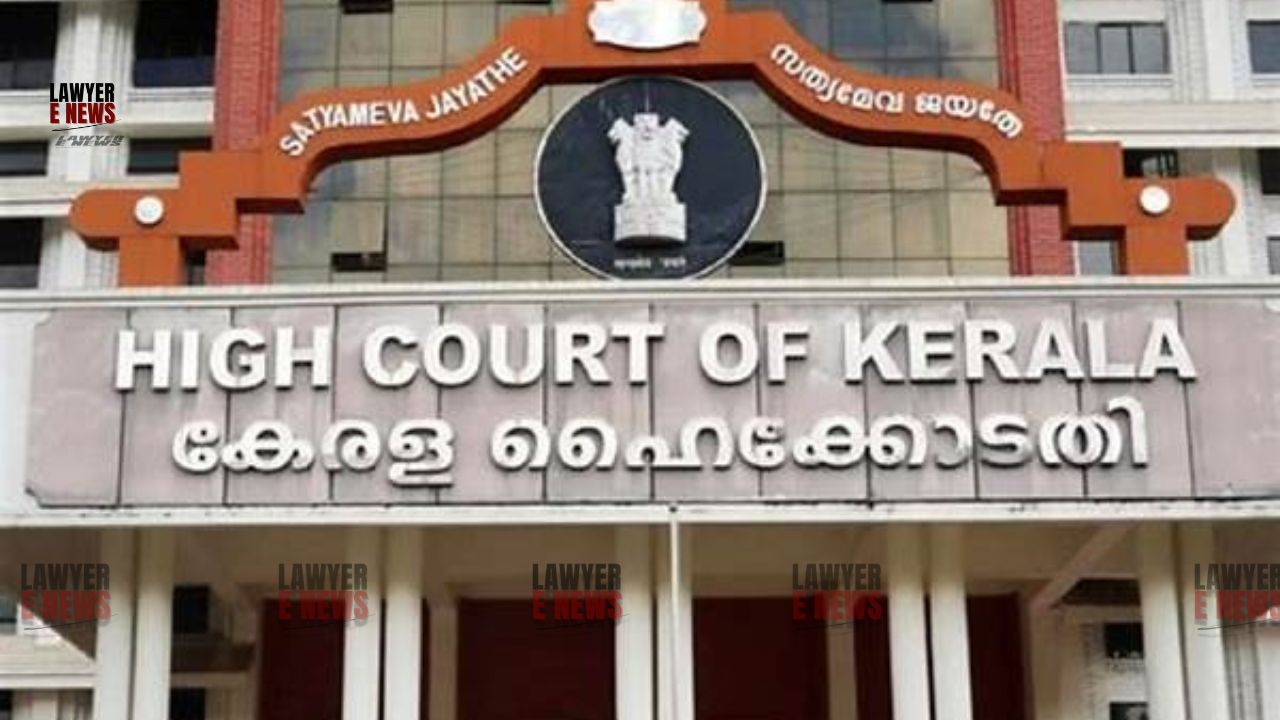
“Statutory Obligation Under Irrigation Act Supersedes Custom—Flooding Due to Bund Breach Is a Legal Failure, Not a Natural Calamity” - In a powerful judicial intervention Kerala High Court at Ernakulam held that the failure of agricultural bunds leading to the flooding of a school cannot be dismissed as a mere consequence of nature, when statutes impose a positive legal obligation on local agricultural bodies to maintain and protect such structures. The Division Bench, led by Chief Justice Nitin Jamdar and Justice Basant Balaji, issued a detailed judgment in WP (PIL) No. 87 of 2025, which had originated from a letter written by students and teachers of SNDP Higher Secondary School, Kuttamangalam in Alappuzha district, complaining of waterlogging that had submerged their classrooms.
The Court took suo motu cognizance of the letter and converted it into a Public Interest Litigation, condemning the systemic inaction of local authorities and bund management committees, while establishing that such obligations are not optional, but part of a codified legal framework under the Kerala Irrigation and Water Conservation Act, 2003 and the Rules of 2005.
“The present situation has been aggravated due to the breach of agricultural bund. This cannot be attributed wholly to an act of nature… Various man-made factors may have contributed to the aggravation of the situation,” the Court categorically held, refusing to allow bureaucratic evasion of responsibility behind the facade of monsoon calamity.
“Without Statutory Annual Action Plans, Any Measures Taken By Agricultural Committees Are Ad Hoc and Legally Deficient”
The High Court sharply criticized the Paruthivalavu Padasekharam Samithi (Respondent No.7) for not preparing the Annual Action Plan mandated under Rule 15 of the Kerala Irrigation and Water Conservation Rules, 2005. Despite claiming financial constraints and having held a meeting post-disaster, the Samithi could not present any pre-existing plan for the season.
“Respondent No.7 has no such annual plan, and it is not clear whether one has ever been prepared… Without an annual plan, which is a statutory mandate, any measures taken by the committees would be ad hoc,” the Court observed.
The Court held that the Padasekharam Committees are not mere customary bodies but statutory organs tasked with proactive planning, bund maintenance, and irrigation coordination under Section 32 of the 2003 Act and Rule 16 of the 2005 Rules. The explanation to Section 32 legally defines a "Padasekharam" and the composition of its committee, making their obligations justiciable.
“When Statutes Impose Duties on Collectives, Negligence by Committees Invites Legal Consequence—Not a Defense of Custom or Poverty”
Confronted with the Samithi’s plea that funds were inadequate to prevent the bund collapse, the Court emphasized that statutory obligations cannot be avoided by citing poverty or inertia.
“It appears from the response of the Samithies that the repairs to breaches in the bunds often require immediate action and ready cash, which many of these Samithies lack… However, statutory obligations cannot be suspended for want of funds,” the Court said.
The ruling clarifies that local custom has now been legally elevated to statutory responsibility, and these duties must be fulfilled irrespective of available finances. The Collector and the Punja Special Officer have both investigative and remedial powers under Sections 31 and 32 to ensure dewatering, bund maintenance, and recovery of costs from negligent landholders.
“Flooded School Classrooms are Evidence of Systemic Inaction, Not Mere Victims of Rainfall”
The factual background of the case revealed that on 29 May 2025, following incessant rain and a bund breach in the Paruthivalavu paddy fields, the school building was submerged, forcing students to use upper floors, libraries, and computer labs to attend alternate shifts. Yet, no timely action was taken by the responsible committee.
The Court remarked with concern:
“Despite the School making various requests to the concerned Padasekharam Samithi, no action was taken… The situation is not just natural adversity but aggravated by the systemic failure to discharge legal obligations.”
The Court also recorded that two of the three dewatering pumps were found non-functional during inspection by the Amicus Curiae and Legal Services Authority, and that sandbags were used to create a walking path for students—a striking testament to the neglect.
“Suo Motu PIL Was Necessitated By Complete Absence of Inter-Departmental Coordination — Such Lapses Cannot Be Repeated”
The Court explicitly recorded that the suo motu action was taken because of the “lack of an effective co-ordination mechanism”. Subsequently, the District Collector was directed to form an ad hoc committee of senior officials across departments, including Education, Agriculture, and Local Governance.
“The grievances of the school authorities can be placed before this ad hoc committee, which is already seized of the issue… The District Collector will direct necessary steps to be taken in this regard as and when pointed out by the School,” the Bench directed.
The Court ordered that this committee must continue functioning until the issue is resolved. Moreover, in future similar emergencies, the Collector must replicate this approach without delay.
“Scientific Study Is Needed to Prevent Further Failures — Chief Engineer Must Explore Structural and Bio-Engineering Solutions”
In a forward-looking directive, the Bench asked the Chief Engineer, Kuttanad Package and Inland Navigation, to conduct a scientific study into long-term flood prevention and bund protection measures. The Court emphasized the need to examine bio-bunding techniques, engineering reinforcements, obstruction removal, and bund redesign, especially as the region lies below sea level and is susceptible to “Madaveezhcha”.
“A study can be carried out under the supervision of the Chief Engineer, Kuttanad Package and Inland Navigation, to examine how occurrences such as the present one can be minimised,” the Court stated.
The Engineer was directed to submit a preliminary report in four months, with the State Government to consider implementation of recommendations and provide logistical support as required.
“Flooding of a School Due to Neglect of Bunds is Not Just a Disaster—It is a Violation of Legal Duty and Right to Education”
The Kerala High Court’s intervention, premised on a letter from distressed students, has led to one of the most far-reaching discussions on the interface between environmental duty, administrative accountability, and statutory agricultural management. The judgment draws a straight line between poorly maintained irrigation infrastructure and denial of educational access, holding statutory actors to account.
The petition was disposed with clear directions for immediate relief, institutional correction, and long-term scientific reforms, while acknowledging the assistance of Amicus Curiae Mr. Jithin Saji Issac and the Kerala State Legal Services Authority.
Date of Decision: 11 September 2025