-
by sayum
25 August 2026 4:05 AM







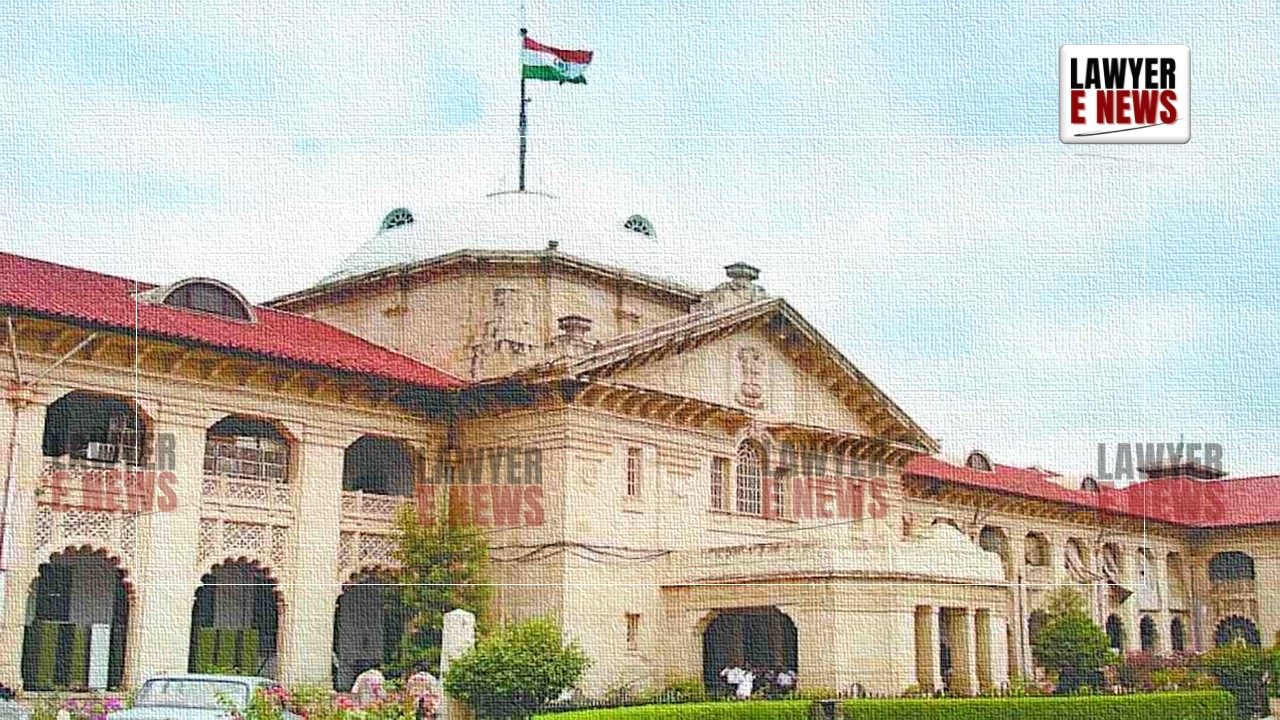
Allahabad High Court on February 13, 2025, upheld the conviction and life imprisonment of Rakshpal in a 1982 armed robbery and murder case from Etah, Uttar Pradesh. Dismissing his appeal in CRLA No. 2806 of 1983, the court ruled that minor investigative lapses and the absence of independent witnesses cannot override clear and credible testimony from injured and natural eyewitnesses.
Justice Vivek Kumar Birla and Justice Syed Qamar Hasan Rizvi, while confirming the life sentence under Section 460 IPC and seven years' rigorous imprisonment under Sections 394 and 397 IPC, observed, "An injured witness comes with a built-in guarantee of his presence at the crime scene and is unlikely to spare his real assailant to falsely implicate someone else."
The case arose from a violent robbery and murder that took place on the intervening night of July 25-26, 1982, at the house of Shiv Raj Singh in Nagla Himmat, Etah district. According to the prosecution, four accused—Rameshwar, Mehndi, Rakshpal, and Jagdish—forcibly entered the house, looted valuables, and assaulted the residents.
When the victim’s family resisted, Johari (Shiv Raj Singh’s brother) was shot and killed, while Ram Chandra (Shiv Raj Singh’s father) was brutally beaten with a lathi. A burning lantern and torches used by neighbors provided visibility, allowing the accused to be identified.
A prompt FIR was lodged at 5:30 AM, naming the accused, including Rakshpal, who was armed with a country-made pistol. The Trial Court convicted all four accused in 1983, sentencing them to life imprisonment and rigorous imprisonment for robbery with arms. Over time, two co-accused (Mehndi and Jagdish) died, while Rameshwar’s appeal was partly allowed in March 2024, modifying his sentence to time served.
Arguing his appeal, Rakshpal claimed false implication, alleging that he was named only because of a complaint filed against a police officer by another person, in which he was a witness. His counsel contended that the testimonies of Shiv Raj Singh (PW-1), Ram Nath (PW-2), and injured victim Ram Chandra (PW-3) should be disregarded as they were related to the deceased. The defense further pointed to inconsistencies in the crime scene depiction and challenged the absence of independent witnesses.
Rejecting these arguments, the Allahabad High Court upheld the conviction, stating, "The law does not mandate independent witnesses in every case, nor does it require that testimonies from family members be discarded simply because of their relationship with the victim."
The court noted that the eyewitness testimonies were clear, consistent, and corroborated by medical evidence. The FIR was filed promptly, lending credibility to the prosecution’s case. Addressing the claim of a flawed crime scene representation, the court observed, "In such moments of attack, people react unpredictably. A minor discrepancy in body position cannot negate the entire chain of events."
Dismissing concerns about the absence of a formal charge under Section 460 IPC, the court ruled, "Under Section 222 CrPC, if evidence proves the commission of a greater offense, conviction under the appropriate section is justified."
The court also took a strong stance on absconding, stating, "While fleeing alone is not proof of guilt, it strengthens the case when combined with strong eyewitness testimonies."
The Allahabad High Court confirmed Rakshpal’s conviction and directed him to surrender immediately, stating, "There is no reason to interfere with the conviction. The prosecution has presented a consistent, reliable, and clear case. The minor discrepancies pointed out by the defense do not weaken the case, and the presence of the accused is well established."
This ruling reinforces the principle that minor discrepancies in an investigation cannot overshadow strong eyewitness accounts, especially when an injured witness corroborates the prosecution's case. The judgment also upholds the doctrine that "an injured witness is the best witness", ensuring that courts do not disregard testimony merely because it comes from a family member.
Date of Decision: 13 February 2025