-
by sayum
29 August 2026 6:23 AM







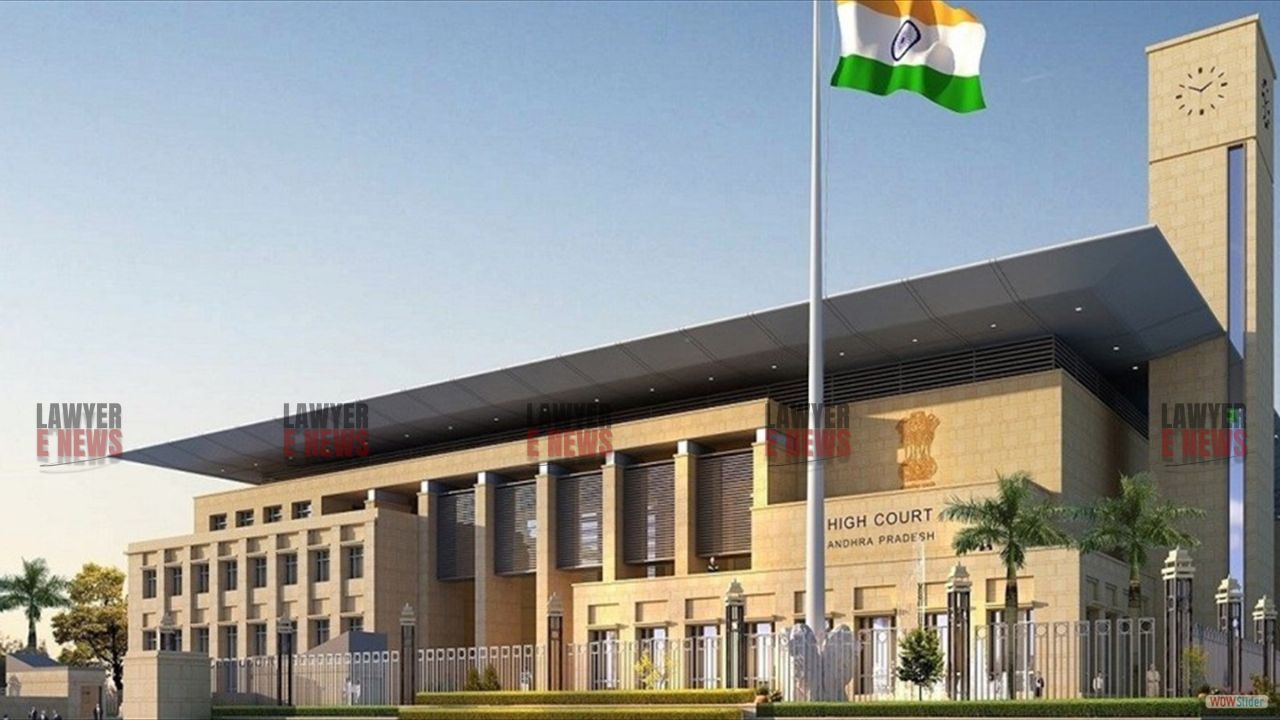
“There is clear-cut manufacturing defect in the instant case”— Andhra Pradesh High Court at Amaravati refusing to interfere with concurrent findings of consumer fora that upheld a complaint against Toyota for supplying a defective Innova vehicle. The Court ruled that the failure of airbags to deploy in a major frontal collision, despite the vehicle being advertised as equipped with premium safety features, amounted to a “clear-cut manufacturing defect.” This decision underlines judicial intolerance towards evasion of liability in consumer safety matters, especially when automotive companies fail to meet the very safety standards they promise.
“The Airbags Did Not Deploy Despite a Severe Frontal Collision – That Is Enough To Establish Defect”: Judicial Endorsement of Consumer Forum Findings
The case arose from a complaint filed by L. Sunil Reddy, who had purchased a Toyota Innova 2.5 V VX model on 11.03.2011 for ₹12,43,045. Just five months later, while traveling from Kurnool to Bangalore, the vehicle was involved in a serious accident on 16.08.2011. Notably, the airbags did not deploy, and all passengers suffered injuries. The complainant alleged this as a failure of the core safety mechanism—a defect that endangered lives. He also highlighted that days prior, the clutch plates had overheated and emitted smoke, burning out on a public road, an issue that should not occur in a premium vehicle shortly after purchase.
When the matter was brought before the District Consumer Disputes Redressal Forum, Kurnool, Toyota argued that the airbags were not triggered because the impact was on the side and not frontal. However, the District Forum found otherwise, referring to photographs, expert evidence, and the FIR filed by the driver of the colliding vehicle. The FIR stated that the Innova was being driven at a “terrific speed” and had a direct frontal collision with an auto, which “turned turtle” due to the impact.
“Toyota’s Recall of 45,000 Innovas for Airbag Issues is Clinching Evidence”: District Forum’s Findings Upheld Across All Forums
The District Forum relied on Toyota’s own admission, through the cross-examination of RW-1 (a company representative), that Toyota had initiated a global recall of Innova vehicles due to defective airbags and steering columns, including 45,000 units in India, reported in The Hindu on 11-11-2014. It observed that:
“The vehicle supplied to the complainant by opposite party No.2 is suffering with manufacturing defect... air bags not deployed when the vehicle met with severe accident... There is clear cut manufacturing defect in the instant case.”
It concluded that the complainant had indeed purchased the vehicle based on assurances regarding the airbag system and was entitled to either replacement of the vehicle or refund of ₹15,09,415 with 9% interest per annum, alongside ₹10,000 for mental agony and ₹5,000 towards litigation costs.
“Not Just a Side Impact – The Damage Was to the Entire Front Portion”: AP State Consumer Commission and NCDRC Confirm Manufacturing Defect
The A.P. State Consumer Commission, in First Appeal No. 467/2015, upheld the District Forum’s ruling. The Commission scrutinised photographs (Ex A4, A5, B12), the FIR, and cross-examinations, concluding:
“Ex.A-4 photographs would clinchingly show that it is a major accident, that there is a frontal collision of the vehicle and the vehicle badly damaged.”
“Only due to the said mechanical defect, airbags were not deployed at the time of the accident.”
The National Consumer Disputes Redressal Commission (NCDRC) in RP No. 2117/2019 agreed and observed:
“There is no reason to disbelieve the evidence of PW-1 in this regard... This, coupled with the evidence of RW-1 with respect to recall of vehicles... lends credence to the case of complainant... We find no illegality or material irregularity.”
The NCDRC further clarified that both Toyota Kirloskar (manufacturer) and the dealer were jointly and severally liable to replace the vehicle or refund the money with interest and directed them to comply within 30 days.
“Article 227 Cannot Be Used To Overturn Concurrent Findings of Fact Based on Evidence”: High Court Declines Toyota’s Revision Plea
Before the High Court, Toyota urged that the findings of the forums below were “perverse and without evidence” and that the accident was only a “side impact”. They also attempted a procedural challenge, asserting that the NCDRC decision was rendered by a single non-judicial member.
Rejecting both arguments, the High Court cited the landmark judgment in Estralla Rubber v. Dass Estate (2001) 8 SCC 97, affirming that supervisory jurisdiction under Article 227 is limited:
“The High Court is not vested with any unlimited prerogative to correct all kinds of hardship or wrong decisions... Interfering is restricted to cases of serious dereliction of duty and flagrant violation of fundamental principles of law or justice.”
The Court observed that the findings of the consumer forums were not only supported by evidence but also reinforced by admissions from Toyota itself, and hence could not be termed as perverse. The plea for remand due to absence of judicial coram was also dismissed as being without legal merit or prejudice.
“Safety Isn’t Optional – If Airbags Fail When They’re Needed Most, It’s A Breach of Trust and Law”: A Resounding Message on Consumer Safety
By affirming the consumer’s claim and rejecting Toyota’s revision plea, the Andhra Pradesh High Court has sent a strong signal to automobile manufacturers that consumer safety commitments must be upheld both in marketing and in engineering.
When a vehicle’s primary safety features like airbags fail during a frontal crash, and the manufacturer’s own data confirms known defects and recalls, courts will not hesitate to hold them accountable under consumer protection law.
The Court's refusal to interfere under Article 227 reinforces the finality of well-reasoned consumer forum verdicts and narrows the scope of supervisory writs to prevent abuse by large corporations seeking to delay justice.
Date of Decision: 15-09-2025