-
by sayum
09 August 2026 1:53 PM







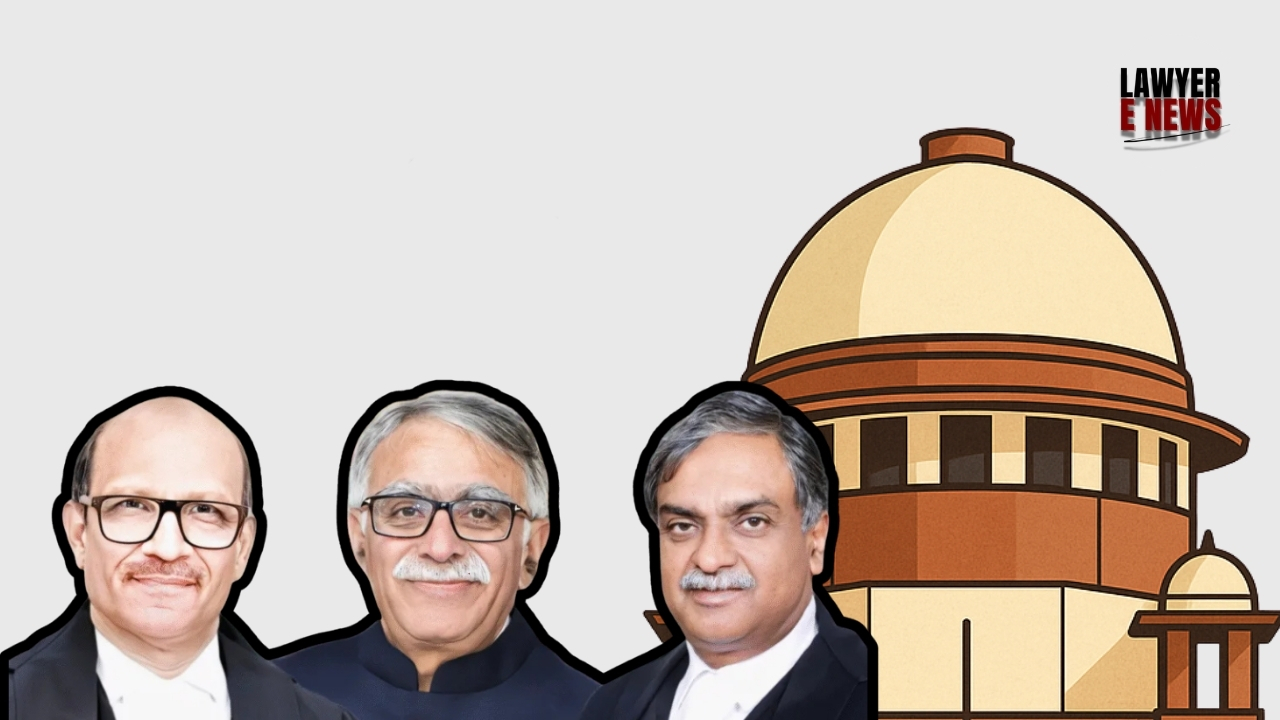
“Prosecution’s Failure To Forensically Link Accused To Crime Scene Destroys Entire Case”, On 16th July 2025, the Supreme Court of India emphatically overturning the death sentence and conviction of a man accused of brutally murdering four members of his family, including his own wife and two young children. The Court, while passing its detailed judgment, laid particular stress on the complete absence of forensic corroboration in the case.
Highlighting the shoddy nature of the investigation, the Bench comprising Justices Vikram Nath, Sanjay Karol, and Sandeep Mehta observed:
“It is quite conspicuous that the investigating agency took minimum pains to link the discovered articles to the incident or the deceased persons through forensic evidence or otherwise.” [Para 37]
Condemning the prosecution’s reliance on a vague forensic report that merely stated the presence of "human blood," the Court ruled that such superficial forensic evidence, without DNA profiling or conclusive linkage, could not possibly sustain a conviction for multiple homicides.
The Court categorically remarked: “The only forensic evidence in this case is the report of the chemical analysis which merely states that the blood found on the exhibits is opined to be of human origin. The same is evidently not sufficient to link the articles to the deceased or the specific offence.” [Para 37]
In the absence of any scientifically reliable evidence, the conviction was held to be legally untenable.
“When The Eyewitnesses Crumble, The Whole Edifice Of The Prosecution Falls”: Supreme Court Rejects Unreliable Testimonies
The case pertained to the gruesome death of four family members in Kapurthala, Punjab, where the appellant, Baljinder Kumar, was accused of slaying his wife, children, and sister-in-law using a gandasi. While the trial court and high court imposed and confirmed the death penalty respectively, the Supreme Court intervened after identifying alarming contradictions in the prosecution’s narrative.
Focusing on the glaring inconsistencies, the Court held: “In matters such as the instant one, the burden on prosecution is to prove beyond reasonable doubt that it is the appellant and appellant alone who has committed the crime. It is settled law that in order to record conviction based on ocular evidence, their testimonies have to be completely credible and trustworthy.” [Para 42]
The Court pointed out how the testimonies of key prosecution witnesses, namely the complainant (PW1), his mother (PW2), and a child witness (PW17), were riddled with contradictions so grave that they collapsed under the weight of cross-examination.
The bench observed: “We cannot turn a blind eye to the obvious inconsistencies in the depositions of its main witnesses which indicate deliberate embellishment and coaching, rendering these testimonies unreliable.” [Para 32]
PW1’s presence at the scene was found fabricated, while PW2’s account was labelled inconsistent, and PW17, the injured child, admitted that he had been asleep during the attack and did not see the assailant.
“Section 106 Cannot Rescue A Collapsing Prosecution”: Supreme Court On Shifting Burden Without Foundational Proof
In an important reaffirmation of evidentiary principles, the Supreme Court rejected the High Court’s reliance on Section 106 of the Indian Evidence Act, which had drawn adverse inference against the accused for not explaining his injuries.
Rejecting this reasoning, the Supreme Court emphatically stated: “Taking recourse to Section 106 of the Evidence Act and employ it against the accused in a detrimental manner in the absence of any foundational facts, shall lead to a severe and unwarranted application of the provision.” [Para 39]
The Court clarified that unless the prosecution first establishes the foundational facts connecting the accused to the crime, no adverse inference could be drawn merely because the accused was injured.
“Absence Of Independent Witnesses And Investigative Lapses Strip The Prosecution Case Of Credibility”
In a scathing indictment of the investigative lapses, the Court noted: “The investigating agency took minimum pains to link the discovered articles to the incident… the weapon was misplaced at a later stage and no forensic analysis placed before the Court.” [Para 37]
The Court was also critical of the absence of any independent witness despite the crime occurring in a village, where the outcry should have attracted neighbors.
“No neighbor has been made a witness anywhere… it is quite surprising to note, especially in a rural set up where the community is close knit.” [Para 27]
“A Death Sentence Cannot Survive On Tainted Testimonies And Hollow Evidence”: Supreme Court Acquits Appellant After 11 Years
Pronouncing its final conclusion, the Supreme Court categorically held that the prosecution failed to establish the appellant’s guilt beyond reasonable doubt, quashed both the conviction and death sentence, and directed the release of the accused.
“Given the facts and circumstances of the case and in light of the above discussion, we cannot bring ourselves to hold the accused-appellant guilty of the charged offence as his guilt has not been proved beyond a reasonable doubt.” [Para 43]
“The impugned judgment and final order… are hereby quashed and set aside. The appellant is acquitted of all the offences charged with.” [Para 44]
The judgment stands as a critical reminder that courts must not allow emotional weight or public pressure in heinous crimes to override the essential requirement of legal proof.
In a concluding note resonating with constitutional principles, the Court said:
“When at stake are human lives and the cost is blood, the matter needs to be dealt with utmost sincerity.” [Para 43]
Date of Decision: 16th July 2025