-
by sayum
27 August 2026 6:51 AM







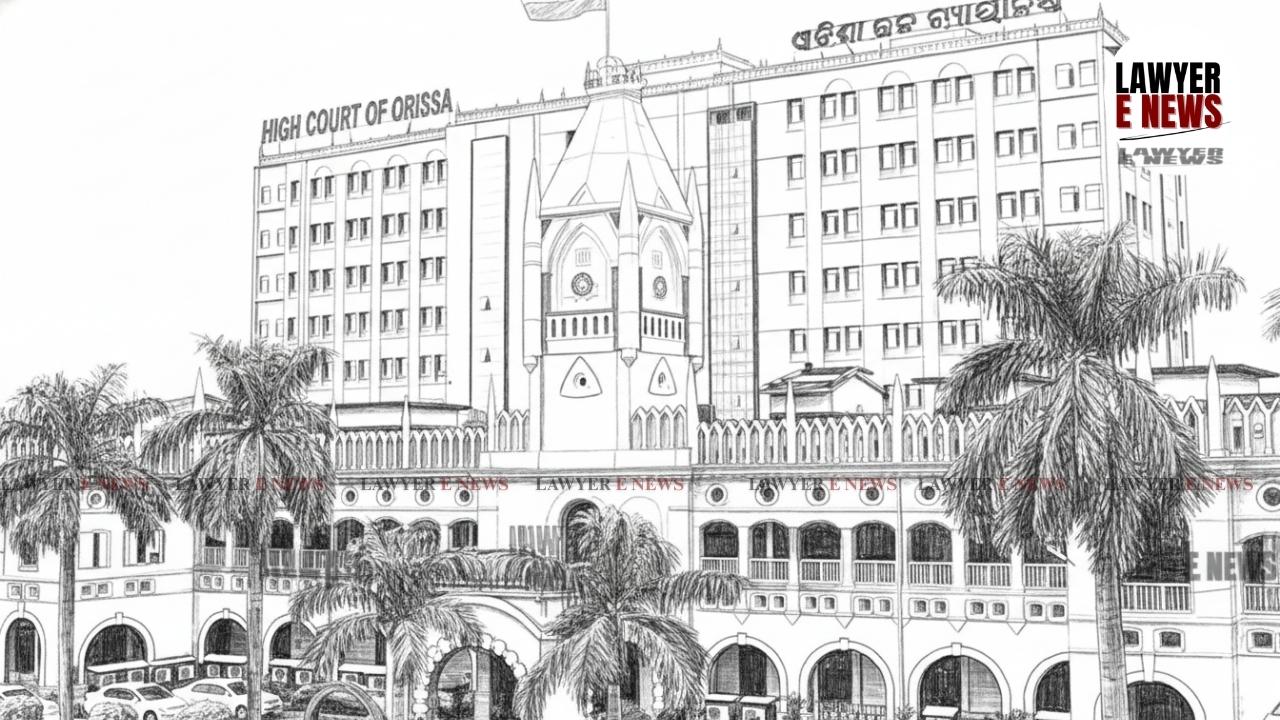
"Mere denial about the liability by itself is not sufficient for the petitioner to wriggle out of the debt as it is reasonably proved by the opposite party that there was a friendly loan." High Court of Orissa, in a significant ruling, held that an accused in a cheque bounce case cannot escape liability merely by claiming the cheque was stolen if no formal police complaint regarding the alleged theft was ever registered.
A single-judge bench of Justice R.K. Pattanaik observed that such a defence is clearly an afterthought and reiterated that the statutory presumption under the Negotiable Instruments Act operates strongly in favour of the cheque holder unless rebutted by credible evidence.
BACKGROUND OF THE CASE
The complainant alleged that he had advanced a friendly loan of Rs. 10,00,000 to the petitioner, a dentist by profession, who issued a cheque towards repayment. When the cheque was dishonoured for insufficient funds and the subsequent legal notice went unanswered, a complaint was instituted under Section 138 of the Negotiable Instruments Act. The Judicial Magistrate First Class, Champua, convicted the petitioner and ordered compensation of Rs. 12,62,500, a decision which was subsequently affirmed by the Additional Sessions Judge, prompting the present criminal revision petition before the High Court.
LEGAL ISSUES
The primary question before the High Court was whether the accused could successfully rebut the statutory presumptions under the Negotiable Instruments Act by merely pleading that the cheque was stolen from his clinic. The court was also called upon to determine whether the concurrent findings of the lower courts warranted interference under the limited scope of revisional jurisdiction.
COURT'S OBSERVATIONS AND JUDGMENT
The High Court commenced its analysis by examining the statutory framework governing dishonoured cheques, specifically Sections 118 and 139 of the Negotiable Instruments Act, 1881. The bench emphasised that the law mandates a reverse burden of proof, drawing a strong presumption that a cheque is issued for valid consideration and towards the discharge of a legally enforceable debt. The court clarified that while the accused is not required to prove their defence beyond all reasonable doubt, they must meet the threshold of preponderance of probabilities. "An accused in case under Section 138 of the Act is required to put up a defence, which is acceptable and not to prove it beyond reasonable doubt but by preponderance of probabilities and the said aspect has been considered by the learned courts below."
Addressing the petitioner’s specific defence that the complainant lacked the financial capacity to advance the loan and had stolen the cheque from his dental clinic, the court found the narrative wholly unsubstantiated. The bench noted that despite advancing such a serious allegation during the trial, the petitioner had never approached law enforcement authorities to report the purported theft. Consequently, the court concurred with the courts below in dismissing the defence as a fabricated afterthought, noting that the petitioner had also failed to reply to the statutory legal notice. "The Court is equally of the conclusion that the petitioner having not lodged any complaint with the local police for the theft of the cheque, any such plea by him during trial could not have been accepted and was rightly rejected."
"When no evidence was led by the petitioner to rebut the presumption in favour of the opposite party, it has to be held that there was a liability."
Delving into the scope of its powers under Sections 397 and 401 of the Code of Criminal Procedure, 1973, the High Court outlined the narrow confines of revisional jurisdiction. Relying on the Supreme Court's pronouncements in the cases of Bir Singh v. Mukesh Kumar and Southern Sales and Services & Others v. Sauermilch Design and Handels GMBH, Justice Pattanaik underscored that a revisional court must refrain from unsettling concurrent findings of fact unless they are vitiated by perversity or a manifest jurisdictional error. "If there is a concurrent finding of fact by the learned courts below and it is found to be not perverse leading to a miscarriage of justice, the same is not to be interfered with while exercising revisional jurisdiction."
Finding no perversity in the appreciation of evidence by the courts below, the High Court dismissed the criminal revision petition. The conviction under Section 138 of the Negotiable Instruments Act, along with the substantive sentence and the direction to pay compensation under Section 357(3) of the Cr.P.C., was upheld in its entirety.
Date of Decision: 30 March 2026