-
by sayum
28 August 2026 2:11 PM







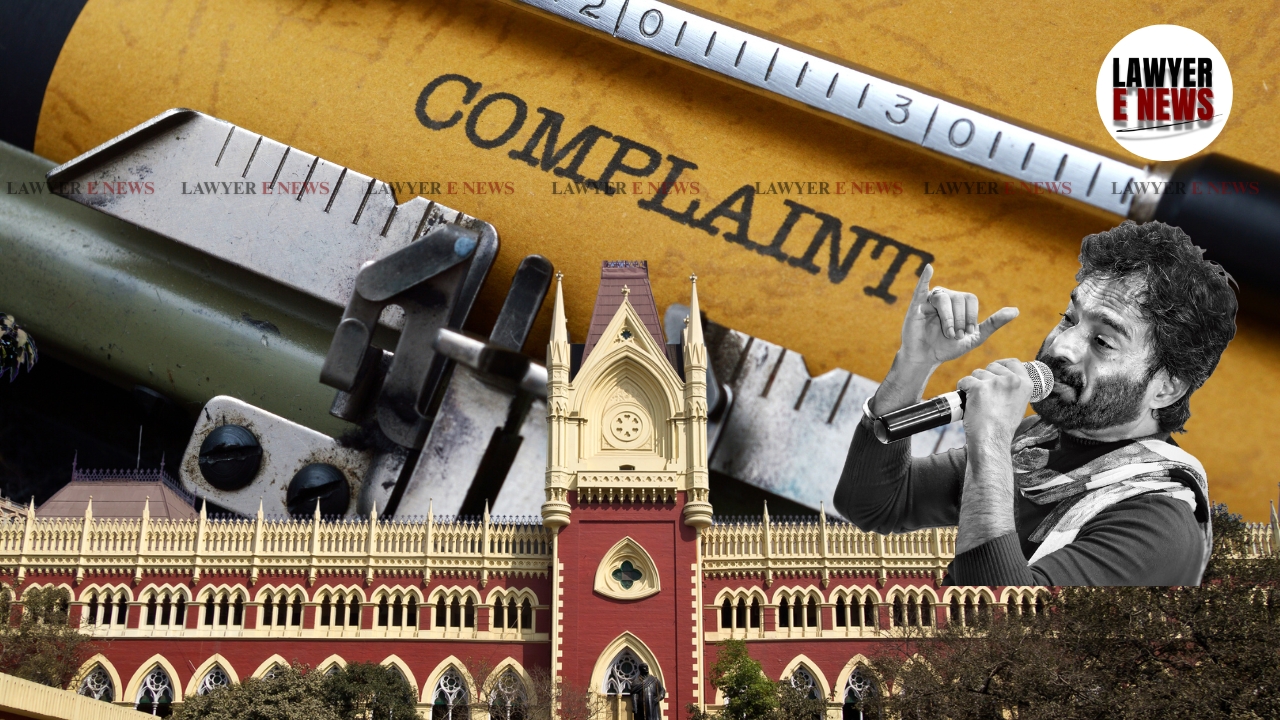
“Absence of Time, Place, and Proof of Incident Makes Application Under Section 156(3) CrPC Unsustainable” — In a detailed judgment Calcutta High Court dismissed a criminal revision petition filed by Anirban Bhattacharya, who had sought directions under Section 156(3) CrPC to register an FIR against noted Bengali singer and composer Nachiketa Chakraborty for allegedly delivering a hate speech during a live concert.
Justice Ajay Kumar Gupta upheld the Magistrate’s earlier rejection of the application for want of territorial jurisdiction and absence of foundational facts. The Court held that mere allegations without establishing the where, when, and how of the purported incident cannot trigger mandatory police action or judicial directions under Section 156(3) of the CrPC.
“Zero FIR Is Not a License to Bypass Territorial Jurisdiction of Magistrates”
The petitioner, a functionary of the Bishwa Hindu Parishad, had approached the Magistrate seeking directions to Shyampukur Police Station to register an FIR under Sections 153, 153A, 295A, and 298 of the IPC. The allegation was that Nachiketa made inflammatory remarks during a live concert, insulting the Hindu community and its deities, particularly Lord Ram.
However, the Court noted that the complaint was devoid of critical facts: “The petitioner failed to produce any documents and information of the date, time and place of the live concert... he neither saw the concert nor visited the spot where the said concert was performed.”
Further, the police report revealed that: “Nachiketa Chakraborty is not a resident under Shyampukur PS and has not performed a live music concert or spread any hate speech in the jurisdiction of Shyampukur P.S. in the last three years.”
The Magistrate, therefore, rightly declined to direct registration of an FIR, observing a lack of territorial jurisdiction and substantive basis for investigation.
The High Court affirmed: “Section 156(3) empowers a Magistrate to order an investigation by the officer in charge of a police station within the Magistrate’s territorial jurisdiction.”
The Court also distinguished between the duty to register a Zero FIR under Section 173 of the Bharatiya Nagarik Suraksha Sanhita, 2023 (BNSS) and judicial competence to order investigation: “Zero FIR allows registration regardless of jurisdiction, but the Magistrate’s power under Section 156(3) remains territorially bound.”
“Social Media Clips Alone, Without Verification, Cannot Justify Judicial Action”
The petitioner had also argued that the alleged hate speech was widely circulated on social media and that the Magistrate failed to act despite its viral nature. The Court rejected this submission outright, cautioning against blind reliance on unverified social media material:
“Only the contents of social media mentioning, without any date, time and place of the concert and without any authenticity, cannot be the ground to take cognizance of such offence even though the allegation of offence is serious in nature.”
The Court clarified that seriousness of allegations alone does not substitute for foundational facts. The complaint lacked the factual matrix required to initiate a criminal investigation under statutory procedure.
Reference to Supreme Court’s Shaheen Abdullah Order Not Applicable Without Verified Incident
The petitioner had also relied upon the Supreme Court’s direction in Shaheen Abdullah v. Union of India, W.P.(C) No. 940 of 2022, wherein the apex court instructed that police authorities must take suo moto action in all cases of hate speech.
However, the High Court clarified that such directions presuppose a verified incident:
“In the instant case, even the State has not taken any suo moto action... as there is no information regarding the alleged incident.”
There was no riot, no public disturbance, and no complaint other than the one by the petitioner. The alleged “viral video” remained unverified and without any traceable origin in time or space.
Court Concludes Petitioner’s Plea Is Without Merit
In closing, Justice Ajay Kumar Gupta held: “Due to lack of sufficient materials placed on the part of the Petitioner, this Court does not find any illegality, infirmity or perversity against the order dated 04.08.2023... the present revisional application is devoid of merit.”
Accordingly, the revision was dismissed and all connected applications stood disposed of.
Territorial Jurisdiction, Factual Verification, and Evidentiary Basis Are Prerequisites for Judicial Intervention Under Section 156(3) CrPC
This judgment reaffirms the importance of procedural propriety and evidentiary sufficiency in criminal jurisprudence, especially in politically or communally sensitive matters. It underscores that:
Date of Decision: 19.09.2025