-
by sayum
27 August 2026 3:32 PM







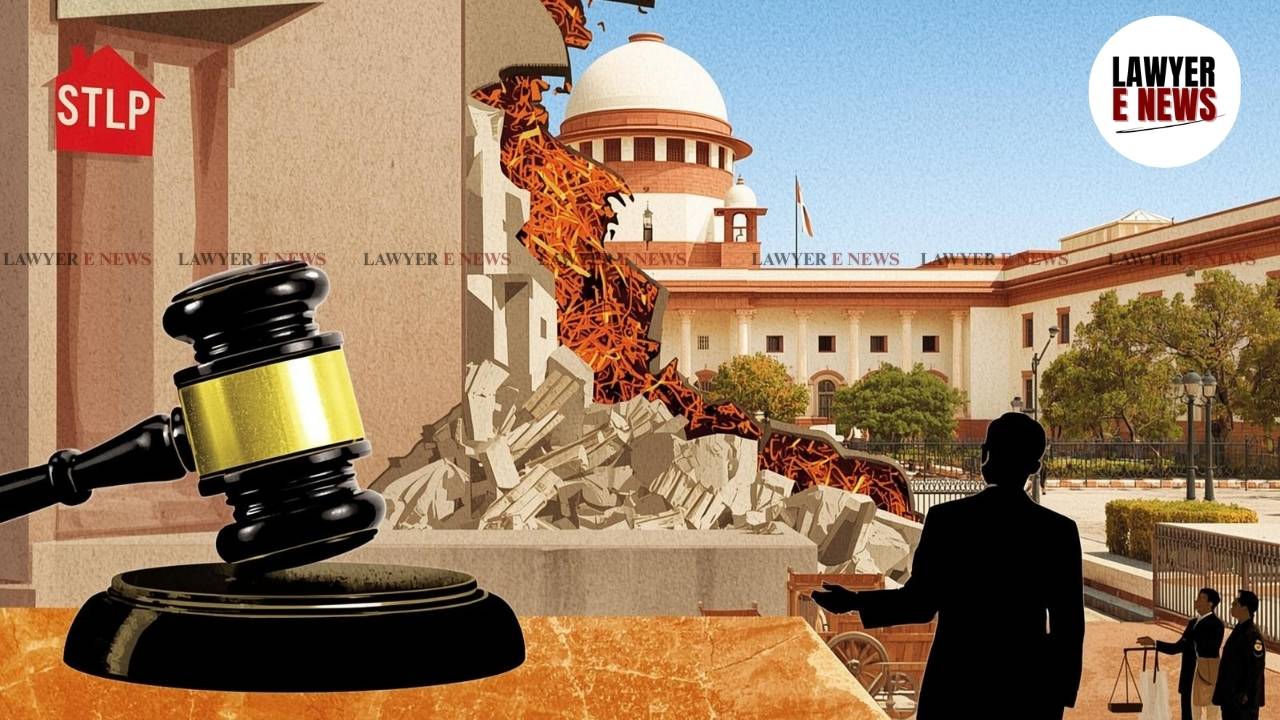
“No Parallel Tracks In Law—You Can’t Litigate the Same Relief in Suit and Writ Simultaneously”, In a strongly worded judgment Supreme Court of India held that a writ petition filed to obtain demolition orders over disputed property, while a civil suit concerning the same dispute was pending, amounted to “abuse of process of law” and violated the principles of natural justice, as the affected party was never even heard.
A Bench comprising Justice B.V. Nagarathna and Justice Ujjal Bhuyan allowed the appeal, quashing both the High Court’s original writ order as well as the subsequent dismissal of a review petition filed by the aggrieved party.
“Relief Cannot Be Sought Before Two Forums Simultaneously”: Court Finds Writ Petition to Be Not Maintainable
At the heart of the dispute was a civil suit (O.S. No.7/2022) filed by Respondent No.1, seeking a mandatory injunction to demolish alleged unauthorised construction by the appellant, along with partition, declaration of certain deeds as void, and possession of suit property.
Despite this pending suit, Respondent No.1 approached the High Court in a writ petition seeking almost identical relief—a writ of mandamus directing demolition of the same construction—without serving any notice to the appellant (Respondent No.6 in the writ). The High Court allowed the writ on March 29, 2023, and later dismissed a review petition filed by the appellant without addressing the fundamental issue of maintainability or the lack of notice.
Slamming this dual pursuit, the Supreme Court observed:
“The first respondent could not have a shortcut in the adjudication of his case by seeking prayer (d) in the suit in the form of a prayer for Writ of Mandamus in the writ petition.”
It was further held that:
“The filing of the writ petition was an abuse of the process of law. Hence, the writ petition is dismissed and consequently, the impugned orders are also set aside.” [Para 10]
“A Decision Without Hearing Is No Decision At All”: Court Holds That Natural Justice Was Violated
The appellant was not issued notice, nor was she heard before the High Court passed adverse demolition directions. This, the Supreme Court unequivocally held, was a gross violation of the principles of natural justice:
“The impugned orders passed by the High Court are in violation of the principles of natural justice inasmuch as the appellant was not heard in the matter.” [Para 7]
The Court rejected the defence offered by counsel for Respondent No.1 that the “prayers were distinct,” clarifying that identical property and overlapping reliefs cannot be pursued separately under the cloak of procedural semantics.
“Article 226 Is Not A Bypass Lane for Civil Suits”: Court Enforces Bar on Duplicative Proceedings Under Order 2 Rule 2 CPC
By invoking Order 2 Rule 2 of the Civil Procedure Code, the judgment reinforced that once relief has been claimed in a suit, it cannot be pursued simultaneously through a separate writ petition.
The writ petitioner’s act of seeking demolition through Article 226, while having already claimed it through prayer (d) in the pending civil suit, was rejected as impermissible:
“The prayers concern the very same property, prayer (d) in the suit and in the writ petition are common.” [Para 9]
The Supreme Court emphasized that the same cause of action and identical relief must be litigated in one forum, not through parallel proceedings, even if one route appears faster or more favourable.
Demolition Order Quashed – Appellant Free to Use Premises Pending Final Suit Decision
Having struck down the High Court’s orders, the Supreme Court also quashed all subsequent actions taken based on those orders, including any demolition or obstruction faced by the appellant. Importantly, it restored the appellant’s right to utilise the premises, albeit subject to the outcome of the pending civil suit:
“All subsequent actions taken by the respondent authorities pursuant to the orders of the High Court stand quashed.” [Para 13]
“The appellant is at liberty to utilise the suit premises subject to the result of the suit.” [Para 14]
While strongly censuring the writ petitioner’s misuse of process, the Court showed judicial restraint by not imposing costs, leaving the matter to proceed before the civil court on its own merits.
This ruling stands as a firm reminder that Article 226 of the Constitution is not a tool to circumvent civil suits, nor can litigants adopt dual tracks to seek the same relief. The Supreme Court reinforced the principle that natural justice demands notice and hearing, particularly before affecting someone’s rights over property.
By declaring the writ petition an “abuse of process” and restoring the proper procedural course through the civil suit, the Court ensured that speed cannot override fairness, and that civil remedies cannot be undermined by writ tactics.
Date of Decision: 20 January 2026