-
by sayum
28 August 2026 2:11 PM







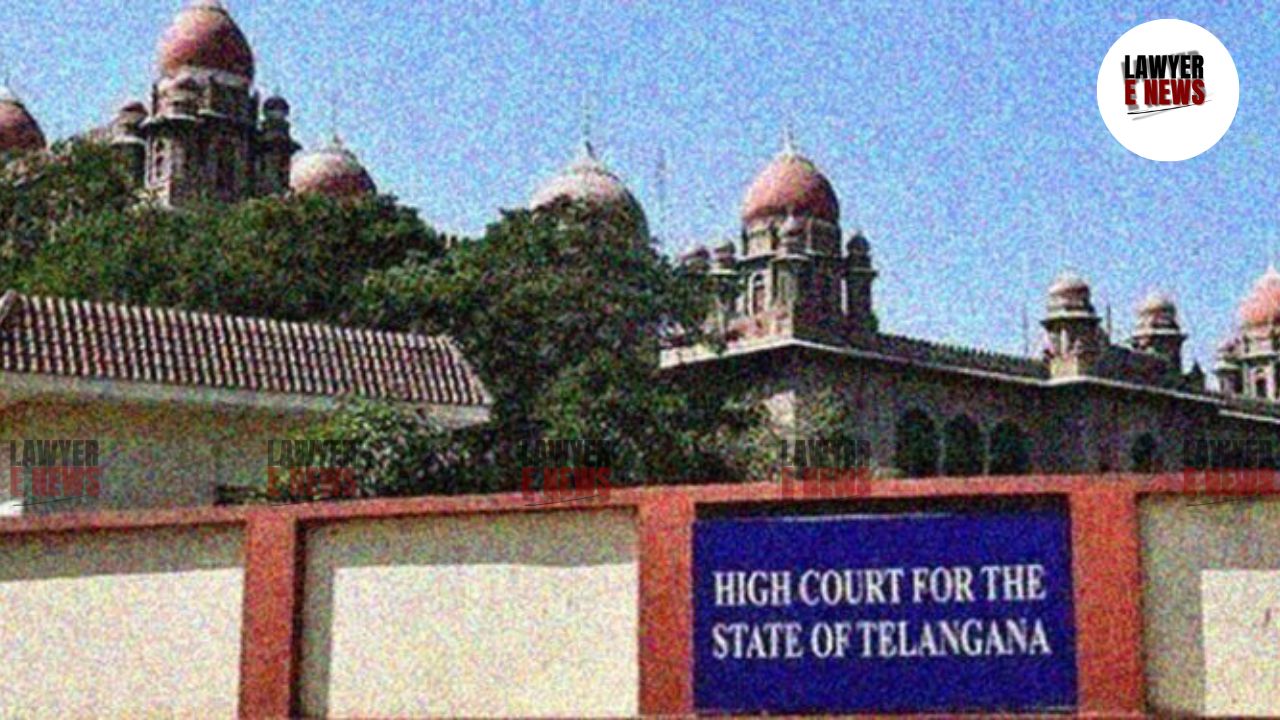
"A witness cannot therefore be confronted in cross-examination (without previous production as per law) a document executed by someone else, " Telangana High Court, in a significant ruling, held that a witness cannot be confronted during cross-examination with a document executed by a third party that was not previously produced before the court.
A bench of Justice Narsing Rao Nandikonda observed that the confrontation of documents is strictly limited to contradicting a witness's previous statements or refreshing their memory, and cannot be used as a "backdoor" entry for documents not on record.
The matter arose from a partition suit where the Fourth Defendant sought to confront the Plaintiff (PW-1) with a Release Deed and a Relinquishment Deed purportedly executed by their deceased father. The Second Defendant challenged the trial court's order permitting this confrontation, alleging that the Plaintiff and the Fourth Defendant were "sailing together" to the detriment of other parties. The High Court was called upon to exercise its power of superintendence under Article 227 of the Constitution of India to rectify this procedural error.
The primary question before the court was whether a document can be confronted to a witness without prior filing before the court as per the rules of procedure. The court was also called upon to determine whether a witness who is not a party to a private document can be confronted with said document during cross-examination for the purpose of admitting it into evidence.
Dual Purpose Of Confronting Documents Under Evidence Act
The High Court observed that according to the Indian Evidence Act, the confrontation of a document to a witness during cross-examination serves only two specific purposes. The first is to contradict the witness regarding a statement they have already made, as contemplated under Section 145 of the Evidence Act. The second purpose is to refresh the witness's memory regarding facts as provided under Sections 159 and 160 of the Act.
Court Explains Limitations On Confrontation
The bench emphasized that the question of confrontation does not arise unless the witness is a party to the document in question. The court noted that a witness cannot be confronted with a document executed by someone else without prior production of that document as required by law. In this case, since PW-1 was not a party to the Release and Relinquishment deeds, the trial court's permission to confront the witness was deemed contrary to settled legal principles.
"A witness cannot therefore be confronted in cross-examination (without previous production as per law) a document executed by someone else."
Confrontation Between Friendly Parties Is Impermissible
The Court highlighted a critical factual aspect where the Plaintiff and the Fourth Defendant were found to be "sailing together." It held that the right to cross-examine a party arises only when there are adversary interests and disputed pleadings. Since the Fourth Defendant and the Plaintiff shared the same stance, the attempt to confront the witness was seen as a collusive effort to bring the document on record without following due process.
Documents Not On Record Cannot Be Put To Surprise
Justice Nandikonda observed that any document intended to be confronted to a party-witness should already be on record to facilitate the other side to rebut the document or submit necessary pleadings. A party to a suit cannot be put to surprise by the sudden confrontation of a private document that was never formally produced or mentioned in the initial pleadings like the plaint or written statement.
"Confronting of a document which is not on record to a witness who is a party to the suit is impermissible."
Distinction Between Admissibility And Proof
The bench further clarified the procedural requirements under the CPC and the Evidence Act regarding the marking of exhibits. It noted that mere admission of a document by a witness during confrontation does not amount to proving the document. The Court held that the procedure for the admissibility of documents is specifically provided under the CPC and must be strictly followed rather than bypassed through cross-examination tactics.
High Court Sets Aside Trial Court’s Docket Order
The High Court concluded that the trial court had committed a jurisdictional error by allowing the documents to be confronted and marked as exhibits. It noted that the proper course for the Fourth Defendant would have been to file an appropriate application to receive the documents and then prove them by examining themselves as a witness. Consequently, the High Court set aside the trial court's orders and directed that the documents be de-exhibited.
The court allowed the Civil Revision Petition, emphasizing that procedural laws are intended to ensure fairness and prevent parties from circumventing the rules of evidence. While setting aside the order, the Court granted liberty to the parties to take appropriate legal steps to admit the documents into evidence in accordance with the prescribed procedure under law.
Date of Decision: 09 June 2026