-
by sayum
26 August 2026 10:38 AM







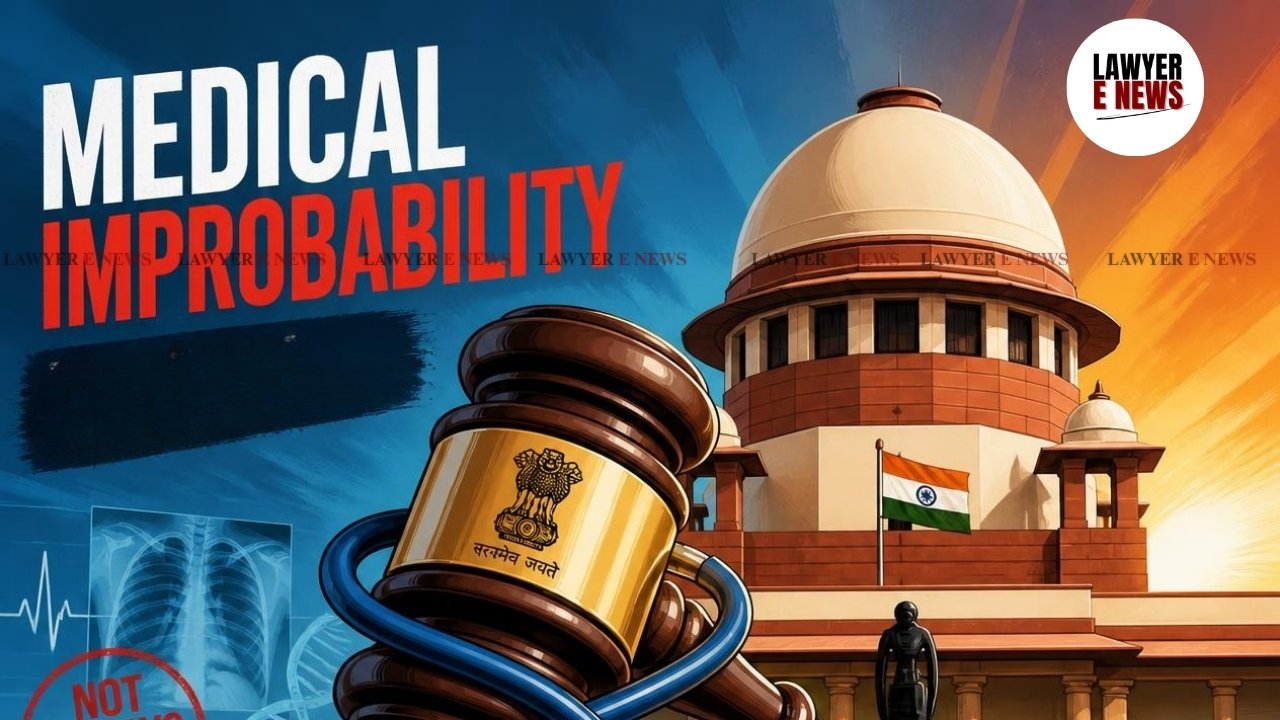
"If a person is beaten continuously for 2 to 3 minutes by 4 persons by 4 iron pipes and the blows falls on the same place then the head may be crushed, depending upon the force of the blows." Supreme Court, in a significant ruling dated August 3, 2026, held that where ocular testimony regarding a brutal assault by multiple armed assailants stands in stark contradiction to the single-injury post-mortem report, courts cannot rely on stereotyped witness accounts to sustain a mass conviction.
A bench of Justices Sanjay Karol and Augustine George Masih observed that an irreconcilable mismatch between eyewitness claims and medical evidence creates a reasonable doubt sufficient to uphold an acquittal under Section 302 read with Section 149 of the Indian Penal Code, 1860.
The case arose from a violent clash on the day of the Holi festival in March 2014 at Washim district, Maharashtra, following a minor dispute over playing a DJ. The informant alleged that twenty-three persons dragged four victims from their house and subjected them to a brutal assault with iron pipes and wooden planks, resulting in the instantaneous death of one Avinash and severe injuries to three others. The trial court convicted twenty accused persons and sentenced them to life imprisonment. However, the Nagpur Bench of the Bombay High Court reversed the conviction and acquitted all accused, prompting appeals by both the mother of the deceased and the State of Maharashtra.
The primary questions before the court were whether the High Court erred in overturning the trial court conviction based on discrepancies between ocular and medical evidence, and whether identical and stereotyped testimonies of related witnesses could form the foundation for the constructive liability of a large assembly under Section 149 IPC.
Court Rejects Stereotyped And Tutored Ocular Testimony
The bench closely examined the depositions of six prosecution witnesses, including three injured individuals and three eyewitnesses, noting that their accounts were identical down to the name of each of the twenty-three assailants, the specific weapon carried, and the exact part of the body assaulted.
"Identical And Stereotyped Version Bears Imprint Of Tutoring"
The court observed that in a sudden and violent occurrence involving a large crowd, individual perceptions naturally differ, and a complete correspondence in minutiae points towards tutoring rather than truthful recollection. The bench relied on precedents including Lakshmi Singh v. State of Bihar and Himmat Sukhadeo Wahurwagh v. State of Maharashtra to hold that while an injured witness is generally reliable regarding the assault on themselves, their testimony cannot be treated as an infallible inventory of the precise roles played by dozens of accused persons.
"Fatal Medical Mismatch Destroys Prosecution Story"
Addressing the core medical jurisprudence issue, the court highlighted that four eyewitnesses deposed that four separate assailants continuously beat the deceased on the head with iron pipes. However, the post-mortem report authored by Dr. Gote (PW-21) revealed only a single laceration and a single fracture of the frontal bone. The medical expert admitted during cross-examination that such continuous blows by four persons would either result in multiple head injuries or, if focused on a single spot, crush the skull entirely, which was not the case here.
"Single Point Of Impact Cannot Be Reconciled With Four Separate Assailants"
The Supreme Court endorsed the High Court's finding that it was physically impossible for multiple armed attackers to repeatedly strike the head without leaving corresponding multiple injuries. The bench cited its recent ruling in Sanjay Kumar v. State of Bihar, reiterating that where detailed attribution of separate acts is not supported by medical evidence, courts must be slow to overturn an acquittal.
"Unexplained Injuries On Accused Point To Suppressed Genesis"
The court further noted that the defence had successfully brought on record that several accused persons also sustained injuries during the incident, which were medically treated but ignored or suppressed by the investigating agency. Relying on Parshuram v. State of Madhya Pradesh and Lakshmi Singh, the bench reiterated that the non-explanation of injuries sustained by the accused creates a strong doubt as to whether the prosecution has brought forth the real genesis of the crime.
"Appellate Acquittal Cannot Be Interfered With Under Article 136 Without Perversity"
The bench emphasized that the threshold for interfering with an order of acquittal under Article 136 of the Constitution of India is exceptionally high and requires a showing of patent perversity or gross miscarriage of justice. Finding that the High Court's view was a reasonable and plausible interpretation of the evidence on record, the Supreme Court declined to disturb the acquittal.
The Supreme Court accordingly dismissed the appeals filed by the informant and the State of Maharashtra, affirming the acquittal of all accused persons by the Bombay High Court.
Date of Decision: 03 August 2026