-
by sayum
28 August 2026 10:07 AM







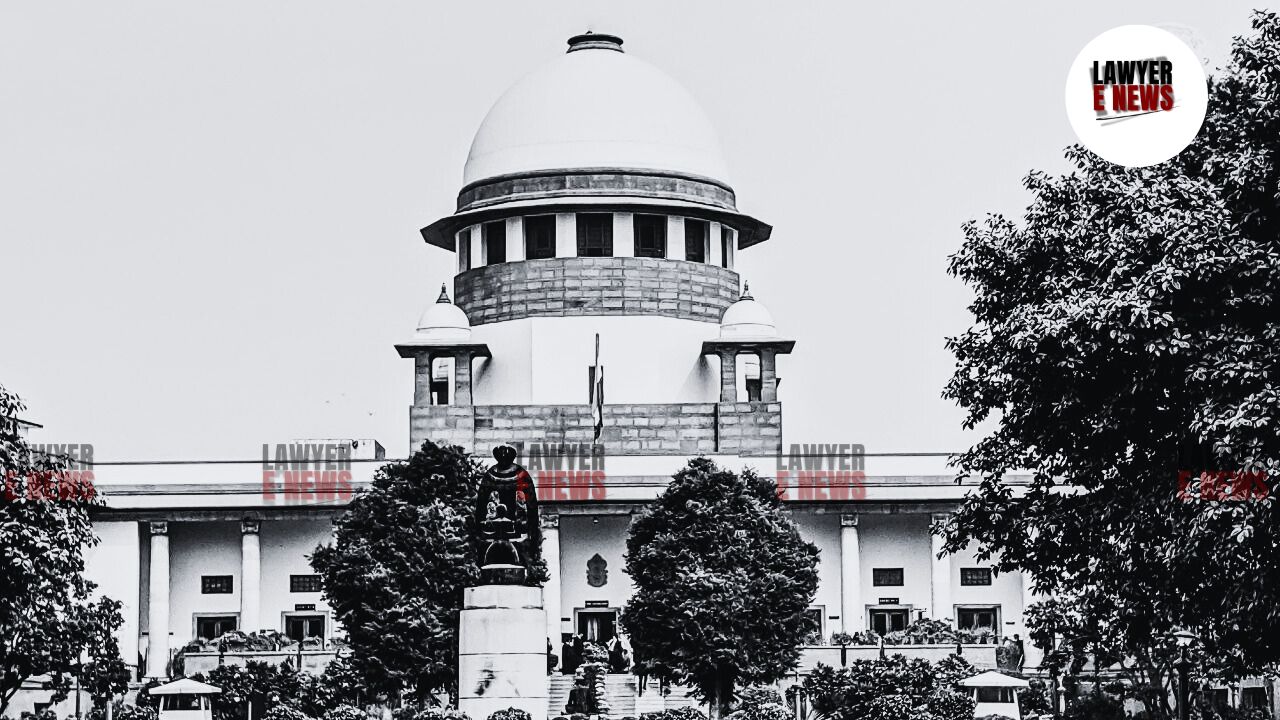
“Rule 21 governs preparation of merit list and not eligibility. Rule 4, which defines eligibility, does not exclude vocational marks — Department and High Court misapplied the law” — Supreme Court - In a strongly worded judgment enforcing the principles of natural justice and correcting misapplication of recruitment rules, the Supreme Court on October 9, 2025, in the case of Ravi Oraon & Ors. v. State of Jharkhand & Ors., quashed the termination orders issued against three Scheduled Tribe primary school teachers whose services had been terminated for allegedly not meeting the eligibility criteria of securing 40% in the Intermediate (Class XII) examination. The Court held that vocational subject marks must be counted toward the aggregate, and found the entire termination process vitiated by procedural unfairness and legal error.
A Bench comprising Justice Dipankar Datta and Justice K.V. Viswanathan delivered the judgment in three connected civil appeals (C.A. Nos. 11748–11750 of 2025), arising out of divergent rulings by the Jharkhand High Court, where a Division Bench had reversed the Single Judge’s decision that favoured the appellants — Ravi Oraon, Premlal Hembrom, and Surendra Munda.
“Vocational Marks Improve Result and Determine Division – There Is No Justification to Exclude Them From Eligibility Calculation” – Supreme Court
The primary legal issue was whether marks obtained in vocational subjects can be included for determining the minimum 40% eligibility requirement for candidates belonging to Scheduled Tribes as per Rule 4 of the Jharkhand Primary School Teacher Appointment Rules, 2012. The Department had excluded those marks, calculating the appellants' percentages at just under 40%, and terminated their services on that basis.
However, the Court held that the relevant guidelines printed on the reverse of the Intermediate marksheet clearly permit the addition of vocational marks over and above the pass marks, stating:
“The marks obtained by a candidate in vocational subjects over and above pass (theory and practical taken together) will be added in aggregate to improve his/her result and determine division.”
Rejecting the Department’s contention that Rule 21 of the 2012 Rules barred inclusion of such marks, the Court clarified:
“Rule 21 governs the preparation of the merit list post-Teacher Eligibility Test (TET), not the determination of eligibility. Rule 4, which applies to TET eligibility, does not exclude vocational marks. The respondents clearly misapplied Rule 21 to eligibility determination — an error repeated by the High Court’s Division Bench.”
“Findings Returned Were at Variance With the Charges — Termination Orders Stand Vitiated” – Breach of Natural Justice Held Fatal
The Court further ruled that the termination orders violated the principles of natural justice. The original show-cause notices accused the appellants of not securing 45% marks and of submitting invalid graduation certificates. In response, the appellants (being ST candidates) correctly pointed out that they needed only 40% and had secured more than that if vocational marks were included. However, the Department proceeded to terminate them based on a new calculation method that was never mentioned in the show cause notice — excluding vocational subject marks.
Criticising this approach, the Court observed:
“The allegation that the appellants had failed to secure 40% marks after exclusion of marks in the vocational subject did not even figure as an allegation in the show cause notices… The respondents were precluded in law from proceeding with such notices.”
“This is akin to a situation where the noticee successfully defends the charge but is punished for a different charge in respect of which he was never put to notice.”
Accordingly, the Court found that the termination orders were passed in violation of audi alteram partem — the core principle of procedural fairness.
“Calculation Method in Marksheet Must Prevail in Absence of Statutory Bar” – Supreme Court Upholds Teachers’ Eligibility
After analysing the marks secured by one of the appellants, Prem Lal, the Court demonstrated that:
Without vocational marks, he secured 39.77%
With just 4 bonus marks from the vocational subject (secured above the pass marks), his score improved to 40.22%, satisfying the eligibility threshold
The Court ruled:
“In the absence of a bar or an alternate method provided by any law, the method provided on the marksheet has to be followed.”
“The respondents failed to discharge the burden of showing why the method of calculation as per the marksheet ought not to apply.”
This logic applied to all three appellants, who were found to be eligible for appointment, rendering the termination orders illegal.
Reinstatement, Full Arrears, and Limited Relief for Deceased Appellant
In the relief segment of the judgment, the Court noted that Ravi Oraon and Premlal Hembrom had been reappointed in 2025, but deemed their original termination illegal, restoring their continuity of service from December 2015 and granting full arrears of pay and seniority benefits. However, their period of forced unemployment was excluded from experience-based promotion considerations, due to lack of hands-on teaching during that time.
As for Surendra Munda, who had passed away in August 2024, the Court quashed his termination posthumously and granted arrears of pay to his legal heirs, along with eligibility to apply for compassionate appointment under any prevailing scheme.
“State Acted Arbitrarily and Without Justifiable Reason” – Strong Disapproval of Government Conduct
The Court did not mince words in condemning the conduct of the authorities. It held:
“The respondents had acted in a rather high-handed, arbitrary and illegal manner in terminating the services of the appellants without justifiable reason and without following due process.”
“Complying with natural justice principles would not have been an idle formality or a forgone conclusion. The appellants were denied a fair and reasonable opportunity to be heard.”
This strong denunciation reinforces the obligation of government employers to act lawfully and fairly, especially when dealing with members of Scheduled Tribes, who are entitled to protective measures under the law.
Supreme Court Restores Legality and Fairness in Recruitment
With this landmark ruling, the Supreme Court has not only clarified the interpretation of the Jharkhand Primary School Teacher Appointment Rules, 2012, but also reiterated that natural justice is not a procedural luxury but a constitutional necessity. The decision protects tribal candidates from arbitrary exclusion and sets a clear precedent for future employment disputes involving eligibility and procedural rights.
Date of Decision: 9 October 2025