-
by sayum
28 August 2026 2:11 PM







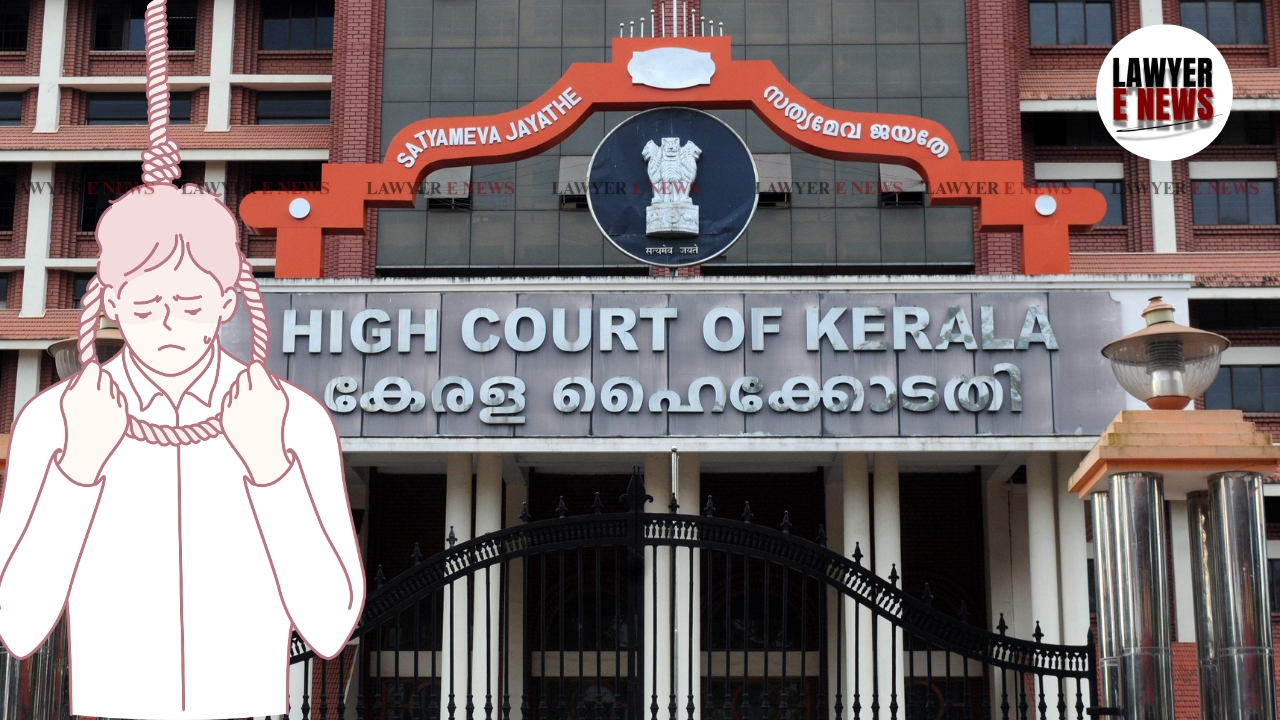
“Not What the Deceased Felt, But What the Accused Intended – Mental Harassment Must Be Proximate to Suicide”: In a significant ruling involving allegations of abetment to suicide linked to religious conversion pressure, the Kerala High Court on 17 September 2025, granted bail to three accused in a case where a woman died by suicide, allegedly after being harassed for refusing to convert before marriage. The Court observed that “even repeated harassment must have a proximate connection to the suicide” and held that “a suicide note alone is not sufficient to constitute abetment under Section 108 of the Bharatiya Nyaya Sanhita (BNS)”, unless the accused’s intention to drive the deceased to suicide is clearly evident.
The case involved petitioners who were arrested on 18 August 2025. The prosecution had added offences under Section 194 of the BNSS and various provisions of the Bharatiya Nyaya Sanhita, including Sections 108, 69, 49, 56, 127(2), 115(2) read with Section 3(5).
“Suicide Note Must Show That Accused Intended Suicide – Not Just That Deceased Was Upset”: Court Finds Detention Unjustified in Absence of Culpable Mental State
Justice Bechu Kurian Thomas, ruling on Bail Application Nos. 10733 & 10741 of 2025, referred to three key judicial precedents, particularly the Supreme Court’s decision in Abhinav Mohan Delkar v. State of Maharashtra, (2025), where it was held:
“Even if there are allegations of continuous and constant harassment, there must be a proximate prior act to clearly find that the suicide was the direct consequence of such continuous harassment.”
The Court also relied on its previous decision in Dr. Radhika Kapahtia v. State of Kerala, 2024 (2) KLT 635, observing:
“It is not what the deceased felt, but what the accused intended that should be the basis for implicating a person as an accused in the crime.”
In the case at hand, the deceased, Ms. Sona Eldhose, had left a suicide note dated 09.08.2025, which made references to harassment and religious conversion pressure. However, the Court found that the note did not establish a clear link between the accused's conduct and the act of suicide.
“Harassment, Even if Proven, Must Be the Immediate Trigger for Suicide – Otherwise No Offence of Abetment”: Kerala High Court Reaffirms Legal Threshold
While acknowledging the seriousness of the allegations, the Court made a sharp distinction between moral culpability and legal abetment, stating:
“Though there are references to repeated harassment of the deceased by the petitioners, taking note of the period of custody already undergone by them from 18.08.2025, I am of the view that further detention is not necessary.”
This finding is consistent with the evolving jurisprudence under both Section 306 IPC (now succeeded by Section 108 BNS) and the broader shift under BNSS, requiring courts to determine the “proximate cause” and “mens rea” of the accused before invoking charges of abetment to suicide.
Bail Granted With Stringent Conditions – ₹50,000 Bond, No Travel Abroad Without Permission
The Court allowed the bail applications with the following conditions:
“Petitioners shall be released on bail on executing a bond for ₹50,000 with two solvent sureties, shall appear before the investigating officer as and when required, shall not influence witnesses or tamper with evidence, and shall not leave the country without permission of the jurisdictional court.”
The order also clarified that any violation or modification request shall be addressed by the jurisdictional court, ensuring continued judicial oversight even after bail.
Suicide Note Cannot Be Treated as Gospel Unless Accused’s Mens Rea Is Evident
This judgment reiterates the principle that criminal law cannot rely solely on subjective feelings of the deceased, especially in sensitive cases involving suicide. By reinforcing that legal abetment requires the accused’s culpable intent, the Court draws a clear line between social blame and legal liability.
Justice Thomas’s ruling ensures that liberty is preserved in the absence of strong, direct evidence, and that pre-trial detention is not misused, especially in emotionally charged cases.
Date of Decision: 17 September 2025