-
by sayum
24 August 2026 11:13 AM







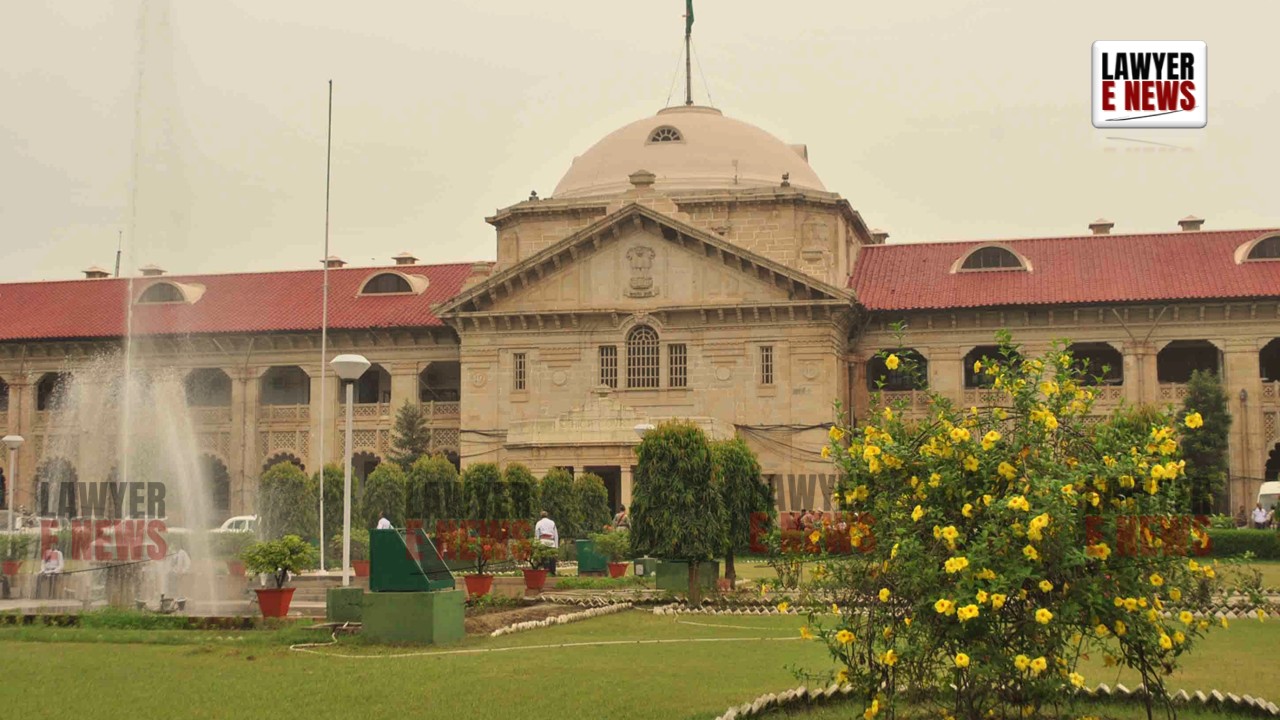
"Issuance of two 3D declarations for the same land, within a year of Section 3A, is not barred under the National Highways Act" – In a decisive judgment Allahabad High Court, comprising Justice Mahesh Chandra Tripathi and Justice Kunal Ravi Singh, dismissed a writ petition filed by landowner Veena Singh, challenging the acquisition of her land for the widening of National Highway 334D (Aligarh–Palwal Section).
The petition, filed under Article 226 of the Constitution, sought quashing of a second Section 3D(1) notification issued under the National Highways Act, 1956, on the grounds that it was illegal, arbitrary, and violative of natural justice. However, the Court firmly upheld the acquisition proceedings, holding that issuance of successive 3D notifications is legally permissible if they relate to the same Section 3A notification and fall within the one-year statutory timeline.
“There is no provision in the Act, 1956 which prohibits the issuance of successive declarations under Section 3D(1) following a single notification under Section 3A(1),” the Court held, reiterating that the National Highways Act is a self-contained, special legislation.
“Petitioner Cannot Take Advantage of Her Own Obstruction” – No Violation of Natural Justice Where Landowners Resist Survey
Veena Singh, the petitioner, had alleged that her hotel-cum-restaurant, constructed on Gata No. 27 in Village Kurana, Aligarh, was wrongfully acquired without giving her an opportunity to file objections. She also challenged the classification of her land as agricultural and questioned the validity of the award dated 15.02.2025, which, she claimed, ignored the commercial usage and structures built on the plot.
However, the High Court rejected these contentions, noting that no objection was filed by the petitioner within the statutory 21-day period under Section 3C, despite the notification being duly published in the Gazette and widely circulated newspapers.
“The petitioner cannot be permitted to take advantage of her own wrong. Having obstructed the survey process, she cannot now turn around and claim that the subsequent notification is illegal,” the Court observed.
The Court found that the second 3D notification dated 10.07.2024 was necessitated due to obstruction by landowners during the initial survey. Only a portion of the land could be covered in the first 3D notification dated 11.03.2024. After survey completion, the remaining portion of the same plot was acquired through a second 3D notification—both within one year of the 3A notification issued on 06.02.2024.
“Judicial Review Is Limited; Alignment and Acquisition Fall Within Expert Domain”
The Court emphasised that decisions regarding alignment, land requirement, and project feasibility lie within the domain of the National Highways Authority of India (NHAI), which operates under a statutory mandate.
Quoting the Supreme Court’s judgment in Kushala Shetty v. Union of India, the Bench noted:
“The Courts are not at all equipped to decide upon the viability and feasibility of a particular project and whether a particular alignment would subserve the larger public interest… The scope of judicial review is very limited.”
It rejected allegations of mala fides or selective targeting of the petitioner’s land. A mathematical analysis of the area proposed and actually acquired from Gata No. 27 showed a reduced acquisition (0.6627 hectares) compared to the original proposed area (0.8348 hectares).
“Land Has Already Vested in Central Government; Compensation Challenge Must Go to Arbitration”
A crucial legal consequence of Section 3D(2) is that land vests absolutely in the Central Government upon publication of the 3D declaration. Further, Section 3D(4) bars any court from entertaining challenges to such declaration.
“Once a declaration is published under Section 3D(1), the land vests absolutely in the Central Government free from all encumbrances,” held the Court, dismissing arguments raised under Article 14 and the U.P. Revenue Code.
Regarding compensation, the Court clarified that alleged procedural lapses under Section 3G(3)—such as failure to publish public notice inviting claims—would not invalidate the acquisition itself. Even assuming irregularities, the proper remedy lies in invoking arbitration under Section 3G(5).
“Procedural lapses in determination of compensation do not affect the validity of acquisition. Once vesting takes place, acquisition cannot be interdicted in writ jurisdiction,” the Court held.
It further noted that the petitioner’s grievances about classification of land, valuation of structures, and quantum of compensation could be raised before an arbitrator as per the statutory scheme under the National Highways Act.
“Individual Hardship Cannot Defeat Public Infrastructure Projects” – Larger Public Interest Must Prevail
The Court struck a firm balance between individual hardship and public interest, particularly in infrastructure projects of national importance.
“While individual hardship is acknowledged, it cannot be permitted to defeat or delay projects of national importance,” observed the Bench.
Drawing from the Supreme Court’s landmark decisions in Ramniklal N. Bhutta, Barangore Jute Factory, and Pratibha Nema, the Court reiterated that fair compensation is the appropriate remedy—not quashing of acquisition.
In this context, the Court noted:
“The construction of the petitioner’s hotel was undertaken while her application for conversion of land use was still pending. She took that risk knowingly and cannot now claim mala fide acquisition.”
The Court expressly preserved the petitioner’s right to pursue arbitration for enhanced compensation, clarifying:
“This Court has consciously refrained from expressing any opinion on the quantum or correctness of the award dated 15.02.2025. All such issues shall be decided independently in the arbitration proceedings.”
Acquisition Valid, Petitioner Free to Seek Compensation Enhancement
Summing up, the High Court concluded:
“The issuance of two Section 3D notifications was necessitated by practical difficulties arising from obstruction by landowners themselves. There has been no change in alignment and no mala fides have been established.”
“The land has vested in the Central Government. The petitioner is at liberty to seek enhancement of compensation by invoking arbitration under Section 3G(5). The present writ petition is misconceived and is accordingly dismissed.”
Date of Decision: 19 January 2026