-
by sayum
26 August 2026 8:00 AM







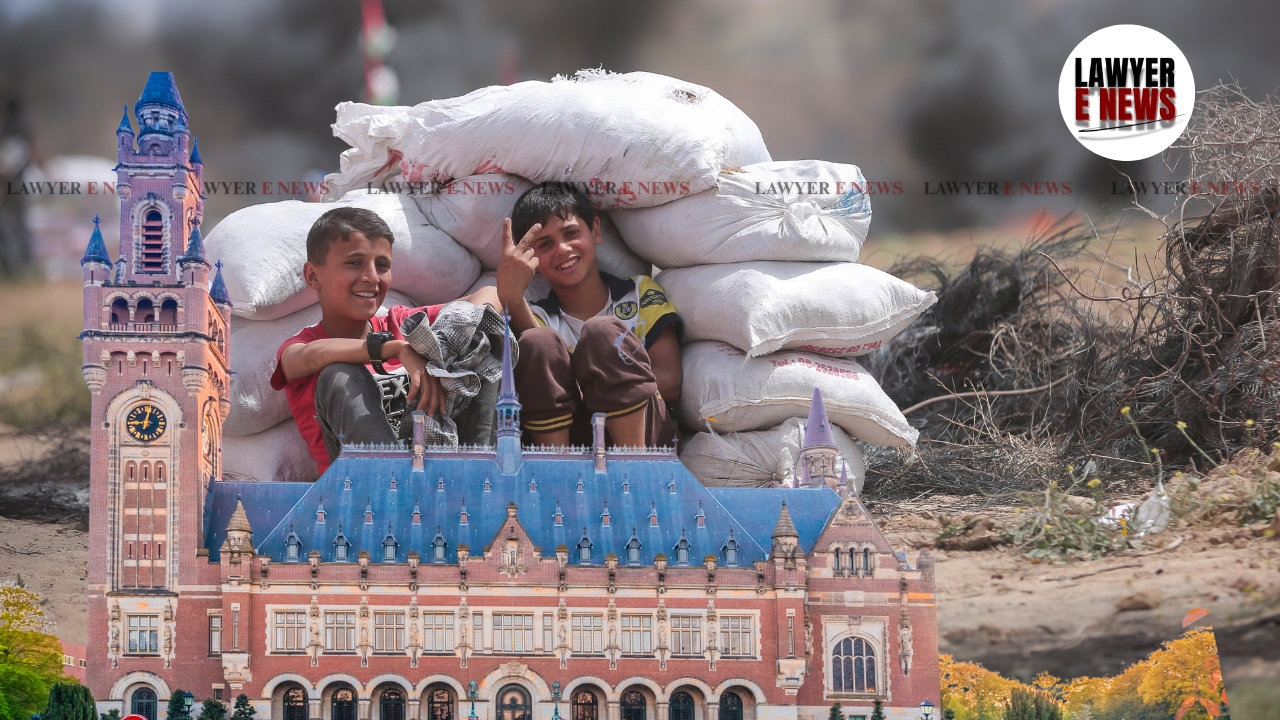
“Security concerns are not a free-standing exception permitting a State to depart from otherwise applicable rules of international humanitarian law” – International Court of Justice
International Court of Justice (ICJ) issued a landmark Advisory Opinion in response to a request from the United Nations General Assembly under Resolution 79/232, addressing the legal consequences arising from Israel’s actions and policies in the Occupied Palestinian Territory (OPT), including East Jerusalem and Gaza. The Court held that Israel, as an occupying power, had violated international humanitarian and human rights obligations, particularly in obstructing humanitarian access and attempting to dismantle the operations of UNRWA—the primary United Nations agency providing aid in Gaza.
The ICJ’s opinion, rooted in binding international legal norms and previous precedent, asserted that Israel’s invocation of national security does not permit the denial of essential aid, forced displacement, or interference with United Nations operations in occupied territory. The judgment significantly strengthens the legal framework protecting humanitarian relief and the rights of occupied populations in the face of state militarism.
This proceeding was triggered by the deteriorating humanitarian crisis in the Gaza Strip, following the 7 October 2023 Hamas-led attack on Israel, which led to a military response of unprecedented scale. Amid allegations of disproportionate force, starvation as a method of warfare, and systemic blockade of humanitarian aid, the United Nations General Assembly approached the ICJ for an authoritative legal clarification on Israel’s obligations under international humanitarian law (IHL), international human rights law (IHRL), the UN Charter, and the Convention on the Privileges and Immunities of the United Nations.
The Court was also asked to examine Israel’s continued attempts to discredit and dismantle UNRWA, including its bans on UNRWA staff, seizure of its offices, and alleged politicization of humanitarian aid delivery.
The Court examined whether Israel had breached its obligations under:
The question of whether Israel remained an occupying power in Gaza post-2005 was also addressed, and the Court reiterated that despite withdrawal of ground troops, Israel continued to exercise effective control over the territory, which intensified further after October 2023.
“The Occupation of Gaza Was Never Terminated—It Deepened After October 2023”
The Court reaffirmed its long-standing position that Israel continues to be an occupying power in Gaza, citing control over airspace, maritime access, borders, population registry, and critical infrastructure. It observed:
“The intensity of Israel’s control over the Gaza Strip has increased since October 2023, not diminished. Its responsibilities under the law of occupation have accordingly deepened.”
The Court rejected Israel’s argument that its disengagement in 2005 ended the occupation, declaring that occupation is defined by effective control, not mere troop presence.
“Israel Violated Article 59 by Blocking All Aid Between March and May 2025”
The ICJ ruled that Israel had unconditionally violated Article 59 of the Fourth Geneva Convention by blocking humanitarian aid to Gaza’s population between 2 March and 18 May 2025. The provision mandates the occupying power to agree to and facilitate relief schemes when the population is inadequately supplied.
“It is clear that during this period, no humanitarian aid was allowed to enter Gaza. This contravenes Israel’s legal obligation to ensure relief schemes reach civilians.”
The Court emphasized that even after partial aid resumed through the so-called Gaza Humanitarian Foundation, deliveries remained insufficient, mismanaged, and at times selectively restricted. The Foundation itself lacked independence and failed to coordinate with core humanitarian actors.
“UNRWA Is Irreplaceable—Its Capacity Cannot Be Replicated or Dismantled Arbitrarily”
Rejecting Israel’s allegations that UNRWA personnel had ties to Hamas, the Court underlined that the neutrality of a UN body cannot be unilaterally assessed by a party to the conflict. The ICJ stated:
“The qualification of a humanitarian organization as ‘impartial’ must be based on an objective assessment. It cannot depend only on the unilateral perception of the occupying power.”
The judgment also cautioned that no alternative entity possessed UNRWA’s infrastructure, logistics, or reach, and thus its forced removal without a legally sound and humanitarian transition plan would breach Israel’s obligations under IHL and the UN Charter.
“Deliberate Starvation Is Prohibited—Blockade of Food and Fuel Amounts to Illegal Warfare”
The Court applied customary international law and Article 54 of Additional Protocol I to hold that Israel’s actions amounted to a deliberate use of starvation as a method of warfare, which is absolutely prohibited.
“Evidence before the Court indicates that the blockade directly led to famine conditions across multiple regions in Gaza. Starvation cannot be used as a weapon.”
The Court found that humanitarian consequences were especially devastating for children, persons with disabilities, and pregnant women, all of whom suffered disproportionate harm due to the restrictions.
“Privileges and Immunities of the United Nations Cannot Be Suspended by Any Member State”
Referring to Article 105 of the UN Charter and the Convention on UN Privileges and Immunities, the ICJ held that Israel had violated international law by obstructing and attacking UNRWA operations, barring staff from entering Gaza, seizing offices in East Jerusalem, and refusing to cooperate with other UN agencies.
“The inviolability of United Nations premises and the immunity of its property must be respected even during armed conflict. These are not conditional.”
The Court clarified that UN operations in occupied territory cannot be terminated unilaterally by the occupying power, especially when their absence endangers the protected population.
“Self-Determination Is Undermined by Denial of Food, Movement, and Governance”
The ICJ found that Israel’s conduct, particularly the blockade, forced displacement, and crippling of UN institutions, amounted to a denial of the Palestinian right to self-determination, a core principle of international law.
“The deprivation of a people of its essential means of subsistence threatens the fundamental conditions that are indispensable for that people to exercise its right to self-determination.”
The Court concluded that the humanitarian collapse was not just a byproduct of war, but a systemic deprivation of sovereignty and autonomy through unlawful occupation practices.
The ICJ’s Advisory Opinion stands as one of the most forceful legal repudiations of humanitarian obstruction in contemporary international law. With emphatic clarity, the Court declared that Israel, as an occupying power, remains fully bound by international legal obligations, regardless of its security concerns or political assessments. The Opinion defends the independence of UN operations, the neutrality of humanitarian actors, and the inalienable rights of civilians under occupation.
Its significance will reverberate not only through the Israeli-Palestinian conflict but also across future theatres of occupation and international humanitarian intervention. As the Court put it, “Security concerns may not be manipulated into a permanent exception to binding humanitarian obligations.”
Date of Decision: 22 October 2025