
-
by sayum
28 August 2026 2:11 PM







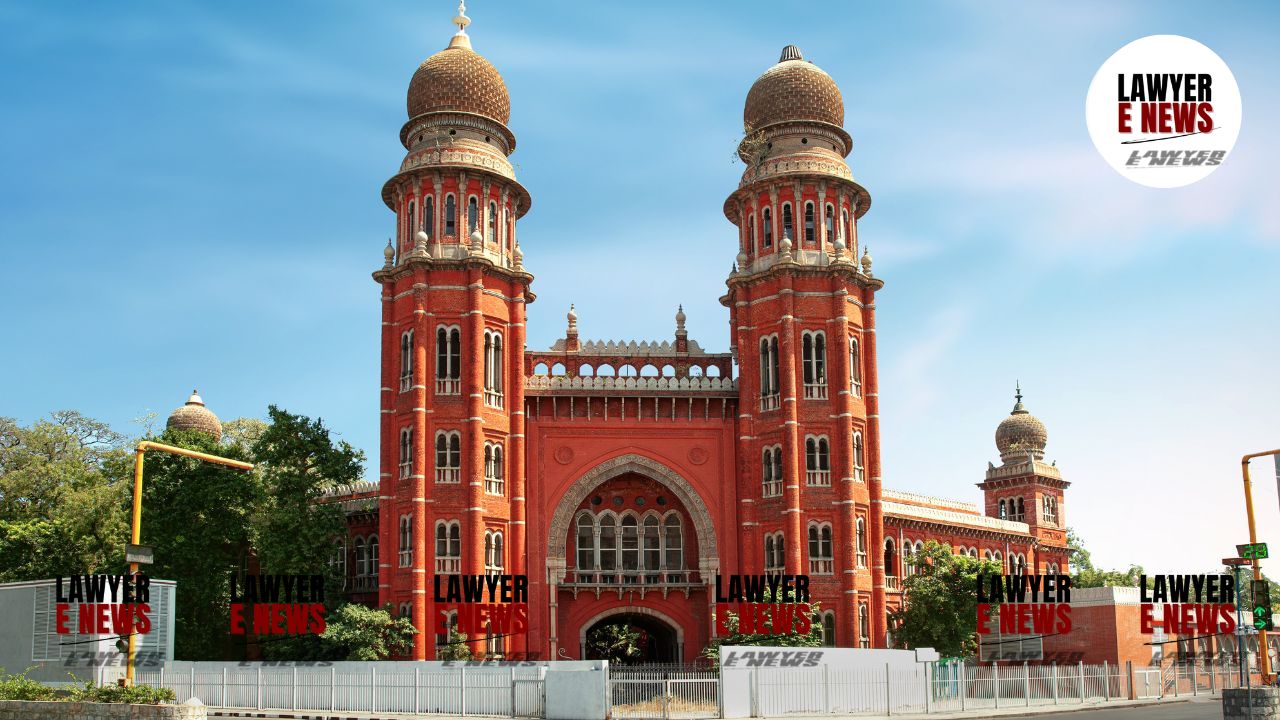
“When the main dispute pertains to a right created by an unregistered document, the document cannot be relied upon for any purpose, collateral or otherwise” – Madras High Court, in a significant judgment rendered by Justice N. Anand Venkatesh, set aside an arbitral award dated 25.02.2023 under Section 34(2A) and Section 34(2)(b)(ii) of the Arbitration and Conciliation Act, 1996, on grounds of patent illegality, perversity in appreciation of evidence, and misapplication of settled legal principles, particularly concerning unregistered documents and burden of proof in document execution.
The judgment marks an important precedent on the evidentiary limits within arbitral proceedings and the permissible use of unregistered documents under Section 49 of the Registration Act, 1908.
Arbitrator’s Misreading of sEvidence and Law Led to Perverse Findings
At the core of the dispute was an alleged cash loan of ₹13.5 lakhs supposedly given by the respondent to the petitioners through a loan agreement dated 05.04.2018 (Ex.C1), and a security letter dated 12.04.2018 (Ex.C2). The petitioners challenged both documents as forged, fabricated, and argued that the respondent, a vegetable vendor, lacked the financial capacity to lend such a significant amount. They further contested the reliance on Ex.C2, which was an unregistered document creating security, inadmissible under the Registration Act.
Despite these substantial objections, the arbitrator upheld the validity of the loan and security documents, leading to the award now struck down by the High Court.
“Execution Includes Knowledge of Contents” – Court Rejects Arbitrator’s Narrow Reading of SC Precedent
Justice Venkatesh held that the arbitrator misapplied the Supreme Court’s ruling in Rangnath Gopalrao Kawathekar v. Rao Saheb, (1974) 4 SCC 181, by selectively quoting only the portion that dealt with signature as proof of execution. However, as the Court clarified:
“The Hon’ble Apex Court, in no uncertain terms, held... if it is pleaded that a party, who signed the document, did not know the contents... it may in certain circumstances be necessary for the party seeking to prove the document to place materials before the Court to satisfy that the party... had the knowledge of its contents.”
The arbitrator failed to appreciate the full context of the precedent, leading to a perverse inference that signature alone was sufficient to conclude execution.
The Court reinforced this reading with Veena Singh v. District Registrar, 2022 (7) SCC 1, where the Supreme Court held:
“The ‘execution’ of a document does not stand admitted merely because a person admits to having signed the document.”
The High Court concluded that burden of proof to establish due execution, including knowledge of contents, rested on the respondent, and was not discharged.
"Arbitrator Ignored the Law on Unregistered Documents" – Court Rules Ex.C2 Was Inadmissible
A central legal misstep by the arbitrator was his reliance on Ex.C2, the security document, despite acknowledging it to be compulsorily registerable and unregistered. The arbitrator invoked the proviso to Section 49 of the Registration Act to admit it for “collateral purpose.”
Rejecting this view, the High Court held:
“In this case, the dispute is regarding the very loan... the sole Arbitrator relied upon [Ex.C2] to see if there was a loan transaction. In this case, that is the primary dispute and therefore, the Proviso to Section 49... will not come to the aid of the sole Arbitrator.”
The Court drew heavily from the Supreme Court’s latest ruling in Paul Rubber Industries Pvt. Ltd. v. Amit Chand Mitra, 2023 SCC OnLine SC 1216, which clarified that:
“If an unregistered document is relied upon to decide the main/primary dispute, the document becomes indivisible and cannot be relied upon.”
Thus, Ex.C2 was inadmissible for any purpose, and the arbitrator’s reliance on it vitiated the award.
"No Proof of Financial Capacity" – Arbitrator Accepted Implausible Explanation Without Scrutiny
Another core issue was the respondent’s lack of financial capacity. He claimed to have lent ₹13.5 lakhs in cash, but admitted in cross-examination that his annual income was only ₹4–5 lakhs. No income tax returns or records of assets were produced.
Instead of examining this critical deficiency, the arbitrator accepted the respondent’s vague claim that the money was “kept in his shop,” calling it a “plausible explanation.” The Court strongly disagreed:
“Even though the sole Arbitrator rendered a finding that the explanation given by CW1 is a plausible explanation, this Court holds that the explanation is not even a possible explanation.”
Such an acceptance of an implausible and unsubstantiated claim was held to be not just erroneous but perverse, especially in light of settled evidentiary principles.
“Award Is Not Even a Plausible View” – Court Applies Ssangyong Test for Patent Illegality
While the respondent argued that the challenge did not fall within any of the categories under Ssangyong Engg. & Construction Co. Ltd. v. NHAI, 2019 (15) SCC 131, the Court found otherwise.
“The award suffers from patent illegality since the findings of the sole Arbitrator are found to be perverse… The view taken by the sole Arbitrator is not even a plausible view.”
Citing the statutory grounds under Section 34(2A) (for domestic arbitration) and Section 34(2)(b)(ii), the Court confirmed its power to interfere where findings are perverse, based on no evidence, or violate settled law.
Arbitral Award Set Aside; Respondent to Pay ₹1 Lakh in Costs
The Court decisively set aside the arbitral award dated 25.02.2023 and directed the respondent to pay ₹1,00,000 as costs to the petitioners within four weeks.
“The above original petition stands allowed and the award... is hereby set aside with cost of ₹1,00,000/- (Rupees one lakh only)...”
This ruling is a noteworthy reaffirmation of the limited yet robust scope of judicial interference under Section 34, particularly in cases where arbitrators commit gross errors of law or perversity in appreciation of facts and evidence.
Date of Decision: 17th September 2025





