
-
by sayum
26 August 2026 1:49 PM







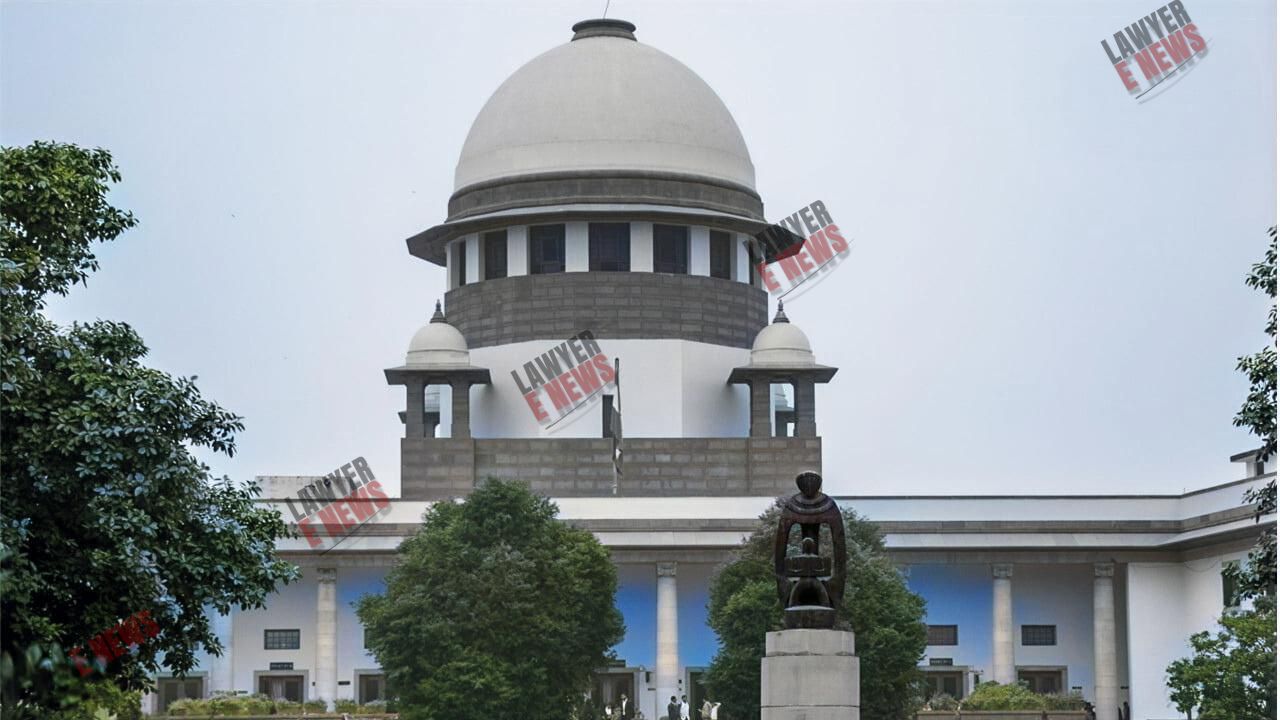
“Whether an accused knew his caste or not is a matter for trial — the High Court erred in assuming such facts and scuttling the prosecution at the threshold” - Supreme Court of India delivered a decisive ruling rejecting the Madhya Pradesh High Court’s 2016 decision that had quashed criminal proceedings against individuals accused of procuring a false Scheduled Caste certificate to contest elections. Terming the High Court’s interference under Section 482 of the Criminal Procedure Code, 1973 (CrPC), as “legally unsustainable” and “conjectural,” the Supreme Court restored the criminal complaint to trial and directed its completion within one year.
At the heart of the case was the allegation that Rajendra Singh, a General Category candidate, fraudulently procured a Scheduled Caste (Sansi) certificate using false documents, affidavits, and fabricated panchnamas, shortly before contesting from the Guna (SC Reserved) Assembly Constituency in 2008. The complaint, filed in 2014, named various individuals — including public officials — who allegedly conspired in the forgery. Despite the caste certificate being cancelled by a Scrutiny Committee and upheld through all appellate levels, the High Court chose to quash the criminal case altogether, relying heavily on the theory that the accused may have been “ignorant of law” or “mistaken” about their caste identity.
This judgment by a Bench of Justice B.V. Nagarathna and Justice K.V. Viswanathan not only reinstates the criminal trial but also clarifies the limits of the High Court’s jurisdiction under Section 482 CrPC, affirming that it cannot weigh evidence or accept defences at the pre-trial stage.
“High Court Has No Business Conducting a Dress Rehearsal of the Trial Under Section 482 CrPC”: Court Condemns Premature Evaluation of Evidence
The Supreme Court expressed strong disapproval of the High Court’s approach, observing that it had exceeded its jurisdiction under Section 482 CrPC. The High Court, rather than confining itself to the legal test of whether the complaint disclosed a prima facie offence, conducted what the apex court described as a “mini-trial”.
“Findings about legal illiteracy are conjectural and patently erroneous,” the Court declared, further stating, “at the stage of exercising powers under Section 482 to record that no evidence was produced is also untenable.”
The High Court had accepted the narrative that Rajendra Singh and his father might not have known they belonged to a Scheduled Caste and had mistakenly identified as Sikh in prior documents. This, the Supreme Court held, was an impermissible inference in a petition seeking quashing of a complaint — a stage at which the Court must accept the complaint at face value without evaluating the merits of defence.
Referring to the High Court’s observations, the Supreme Court stated: “The High Court virtually conducted a dress rehearsal of the trial. It undertook a factual examination and accepted speculative defences such as ‘legal illiteracy’, which are impermissible at this stage.” [Para 23]
“Forgery, Cheating, and Criminal Conspiracy Cannot Be Buried Under Speculative Explanations”: Prima Facie Case Clearly Made Out
Rejecting the argument that no criminal offence was made out, the Supreme Court held that the complaint, on its face, disclosed serious offences under Sections 420, 467, 468, 471, and 120B of the Indian Penal Code, 1860 (IPC).
The Bench noted that the complaint alleged a deliberate scheme by which Rajendra Singh and others forged documents and submitted false affidavits to falsely obtain a Scheduled Caste certificate. It was also alleged that public officers — including a Patwari, Councillor, Tehsildar, and Sub-Divisional Officer — actively aided the process by certifying facts without due enquiry.
“As would be clear from the averments... it could not be said that... no offence under Sections 420, 467, 468 and 471 IPC... are prima facie made out.” [Para 21]
On the conspiracy angle, the Court observed that the alleged acts — involving collusion between officials and private individuals — were sufficient at the cognizance stage to justify proceeding with the charge of criminal conspiracy under Section 120B IPC.
The Court further rejected the notion that the complaint lacked merit merely because the caste certificate was ultimately cancelled by administrative action.
“Even after administrative cancellation of false caste certificate, criminal liability for its fraudulent procurement remains... Quashing such complaints frustrates the object of the rule of law and constitutional reservation policy.” [Paras 20–22]
“Madhuri Patil Guidelines Mandate Prosecution Where False Caste Certificates Are Found”: Supreme Court Emphasises Rule of Law
Referring to the binding precedent in Kumari Madhuri Patil v. Addl. Commissioner, Tribal Development, (1994) 6 SCC 241, the Court reminded that prosecution is not optional in cases where false caste certificates are unearthed. The Madhuri Patil guidelines were formulated to ensure that constitutional safeguards meant for Scheduled Castes and Scheduled Tribes are not misused, and that fraudulent claimants are not allowed to benefit from affirmative action policies.
In the instant case, the caste certificate was found to have been issued on the basis of false affidavits and statements. The Scrutiny Committee, after an exhaustive inquiry, had cancelled the certificate and recommended departmental action against the officers involved. These findings, affirmed by the High Court and Supreme Court in earlier proceedings, made the continuation of criminal trial imperative.
“No One Is Prohibited From Claiming Benefit of Their Caste – But False Documents Cannot Be a Means to That End”: Court Cautions Against Misuse of Social Justice Framework
Rejecting the defence’s claim that the accused merely acted on belief or inherited misinformation, the Supreme Court categorically stated that ignorance of law cannot be a ground to prevent criminal prosecution in such matters. The caste-based reservation system is an integral part of constitutional equality, and deliberate misuse through forged documentation not only undermines that system but also erodes public trust.
The Court observed: “Whether the applicant Rajendra Singh was aware about his caste or not is a question of evidence. The High Court could not have assumed such facts to exonerate the accused at the threshold.” [Para 24]
Conclusion: Trial Must Proceed Uninfluenced by High Court’s “Erroneous and Conjectural” Findings
Allowing the appeals filed by the original complainant and social activists, the Supreme Court set aside the Madhya Pradesh High Court’s orders in Miscellaneous Criminal Cases Nos. 5897 and 6319 of 2014, and restored Criminal Complaint Case No. 1072 of 2014 to the Chief Judicial Magistrate, Guna. Cognizance, already taken by the Magistrate in 2014, was also revived.
The Bench ordered: “The trial shall proceed from the stage of cognizance and be concluded within one year. Needless to observe, the trial will be held uninfluenced by the findings of the High Court or this Court in the present proceeding.” [Para 28]
This judgment strengthens the legal position that criminal complaints disclosing serious offences such as forgery, cheating, and conspiracy must not be short-circuited by pre-trial evaluations cloaked under Section 482 CrPC. The Court has reinforced the principle that criminality arising from misuse of constitutional benefits must face the test of trial, and that courts must remain vigilant in upholding the sanctity of the reservation system.
Date of Decision: 14 October 2025





