-
by sayum
28 August 2026 10:07 AM







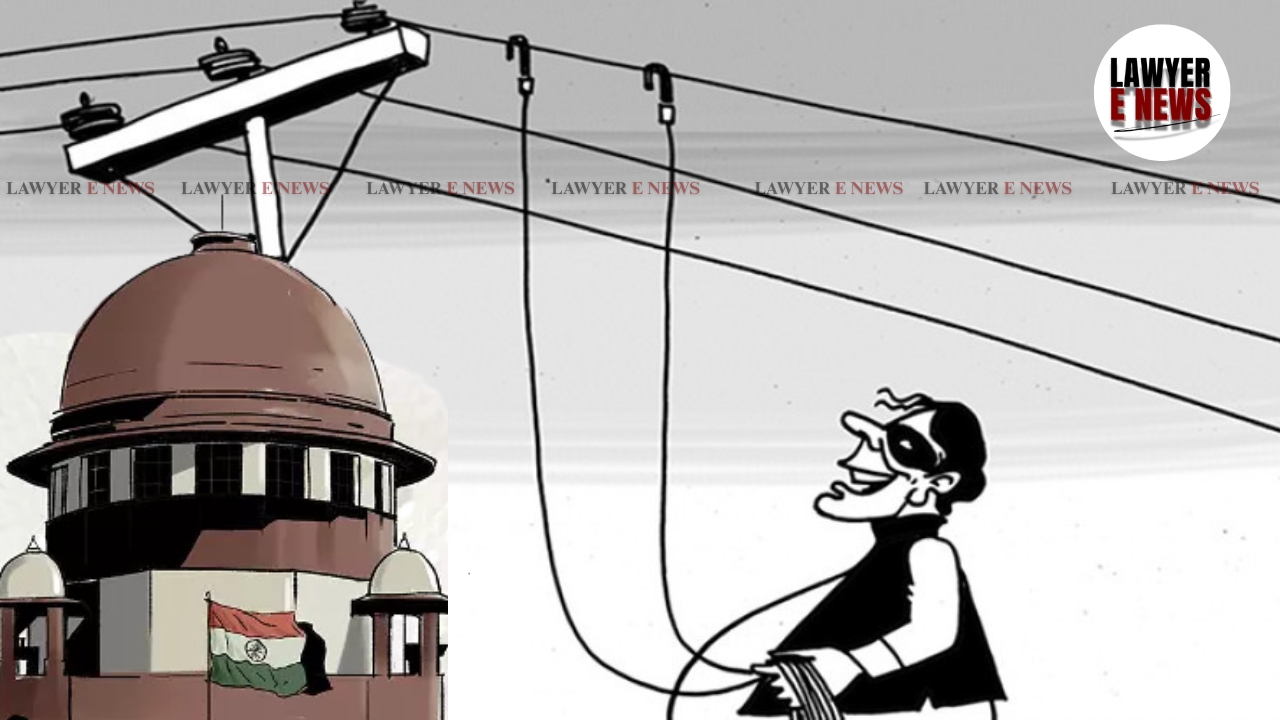
“Most testimonies are based on estimation, presumption, approximation or possibilities. Needless to state, the same cannot be deemed to be sufficient for the purposes of proving the theft.” - On October 8, 2025, the Supreme Court set aside the conviction of a company director under Sections 39 and 44 of the Indian Electricity Act, 1910, ruling that the presumption of theft under Section 39 cannot arise unless the prosecution proves the use of artificial or unauthorized means for energy abstraction. In doing so, the Court restored the trial court’s acquittal, which had been reversed by the Bombay High Court in 2010.
A bench of Justice Sanjay Karol and Justice Prashant Kumar Mishra held that the evidence presented by the prosecution lacked the concreteness necessary to establish theft of electricity beyond reasonable doubt, and did not justify invoking the statutory presumption under Section 39 of the Act.
"Presumption Under Section 39 Is Not Automatic – Proof of Artificial Means is a Precondition"
The Court reaffirmed the legal position that Section 39 of the Indian Electricity Act creates a legal fiction, deeming dishonest abstraction of electricity to be theft under the Indian Penal Code. However, the Bench emphasized:
“The presumption is not of automatic application... it must be established by the MSEB that an artificial means had been employed.”
This legal threshold, the Court ruled, had not been met. While the Maharashtra State Electricity Board (MSEB) officials claimed to have found three holes in the meter box, the Supreme Court found that none of the five prosecution witnesses could confidently establish the use of these holes for any dishonest purpose.
Even the complainant, PW-3, admitted under cross-examination that:
“All the conclusions reached by us in the alleged occurrence about theft of electricity in respect of meter box in question [are] entirely based upon inference only.”
“Inference, Estimation and Suspicion Do Not Replace Proof Beyond Reasonable Doubt” – Supreme Court Slams Evidence Quality
“The testimonies that make up this case appear to fall squarely into the categorization of ‘wholly unreliable’.”
Analyzing the prosecution evidence, the Court meticulously dissected the testimonies of all five witnesses:
PW-1, a panch witness, admitted he did not understand what was written in the inspection report he signed.
PW-2, a Deputy Engineer with MSEB, confessed that all his observations were “based on guesswork”.
PW-3, the complainant, conceded that no testing was conducted to verify if electricity was actually being stolen through the holes.
PW-4, who tested the meters, acknowledged that his findings were based on possibilities, not actual detection of misuse.
PW-5, a senior MSEB officer, admitted that the very presence of the holes was used to justify the allegation of theft.
The Court held that such speculative, inferential and inconsistent testimony could not support a conviction, especially when statutory presumptions require a threshold of proof.
“Tampering Must Be Proved, Not Assumed – Section 44 Offence Also Not Made Out”
The High Court had also convicted the appellant under Section 44(c) of the Indian Electricity Act, which punishes fraudulent tampering with meters and improper use of energy. However, the Supreme Court rejected this conviction as well.
“Nothing has been brought on record to show that the meter had been injured or tampered with.”
Importantly, no MSEB official carried out any test or demonstration to show that the holes were actually used to tamper with the meter or interfere with its readings. The Court observed that no one had seen the accused or company employees tampering with the equipment, and no documentation or physical evidence proved intentional interference.
The Court found that criminal liability could not be affixed based on “open possibilities”:
“There are too many open possibilities for criminal liability to be affixed to any person. Section 44 also has not been proved beyond a reasonable doubt.”
“High Court’s Reversal of Acquittal Without Strong Justification Was Erroneous”
The Bench also addressed the broader criminal law principle regarding the reversal of acquittal by appellate courts. Citing the decisions in Kalamani Tex v. P. Balasubramanian and Ghurey Lal v. State of U.P., the Court reiterated that a High Court must show compelling reasons to overturn an acquittal, such as:
Perversity in findings,
Grave miscarriage of justice, or
Patent errors of law.
In this case, the Trial Court had carefully analyzed the evidence and found it insufficient. The High Court, however, chose to reverse the acquittal on the basis of inferences drawn from circumstantial indicators, such as a reduction in power consumption after sealing the holes.
The Supreme Court termed this reasoning legally insufficient:
“The High Court erred in reversing acquittal without compelling grounds... The Trial Court had correctly evaluated the lack of concrete evidence.”
The Court clarified that under Article 136 of the Constitution, it does not reappreciate facts unless the decision under challenge is “manifestly erroneous or perverse”, but found that the High Court’s conviction did warrant intervention due to legal error and misapplication of evidentiary principles.
Conviction Set Aside, Acquittal Restored
Concluding that the prosecution failed to prove the use of artificial means, and that the statutory presumption of theft under Section 39 was wrongly applied, the Supreme Court allowed the appeal.
“Neither Sections 39 nor Section 44 could be established against the appellant-convict. As such, the appeals are allowed.”
The judgment of the Bombay High Court dated 15 October 2010, which had convicted Mahaveer and sentenced him to one year of rigorous imprisonment and a fine of ₹2 lakhs, was quashed.
The appellant Mahaveer was acquitted of all charges, and the bail bonds were discharged.
Date of Decision: 08 October 2025