-
by sayum
24 August 2026 11:13 AM







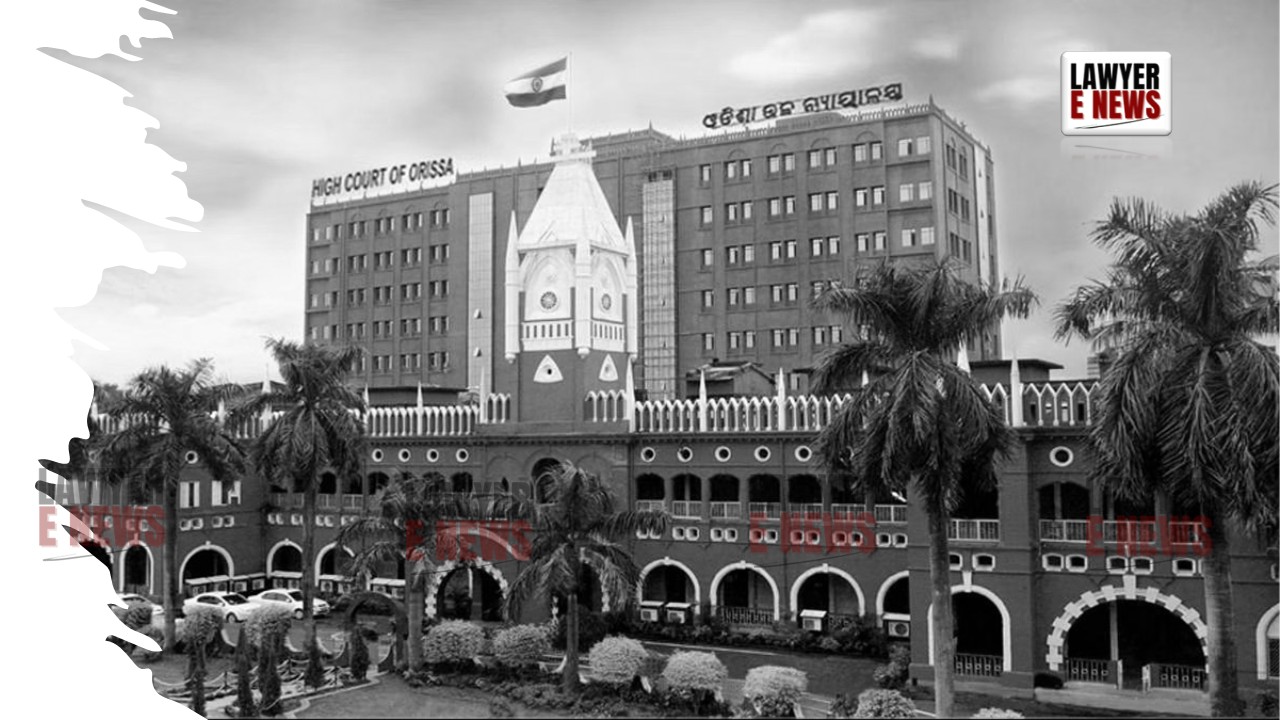
“Once a witness has been discharged, recall cannot be sought to make up for earlier omissions. The power must be used sparingly and with caution,” In a significant ruling reaffirming procedural discipline in civil trials, the Orissa High Court quashed two orders passed by the Civil Judge (Senior Division), 4th Additional Court, Cuttack, which had allowed a defendant to recall a witness for cross-examination after that witness had already been discharged and evidence stood closed.
Justice Sashikanta Mishra held that the trial court had committed a serious error in law by permitting Defendant No.1 to reopen evidence without demonstrating any bona fide cause or legal basis.
“The Court below has not made the effort to ascertain and satisfy itself that Defendant No.1 had valid and bona fide reasons for not cross-examining P.W.2 at the relevant time,” the High Court remarked, finding the impugned orders to be legally unsustainable.
“Discretion Cannot Be Used as a Tool to Undo a Party’s Own Negligence” – Court Slams Misuse of Judicial Powers in Recalling Witnesses
The dispute arose in a suit for recovery of possession filed by Bhimsen Ojha and another, where P.W.2 had been examined and cross-examined only by Defendant No.2. Despite being present, Defendant No.1 had consciously declined to cross-examine the witness, who was thereafter discharged. Subsequently, Defendant No.1 sought to recall the witness under the guise of “interest of justice,” not once, but twice—his first application being withdrawn and the second allowed by the trial court on 6th December 2023.
The High Court came down heavily on this approach and clarified the true legal standard. Citing the Supreme Court’s authoritative decision in K.K. Velusamy v. N. Palanisamy, (2011) 11 SCC 275, the Court reiterated:
“The power under Order XVIII Rule 17 is not intended to be used to fill up omissions in the evidence of a witness who has already been examined.”
Justice Mishra further observed, “The trial court treated this power as if it were a matter of right rather than a matter of exception. Such a view is a complete misapprehension of law.”
“Recall of Witness Must Be Justified by Adequate Reasons, Not Convenience” – High Court Cautions Against Routine Invocations of Inherent Powers
The trial court had attempted to justify its decision by stating that denying the defendant a chance to cross-examine might cause him prejudice and that interest of justice demanded leniency. The High Court dismantled this reasoning as legally flawed.
“Opportunity is to be given to the defendants to cross-examine. But here, Defendant No.1, being given the opportunity at the relevant time, chose not to avail it,” the Court pointed out.
The Bench stressed that mere fear of prejudice cannot substitute for diligence, and added, “A witness cannot be recalled only on the ground that it would not cause prejudice to the other party.”
On the invocation of Section 151 CPC, the Court clarified that inherent powers cannot override explicit procedural safeguards. “Section 151 cannot be a cloak for reopening what has been consciously closed,” it ruled.
“Judicial Orders Must Not Suffer from Casual Errors” – Court Criticises Trial Court’s Lack of Precision
Beyond the legal infirmities, the High Court expressed concern over the lack of care shown by the trial court in drafting the impugned order. The order described the plaintiff as the petitioner in a recall application filed by Defendant No.1, and even misidentified P.W.2 as P.W.1.
Highlighting the need for accuracy, the High Court stated: “It is the duty and responsibility of the Court to ensure that the orders passed by it are factually correct and free from errors before signing the same.”
Such errors, the Court observed, were not merely clerical but reflected a troubling absence of judicial application of mind.
“Recall of Witness Is the Exception, Not the Norm” – Court Exercises Supervisory Jurisdiction to Set Aside Improper Orders
Applying the principles laid down by the Supreme Court in Bagai Construction v. Gupta Building Material Store, (2013) 14 SCC 1, and Shubhkaran Singh v. Abhayraj Singh, 2025 LiveLaw (SC) 536, the High Court held that the power to recall a witness must be used “sparingly and in exceptional cases only.”
The impugned orders dated 06.12.2023 and 24.01.2024 were found to have been passed without any reference to law, without inquiry into the reason for non-examination, and without meeting the standard required under Order XVIII Rule 17 CPC.
Holding that the trial court’s approach amounted to “misuse of discretion”, the High Court allowed the petition and quashed both orders.
“Judicial System Cannot Endorse Re-litigation by Neglect” – Orissa High Court Reasserts Procedural Fairness
In conclusion, Justice Sashikanta Mishra reminded the judiciary and litigants alike that procedural safeguards are not mere technicalities, but essential to fairness.
“Fact remains that nothing can be done unless the same is provided by law,” the Court said in categorical terms, reiterating the limits of judicial discretion in civil trial procedure.
The Court also placed on record its appreciation for Mr. A.R. Dash, who appeared as Amicus Curiae, and acknowledged his valuable assistance in the absence of representation from the defendants.
Date of Decision: 16 January 2026