-
by sayum
28 August 2026 2:11 PM







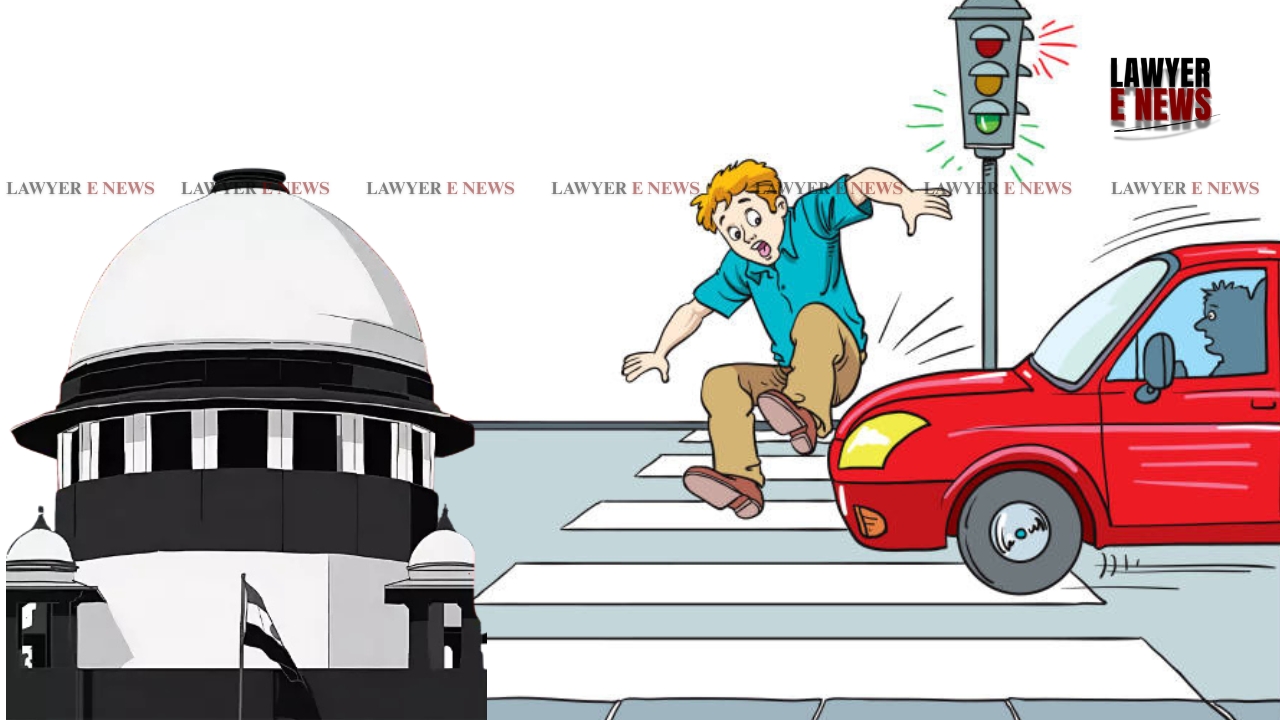
In a landmark decision delivered on 7th October 2025 , the Supreme Court of India issued a sweeping set of directions addressing India’s spiraling road safety crisis, especially the alarming number of pedestrian deaths. Recognising the right to safe mobility as a constitutional guarantee under Article 21, the Court declared that "every pedestrian has the right to move on roads safely and with dignity," and held that failure of authorities to provide safe and accessible walking and crossing infrastructure amounts to "a serious breach of fundamental rights."
The bench comprising Justices J.B. Pardiwala and K.V. Viswanathan observed, “The deaths of pedestrians may be attributed to lack of sufficient pedestrian infrastructure, namely footpaths, which force the pedestrians to walk on the streets.” In this backdrop, the Court took judicial notice of the 35,221 pedestrian deaths in 2023, noting that they represented over 20% of all road fatalities, a figure it described as "akin to a national genocide."
“Footpaths Are Not A Luxury—They Are A Legal Obligation”: Court Orders Nationwide Infrastructure Audit Under IRC Guidelines
The case was a public interest petition filed by Dr. S. Rajaseekaran, a senior orthopedic surgeon and road safety advocate, who urged the Court to treat road accidents as a public emergency and direct institutional accountability across governments. The Court responded with urgency, noting, “Pedestrians, being the most vulnerable road users, are increasingly at risk… there is a dire need to ensure that pedestrian crossings and footpaths are safe, accessible, and obstruction-free.”
The Court issued binding directions for footpath and pedestrian crossing audits across 50 million-plus cities and key NHAI corridors, requiring authorities to implement the Indian Roads Congress (IRC) Guidelines for Pedestrian Safety (IRC:103–2022) in full. Citing Rule 166 of the Central Motor Vehicles Rules, 2020, the Court held, “The design, construction and maintenance of roads shall be in accordance with the standards and specifications of the Indian Roads Congress… these are not advisory—they are mandatory.”
Addressing the chronic encroachment of footpaths, the Court reminded municipal and highway authorities of their legal duty under Section 201 and 210B of the Motor Vehicles Act, and called for “structured assessments, clearance drives, and automated camera-based monitoring.” It sternly warned that “public property cannot be allowed to be converted for private purposes,” relying on the long-standing principle in Olga Tellis v. Bombay Municipal Corporation (1985) 3 SCC 545 that “no person has the right to encroach, by erecting a structure or otherwise, on footpaths, pavements or any other place reserved for a public purpose.”
“35,000 Pedestrian Deaths Cannot Be a Statistic”: Court Orders Time-Bound Enforcement of Safety Standards, Helmet Laws, and Lane Discipline
The Court made it clear that the situation had moved beyond mere policy reform and now required judicial enforcement. “Despite statutory provisions, road design standards, and national guidelines, there is gross non-compliance,” the judgment declared, calling for time-bound implementation of safety mechanisms.
Highlighting the role of unsafe road crossings, the Court directed the installation of “high-visibility zebra crossings, audible pedestrian signals, tactile paving, illumination, and panic buttons,” especially near schools, transit stations, hospitals, and marketplaces. Taking note of pedestrian conflict zones such as the Delhi High Court–National Zoo crossing on Mathura Road, the Court ordered urgent construction of a safe crossing and directed that it be completed within seven months.
Equally serious was the Court’s treatment of helmet violations. Referring to Section 129 of the Motor Vehicles Act and the Road Accidents in India 2023 report, the Court stated: “More than 54,000 two-wheeler deaths were caused due to non-wearing of helmets. These are not accidents, but avoidable deaths.” It directed all States and Union Territories to submit data on enforcement of helmet laws and warned that “non-compliance will be treated as contempt.”
“Wrong-Lane Driving and LED Glare Are Silent Killers”: Supreme Court Orders Crackdown on Traffic Indiscipline and Visual Hazards
The Court went beyond infrastructure to focus on enforcement, particularly wrong-lane driving and unauthorised LED headlights and sirens. “Wrong-lane driving creates unpredictable vehicle movement and increases the risk of fatal collisions, especially for pedestrians,” it observed. Invoking Sections 184 and 206 of the Motor Vehicles Act, the Court directed traffic police and transport authorities to deploy automated cameras, rumble strips, and tyre killers, and recommended real-time dashboards to record violations.
On the misuse of dazzling white headlights and illegal red-blue strobes, the Court remarked, “Pedestrians face momentary disorientation from glare, increasing risk of tripping or being struck.” Terming this a systemic hazard, it directed the Ministry of Road Transport and Highways (MoRTH) and States to prescribe beam-angle and luminance limits and enforce a nationwide ban on sale and installation of unauthorized sirens and strobe lights.
“Public Officials Will Be Personally Liable for Deaths Caused by Poor Road Design”: SC Invokes Section 198A of MV Act for Accountability
Perhaps the most striking legal innovation in the judgment is the invocation of Section 198A of the Motor Vehicles Act, which criminally penalises officials, contractors, and consultants for road design and maintenance failures that lead to death or injury. “Where failure to comply with standards results in death, such authority shall be punishable with a fine which may extend to one lakh rupees,” the Court recited from the provision, and ordered authorities to apply it proactively.
“Pedestrian deaths arising from infrastructure defects must not be treated as mere accidents but as institutional negligence,” the Bench declared. “Officials and contractors shall be personally liable… accountability must become the cornerstone of road safety administration.”
“We Will Review Implementation—This Judgment Is Not the End, It Is the Beginning”: Supreme Court To Monitor Compliance Every 7 Months
The judgment concluded with the Court retaining continuing mandamus jurisdiction, directing all stakeholders to submit compliance affidavits within seven months. “We shall keep monitoring the compliance of said directions by way of this order,” the Bench stated.
Commending Amicus Curiae Mr. Gaurav Agrawal for his “yeoman service over more than a decade,” the Court reiterated that the real test of this judgment lies in its execution. “Road safety is not only a matter of policy—it is a matter of constitutional right, administrative duty, and judicial oversight.”
Date of Decision: 7th October, 2025