-
by sayum
28 August 2026 2:11 PM







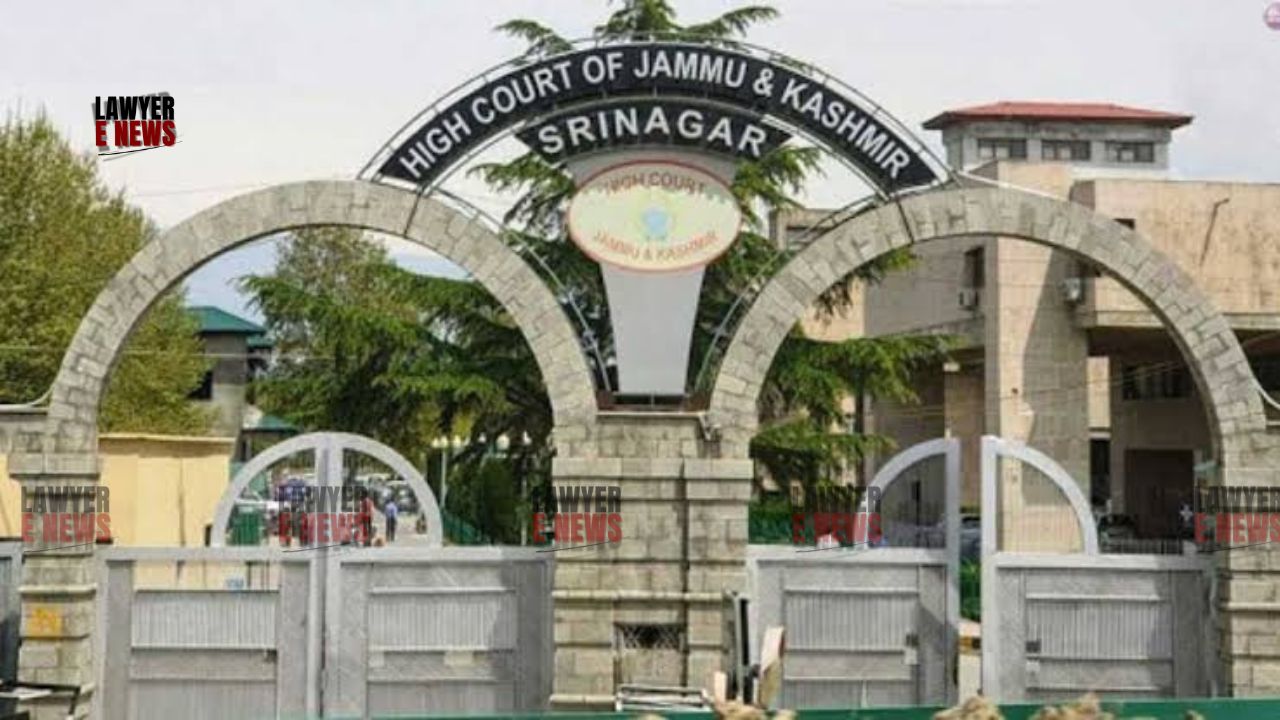
"Such an order does not qualify to be a 'decree' under Section 2(2) CPC" – High Court of Jammu & Kashmir and Ladakh at Jammu ruled that an order dismissing an application under Order 7 Rule 11 of the Civil Procedure Code (CPC), when passed by a civil court, is not appealable as it does not amount to a decree under Section 2(2) of CPC. The judgment, delivered by Justice Sanjay Dhar, clarified the legal position regarding maintainability of appeals against interlocutory orders and criticized the 1st Appellate Court for assuming jurisdiction it did not possess.
The ruling has significant implications on how litigants can challenge procedural orders at preliminary stages of litigation.
"An order refusing to reject the plaint does not conclusively determine rights in the suit, hence it is not a decree" – High Court
The dispute arose out of a civil suit filed by Sat Pal and another, seeking a declaration and permanent injunction in respect of land measuring 1 kanal situated in Village Biaspur, Tehsil Suchetgarh, Jammu. The plaintiffs claimed peaceful possession of the land and sought to restrain the defendant, Raghubir Singh, and others from interfering.
Raghubir Singh, the defendant, filed an application under Order 7 Rule 11 CPC before the Trial Court (Additional Special Mobile Magistrate, R.S. Pura) for rejection of the plaint. The trial court dismissed the application on 22.08.2024. He then preferred a first appeal under Section 96 CPC before the Principal District Judge, Jammu, which was also dismissed on 04.02.2025. Raghubir Singh thereafter filed a second appeal under Section 100 CPC before the High Court.
“Not Every Order is Appealable – Only a Decree or Order Under Order 43 Rule 1 CPC Can Be Appealed”
At the core of the case was the question of whether an order dismissing an application under Order 7 Rule 11 CPC can be considered a “decree” and thus appealable under Section 100 CPC.
Justice Sanjay Dhar elaborated: “A decree is the formal expression of an adjudication which conclusively determines the rights of the parties with regard to all or any of the matters in controversy in the suit.”
Under Section 2(2) CPC, rejection of a plaint is included within the definition of “decree”, but refusal to reject the plaint is not.
“An order refusing to reject the plaint does not finally bring an end to the suit nor does it qualify to be a preliminary decree. It merely keeps the suit alive,” the Court explained.
The Court held that unless the order either falls within the scope of Order 43 Rule 1 CPC or qualifies as a decree, no appeal lies against it. The Court went further:
“The learned 1st Appellate Court has landed itself into a jurisdictional error in entertaining the appeal against the said order.”
“Wider Interpretation of ‘Judgment’ under Letters Patent Does Not Apply to Orders Passed by Civil Courts”
Misplaced Reliance on Shah Babulal Khimji and Liverpool Case
The 1st Appellate Court had relied heavily on the Supreme Court decisions in:
Shah Babulal Khimji v. Jayaben D. Kania
Liverpool & London S.P. & I Association Ltd. v. M.V. Sea Success I
to hold that dismissal of an Order 7 Rule 11 CPC application is a "preliminary judgment" and therefore appealable.
However, Justice Dhar clarified: “While an order passed by a Single Judge of the High Court in original jurisdiction may qualify as a 'judgment' under Clause 12 of Letters Patent, the same cannot be said for an order passed by a civil court unless it qualifies as a 'decree' or is specifically appealable under CPC.”
He emphasized that the concept of "judgment" under Letters Patent is broader, while "decree" under CPC is narrower and statutorily defined.
“Second Appeal Under Section 100 CPC Not Maintainable Against Such Orders”
The Court further concluded: “Having held that the order passed by the trial court does not qualify to be a decree, the second appeal under Section 100 of the CPC against the said order is not maintainable.”
Accordingly, the second appeal was dismissed as not maintainable, and the appellant was left free to pursue any other appropriate remedy, if available.
This judgment sets a clear procedural boundary by reinforcing that only orders qualifying as decrees or fitting within Order 43 Rule 1 CPC are appealable. It also reiterates the distinction between “judgment” as understood in Letters Patent appeals and “decree” under CPC, a crucial point that has often led to jurisdictional confusion.
By pointing out the error in jurisdiction committed by the District Judge, the High Court has preserved the sanctity of procedural law under CPC.
Date of Decision: 11 September 2025