-
by sayum
24 August 2026 11:13 AM







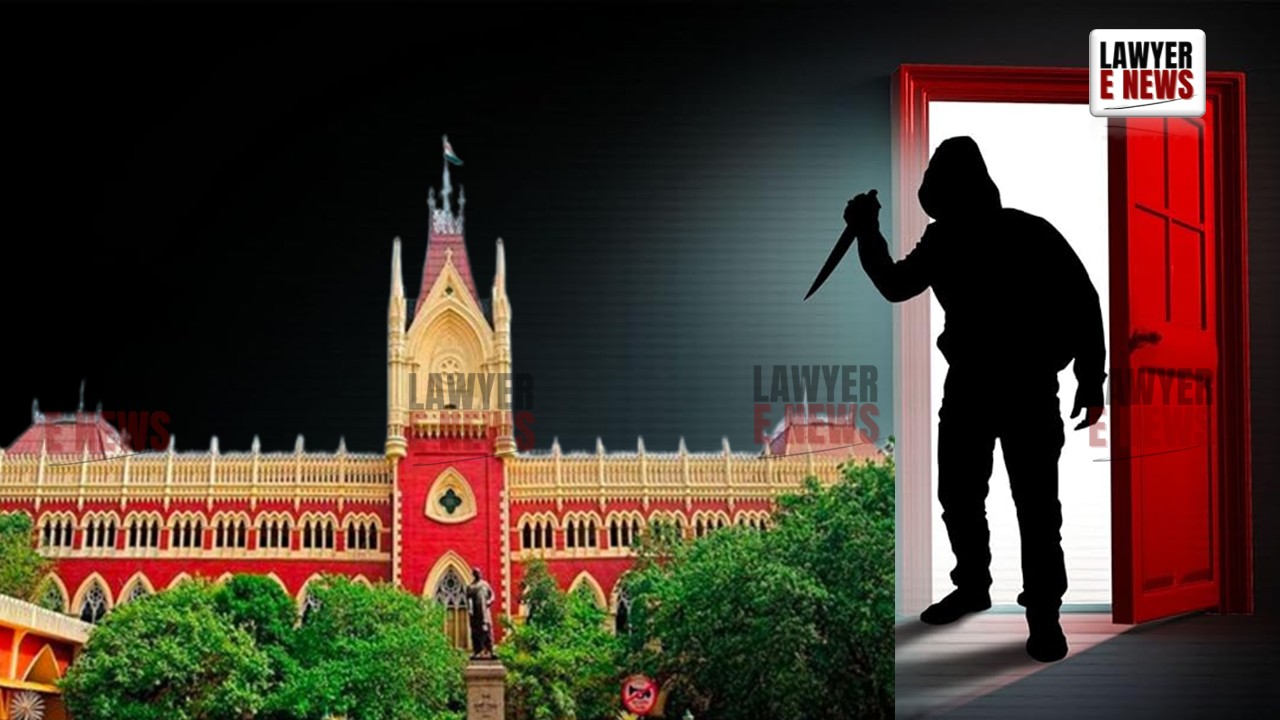
“Victim’s spontaneous utterance identifying assailants after first bullet injury is admissible under Sections 6, 7, and 32 of the Evidence Act” – In a landmark judgment Calcutta High Court upheld the conviction and life sentence of two appellants—Sajal Kanti Roy @ Subrata @ Subho and Bhagirath—for the murder of one Sagar Ghosh on the eve of the 2013 Panchayat elections in West Bengal.
The Division Bench of Justice Rajasekhar Mantha and Justice Ajay Kumar Gupta relied heavily on oral dying declarations, res gestae evidence, and corroborating medical testimony, despite acknowledging serious lapses and irregularities in the investigation.
The Court dismissed the appeal and confirmed the Trial Court’s judgment dated April 27, 2018, under Sections 302/34 IPC, 448 IPC, and 27 of the Arms Act, imposing life imprisonment, fines totalling ₹1.55 lakhs per accused, and modifying the compensation to be shared equally between the victim’s wife and daughter-in-law.
"Res gestae is not direct evidence, but it removes the barrier of hearsay when rooted in the same transaction"
One of the central legal questions addressed was whether oral statements made by the victim after being shot could be relied upon for conviction. The appellants argued that such utterances were hearsay and inadmissible. The Court disagreed.
The Bench held:
“The victim, after receiving the first bullet injury, shouted out the names of the appellants and identified them as having fired the bullets at him... The shout out and identification... amounts to the victim indicating the cause of his death... in terms of Section 32 of the Evidence Act.” [Para 49]
Further, the Bench ruled such utterances are admissible under Section 6 and 7 of the Evidence Act, as forming part of the same transaction (res gestae) and the surrounding environment of the crime. The Court explained:
“The naming by the victim of the appellants is a natural response given by a person who has suffered bullets from persons he knows. The same formed part of the same set of events.” [Para 43]
This reasoning was backed by precedents including Dhal Singh Dewangan v. State of Chhattisgarh (2016) 16 SCC 701, and Krishan Kumar Malik v. State of Haryana (2011) 7 SCC 130, where the Supreme Court permitted spontaneous declarations made during the commission of an offence to be admitted under res gestae.
“No light? Then how did the bullets find their mark?” – Court rejects argument of poor visibility
A major defence taken by the appellants was that the victim and witnesses could not have seen the assailants due to poor lighting. The Court rejected this argument outright:
“When the assailants could zero down on the victim and fire bullets at him, it follows that the victim and his assailants could equally see each other.” [Para 52]
The Court also found that the assailants fired through a grill gate which provided mutual visibility, thereby enabling the victim to identify them not only by sight but also by voice recognition, as in the case of appellant no.2, Bhagirath.
“Oral dying declarations admissible even if not recorded by Magistrate” – Spontaneity and pain indicate truthfulness
The Court rejected the notion that dying declarations must be recorded in writing or by a Magistrate to be admissible. Citing Sudhakar v. State of Maharashtra (2000) 6 SCC 671, the Bench observed:
“If it is verbal, it should be proved by examining the person who heard the deceased making the statement… The admissibility of a dying declaration is not dependent on in what form and who has heard or recorded the same.” [Paras 55–60]
The Court found the oral dying declaration made after the first bullet—heard by the victim’s wife (PW-14) and daughter-in-law (PW-15)—was both admissible and reliable, particularly as the victim used the nicknames “Subho” and “Bhaghi,” showing a level of familiarity and spontaneity that supports veracity.
“Eyewitnesses may exaggerate but truth can be sifted from embellishment” – Trustworthiness remains key
The appellants attacked the credibility of PWs 14 and 15, arguing that they were related to the victim and had contradicted themselves, including by alleging police coercion in their initial complaint. However, the Court reiterated the well-settled principle that minor inconsistencies do not destroy overall credibility.
Relying on Leela Ram v. State of Haryana (1999) 9 SCC 525, the Court held:
“One hardly comes across a witness whose evidence does not contain some exaggeration or embellishment… The court can sift the chaff from the grain and find out the truth from the testimony.” [Para 71]
"Investigation lapses cannot wash away credible eyewitness and dying declaration evidence"
The Court acknowledged grave irregularities in the initial investigation, including:
Delay of six months in recording statements under Section 164 CrPC
Sketch map omissions and poorly documented crime scene
Missing written dying declaration allegedly recorded by police
Police coercion in initial complaint
Failure to conduct X-ray in post-mortem
Despite these lapses, the Court held:
“This case is a reflection of an investigative casualty. The same, however, has not negated the prosecution's case in view of the deposition of PW 14–18.” [Para 66]
"Failure to plead alibi under Section 313 CrPC draws adverse inference"
Notably, the appellants did not offer any alibi or alternate explanation under Section 313 CrPC. The Court drew an adverse inference, holding:
“It was incumbent on the appellants to either explain why they were present in the house of the victim on the fateful day or to prove their alibi. They, however, have not shown any alibi.” [Para 40]
Conviction and Life Sentence Upheld with Directions for Compensation and Surrender
The High Court dismissed the appeal, affirming:
Life imprisonment under Section 302 IPC read with Section 34
Additional sentences under Section 448 IPC and Section 27 of the Arms Act
Fine of ₹1 lakh each, to be paid equally to the victim’s wife and daughter-in-law (PW-14 and PW-15)
Alternate compensation of ₹5 lakhs by the State if fines are not paid within 30 days
“The appellants shall surrender before the jurisdictional Trial Court. If they fail to pay the fine within 30 days, the State shall pay ₹5 lakhs as compensation, equally to the wife and daughter-in-law of the victim.” [Paras 80–84]
Date of Decision: January 19, 2026