-
by sayum
25 August 2026 9:55 AM







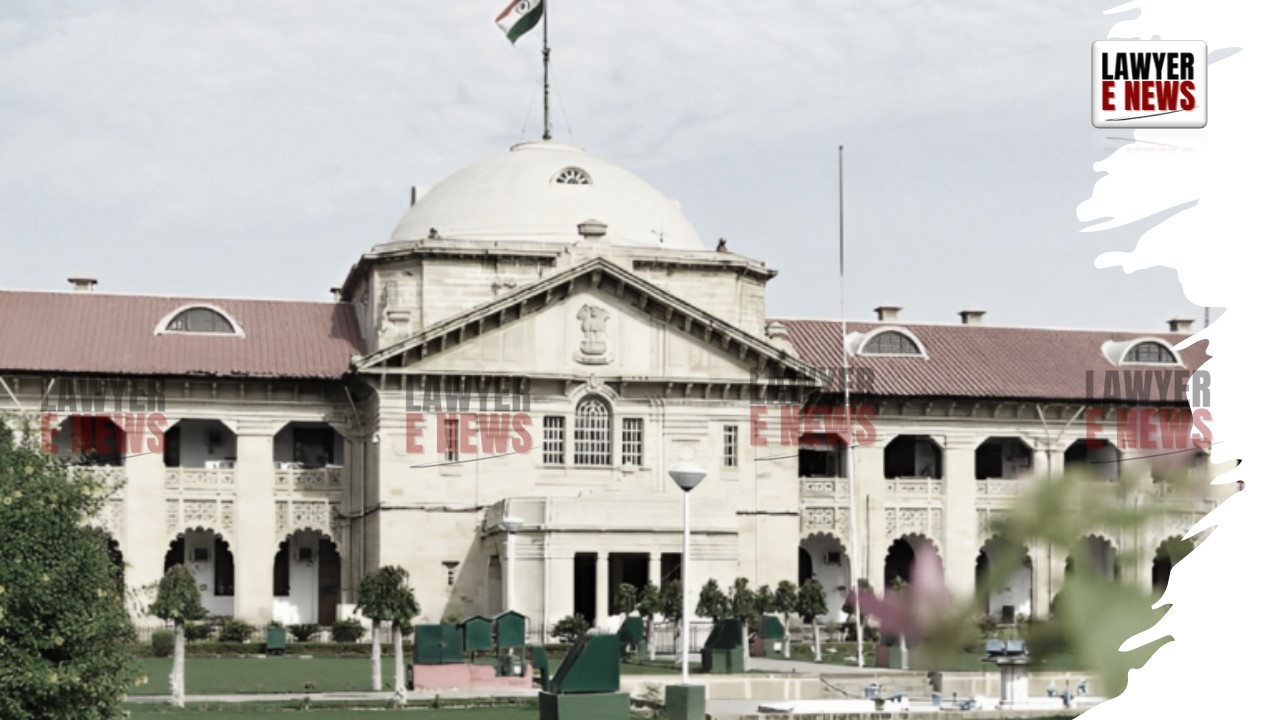
“Every member of an unlawful assembly is vicariously liable, irrespective of whether they inflicted the fatal blow” – In a significant reaffirmation of the doctrine of vicarious liability under Section 149 of the Indian Penal Code, the Allahabad High Court dismissed a 39-year-old criminal appeal and upheld the conviction of the sole surviving appellant, Sanwarey, under Sections 147, 148, and 302 read with Section 149 IPC. The Division Bench of Justice Chandra Dhari Singh and Justice Chawan Prakash held that "once the common object to commit murder is established, the specific role of each accused, or the nature of weapon used, becomes immaterial."
The judgment involved a deadly assault that took place during the early morning hours of April 7, 1985, in village Gajauli, district Basti. The Court reiterated that the presence of an accused as part of an unlawful assembly having a common object to kill is sufficient to attract constructive liability under Section 149 IPC, even if the accused did not deliver the fatal injury.
Eyewitness Testimony: “Trivial Contradictions Cannot Corrode the Core of the Prosecution Case”
The prosecution case was based primarily on the testimonies of the deceased’s wife (PW-2) and two co-villagers (PW-3 and PW-4), who witnessed the brutal murder of Bideshi Kurmi in a moonlit field during harvesting season. The main accused, including appellant Sanwarey, were relatives of the deceased with whom there was a long-standing property dispute.
Dismissing the defence argument about minor discrepancies in the witnesses’ accounts, the Court noted:
“In the depositions of witnesses there are always some normal discrepancies however honest and truthful they may be. These discrepancies are due to normal errors of observation, lapse of time, and shock at the time of occurrence.” [Para 36]
The Bench found the eyewitness testimonies to be consistent, natural, and trustworthy. Citing State of Rajasthan v. Kalki [(1981) 2 SCC 752], the Court emphasized that a related witness cannot be termed “interested” merely due to kinship:
“She [PW-2] cannot be called an ‘interested’ witness. She is related to the deceased. ‘Related’ is not equivalent to ‘interested’. A witness may be called ‘interested’ only when he or she derives some benefit from the result of the litigation.” [Para 37]
The Court further drew strength from decisions such as M.K. Anthony [(1985) 1 SCC 505] and Saravanan [(2008) 17 SCC 587], underscoring that “minor contradictions, inconsistencies or embellishments on trivial matters without affecting the core of the prosecution case should not be made a ground to reject the evidence in its entirety.”
Vicarious Liability under Section 149 IPC: A Constructive Net Around Unlawful Assemblies
In one of the most critical observations of the judgment, the Bench unequivocally held:
“The appellant has been roped in this case by virtue of Sections 148 and 149 IPC. He was a part of the unlawful assembly which had the common object of eliminating the deceased... therefore, being a member of the unlawful assembly, he was also guilty of the offence committed in prosecution of the common object, i.e., the offence under Section 302 IPC.” [Para 51]
Referring to the jurisprudence in Krishnappa v. State of Karnataka [(2012) 11 SCC 237], Vinubhai Ranchhodbhai Patel v. Rajivbhai Dudabhai Patel [(2018) 7 SCC 743], and Nitya Nand v. State of U.P. [(2024) 9 SCR 37], the High Court stressed that:
“Section 149 IPC creates a constructive or vicarious liability... The factum of causing injury or not causing injury would not be relevant, where the accused is sought to be roped in with the aid of Section 149 IPC.” [Para 54]
This means even if appellant Sanwarey did not inflict the fatal wound (which was attributed to co-accused Rajendra using a knife), his liability under Section 302/149 IPC remained intact due to his active participation in the common object of the group to commit murder.
Identification at Night: Moonlight, Familiarity, and Voice Recognition Found Credible
Rejecting the argument that it was too dark to identify the assailants, the Court noted that all witnesses and accused belonged to the same village and were well-acquainted.
“Since the witnesses were familiar to the accused, there was no difficulty for them to identify the accused.” [Para 57]
Quoting Anwar Hussain v. State of UP [AIR 1981 SC 2071], the Court reaffirmed:
“Even if there is insufficient light, a witness can identify a person, with whom he is fairly acquainted or is in intimate terms – from his voice, features etc.” [Para 58]
Defective Investigation Does Not Dent the Core of the Case
The defence had also raised issues regarding alleged lapses in the investigation, including discrepancies in the forensic reports and the failure to prepare memos for torches carried by witnesses. The High Court, however, dismissed these contentions:
“Defective investigation by itself cannot be a ground for acquittal... The investigation is not the solitary area for judicial scrutiny in a criminal trial.” [Para 46, C. Muniappan v. State of Tamil Nadu]
The Bench emphasized that the failure of police officials in not preparing a memo of the torch or the FSL report not finding blood on one shirt does not weaken the consistent and credible oral testimony of eyewitnesses.
Appellant to Surrender: Sentence Affirmed
Considering the brutal nature of the murder, the Court concluded:
“It was a gruesome murder. Perusal of postmortem shows that the deceased was mercilessly attacked. Severity of injuries clearly demonstrate the brutality of the attacks.” [Para 61]
Dismissing the appeal of Sanwarey, the Court affirmed the life sentence awarded by the Sessions Court and directed:
“The appellant Sanwarey is on bail. His bail bond is cancelled... He is directed to surrender before the Court concerned within four weeks to serve out the sentence awarded to him by the learned Trial Court.” [Para 65]
The Allahabad High Court's judgment underscores the principle that when a common object to commit a grave offence like murder is proven, all members of the unlawful assembly are equally culpable under Section 149 IPC. The ruling reinforces settled legal principles on appreciation of eyewitness testimony, the limited relevance of investigative lapses, and the scope of constructive liability in group offences.
Date of Decision: 02 February 2026