-
by sayum
26 August 2026 10:38 AM







"‘Right to Life’ enshrined under Article 21 of the Constitution of India is not merely a guarantee against the unlawful taking of life, but a positive mandate upon the State to ensure a safe environment where human life is preserved and valued." Supreme Court of India, in a far-reaching judgment dated August 04, 2026, issued a slew of directions aimed at enforcing mandatory motor vehicle insurance and streamlining accident claim processes.
A bench comprising Justice Sanjay Karol and Justice Prashant Kumar Mishra observed that the lack of compliance with Section 146 of the Motor Vehicles Act, 1988 (MVA), which mandates third-party insurance, directly impacts the right to life under Article 21 of the Constitution of India, and victims are often left without adequate compensation.
The present appeal originated from a Motor Accident Civil Miscellaneous Appeal before the High Court of Telangana, arising from a MACT order of 2009. The case involved an insurance company challenging an award where the High Court held that a comprehensive policy covered the owner of the vehicle even when travelling as a passenger. Recognizing the larger public interest issues surrounding uninsured vehicles and delayed compensation, the Supreme Court expanded the scope of the appeal, impleading various stakeholders including the Ministry of Road Transport and Highways (MoRTH), the Insurance Regulatory and Development Authority of India (IRDA), the General Insurance Council, and several insurance companies to address systemic deficiencies.
The primary issues before the Court were two-fold: first, the pervasive lack of compliance with Section 146 of the MVA requiring valid third-party insurance; and second, whether a uniform motor-vehicle policy structure should be implemented to cover all occupants of a vehicle, beyond the statutorily mandated third-party risks.
Alarming Rate of Uninsured Vehicles Flagged
The Supreme Court highlighted the alarming statistics, noting that nearly 56% of vehicles plying on Indian roads, amounting to 16.54 crore out of 30.48 crore, remain uninsured. This stark figure, derived from a Report of the Standing Committee on Finance 2024-25, severely compromises the statutory safeguard of victim compensation and often leads to prolonged litigation for accident victims and their families.
Road Safety as a Facet of Article 21
The Court underscored the constitutional imperative of road safety, reiterating its observation in In Re: Phalodi Accident v. National Highways Authority of India and Ors. (2026 SCC OnLine SC 646) that a safe environment is integral to the right to live with dignity under Article 21 of the Constitution. It also referred to the Patna High Court's ruling in Abhijeet Kumar Pandey v. State of Bihar (2023 SCC OnLine Pat 279) recognizing the right to safe travel as inherent to Articles 19(1)(d) and 21.
Enhanced Enforcement Through Technology
To combat the issue of uninsured vehicles, the Court directed robust integration of technology. Automatic Number Plate Recognition (ANPR) cameras, already used for traffic violations, are now to be integrated with data from the Insurance Information Bureau (IIB) and the VAHAN portal to issue automatic e-challans for uninsured vehicles, in line with the SOP for Electronic Monitoring and Enforcement of Road Safety.
Police to Utilize Handheld Devices for Real-time Verification
State Police will be equipped with handheld devices or downloadable applications, linked to the IIB and VAHAN portal, to monitor real-time insurance status and issue challans on the spot, ensuring ground-level compliance.
Linking Fuel Purchase to Valid Insurance
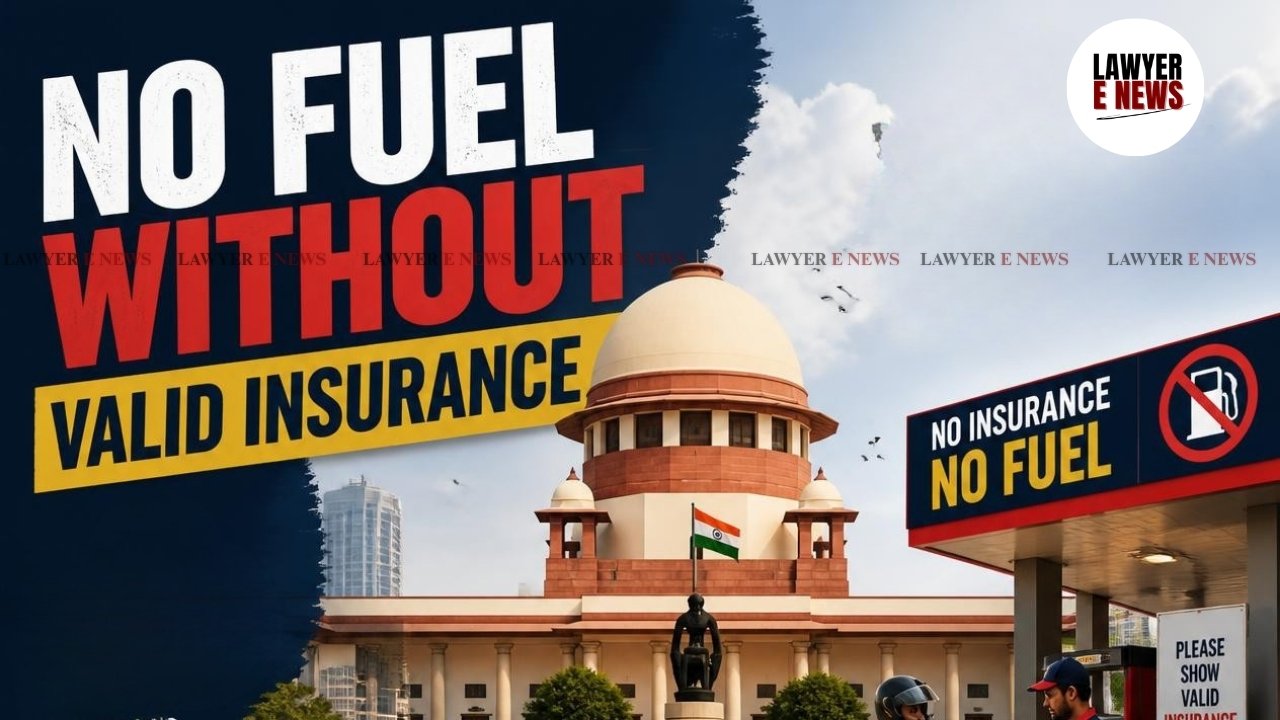
In a significant move, the Court directed the IRDA, in consultation with MoRTH, to develop a pilot project linking the purchase of fuel for vehicles with their valid insurance status. This initiative aims to refuse fuel to uninsured vehicles at petrol pumps until valid insurance is obtained, thereby promoting compliance and aiding in the identification of unregistered vehicles. The Ministry of Petroleum and Natural Gas has, in principle, expressed no objection to this proposal.
Stricter Penalties and Vehicle Impoundment
The Court emphasized strict compliance with the amended Section 196 of the MVA, which introduces progressive fines for driving uninsured vehicles: three times the basic premium or ₹5,000 (whichever is higher) for the first offence, and five times the basic premium or ₹10,000 (whichever is higher) for subsequent infractions. Additionally, uninsured vehicles may be impounded, and flagged as 'not to be transacted with' in the VAHAN portal to prevent access to transport-related services until insurance is renewed.
Standardised Four-Layer Insurance Policy Structure
For private vehicles, the Court mandated a broad four-layer insurance policy structure to bring clarity and ensure informed choices for vehicle owners. This structure includes:
Mandatory "Customer Option Form" and Information Sheet
At the time of insurance purchase, whether offline or online, customers must be issued a "customer option form" allowing them to opt-in for add-on covers via a checkbox. A consumer-friendly information sheet must also be provided, outlining who is covered under mandatory and optional covers, particularly highlighting coverage options for occupants, pillion riders, and the driver. IRDA, in consultation with the General Insurance Council (GIC) and insurance companies, will formulate uniform policy wordings for these optional covers.
Extended Tenure for Third-Party Insurance
Acknowledging that previous directions in S. Rajaseekaran v. Union of India (2018) 8 SCC 447, mandating three-year third-party cover for new cars and five-year cover for new two-wheelers, had not sufficiently reduced uninsured vehicles, the Court directed an extension. Henceforth, new cars will require a four-year third-party insurance policy, and new two-wheelers will require a six-year policy. IRDA is directed to issue necessary instructions immediately.
Expediting Pending MACT Cases
The Court addressed the long pendency of Motor Accident Claims Tribunal (MACT) cases, as observed in Shishu Pal @ Shish Ram & Ors v. Surjeet & Ors (2026 INSC 634), General Insurance Council v. State of Andhra Pradesh (2007) 12 SCC 354, and M.R. Krishna Murthi v. New India Assurance Company Limited (2020) 15 SCC 493. For accident cases prior to March 31, 2022, where claims are pending:
The Registry of the Supreme Court is to forward these directions to the Secretary, High Court Legal Services Authority of all High Courts for dissemination to the respective State Police.
Dismissal of Insurance Company's Appeal
On the original appeal, the Court dismissed the challenge by National Insurance Co. Ltd., upholding the High Court's judgment. The Supreme Court affirmed that under a comprehensive/package policy, insurance companies are liable to compensate for any occupant in the vehicle. The Court relied on an IRDA circular dated November 16, 2009, and reiterated that a hyper-technical approach should be avoided in motor accident claims.
The Supreme Court's comprehensive judgment not only dismissed the insurance company's appeal, clarifying that comprehensive policies cover owners as passengers, but also laid down a robust framework for enhancing road safety and ensuring compliance with mandatory motor vehicle insurance across India. The directives, ranging from technology-driven enforcement and extended policy tenures to potentially linking fuel purchases with insurance, underscore the Court's commitment to protecting victims of road accidents and upholding the constitutional right to life, with all stakeholders mandated to comply and report back to the Court.
Date of Decision: August 04, 2026