-
by sayum
28 August 2026 10:07 AM







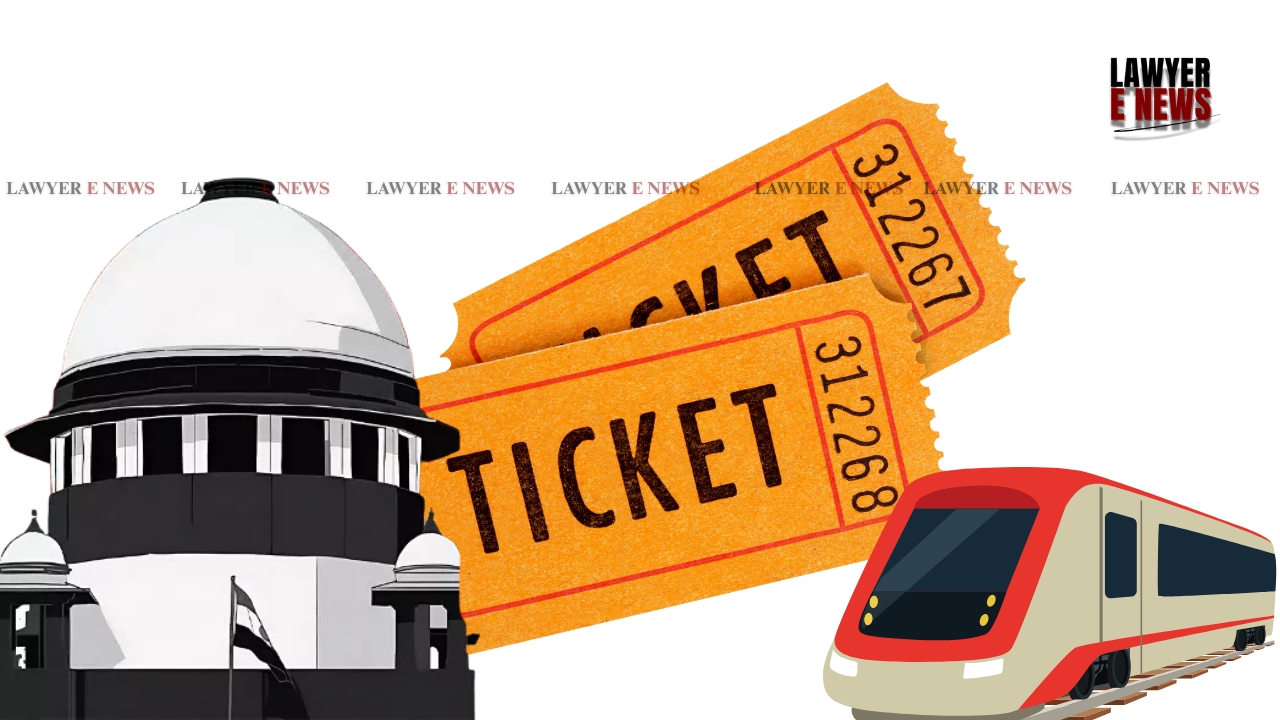
“Proceedings under Section 124-A of the Railways Act are not criminal trials demanding proof beyond reasonable doubt, but are governed by the principles of preponderance of probabilities” - On October 8, 2025, the Supreme Court of India overturned the denial of compensation to the widow and minor son of a man who died in an alleged accidental fall from a train. Delivering a significant judgment under the Railways Act, 1989, a bench of Justice Aravind Kumar and Justice N.V. Anjaria ruled that once initial facts are shown, the burden shifts to the Railways to disprove bona fide travel, and mere absence of a physical train ticket cannot defeat a valid claim.
The Court categorically held that such compensation proceedings are governed by a welfare standard, not the evidentiary rigour of criminal trials. Emphasizing the liberal and humane interpretation of beneficial legislation, the Court allowed the appeal and directed the Union of India to pay ₹8,00,000 within 8 weeks to the deceased’s family.
“Once Affidavit and Verified Ticket Exist, Railways Cannot Deny Liability by Citing Missing Seizure Memo”: Court Rejects Hyper-Technical Approach
In a compassionate yet legally precise ruling, the Supreme Court emphasized the true spirit of Section 124-A of the Railways Act — a strict liability regime intended to ensure speedy relief to victims of untoward railway incidents. The case involved the death of Sanjesh Kumar Yagnik, who allegedly fell from Train No. 12465 – Ranthambore Express, after boarding at Indore Junction on May 19, 2017, en route to Ujjain. The incident was recorded under Section 174 CrPC and post-mortem confirmed death due to head trauma from a blunt-force injury.
Despite evidence such as a DRM report verifying the ticket and an affidavit by the widow, the Railway Claims Tribunal (RCT) and the High Court of Madhya Pradesh rejected the family’s claim on the technical ground that the actual ticket was not recovered, and the photocopy lacked a seizure memo.
The Supreme Court condemned this approach, observing: “Mere absence of ticket or procedural lapses cannot override substantive justice under a beneficial statute.”
On May 19, 2017, Sanjesh Kumar allegedly fell from a moving train due to overcrowding. His body was discovered near Pole No. 15/21 within the jurisdiction of Narwar Police Station. The inquest proceedings under Section 174 CrPC were conducted, and the post-mortem concluded that death resulted from severe head injury due to blunt trauma.
His widow Rajni and their minor son filed a claim under Section 16 of the Railway Claims Tribunal Act, 1987, seeking compensation of ₹12,00,000. The RCT dismissed the claim on January 16, 2023, holding that the deceased was not proved to be a bona fide passenger, mainly because no physical ticket was found and the photocopy (Annexure A/7) was considered “doubtful”. The High Court upheld this reasoning in an order dated May 15, 2024, even though it conceded that the death qualified as an “untoward incident” under Section 123(c)(2) of the Act.
The pivotal legal question was whether compensation under Section 124-A can be denied solely due to procedural lapses such as non-recovery of the ticket, despite material proof that the deceased boarded the train and died in an untoward incident.
The Court noted that Section 124-A embodies a strict liability regime for accidental deaths, independent of any fault or negligence. The requirement under Explanation (ii) to Section 124-A — that a “passenger” includes one who has purchased a valid ticket — must be liberally interpreted.
Citing the ruling in Union of India v. Rina Devi [(2019) 3 SCC 572], the Court reaffirmed:
“Mere absence of ticket with such injured or deceased will not negative the claim that he was a bona fide passenger. Initial burden will be on the claimant which can be discharged by filing an affidavit of the relevant facts and burden will then shift on the Railways.”
The appellants had submitted an affidavit from the widow and a DRM note dated 23.02.2019 verifying the issuance of ticket no. L10274210 from Indore to Ujjain. This ticket was confirmed by the Chief Booking Supervisor, Indore and was part of the police records forwarded to the railway authorities.
Yet, the RCT and High Court rejected this material, focusing on non-production of a seizure memo, absence of the investigating officer’s testimony, and inconsistencies in identifying the exact location of the fall.
Rejecting this approach, the Court declared: “To insist on a formal seizure memo or the production of the investigating officer’s testimony is to import the evidentiary rigour of a criminal trial into proceedings meant to uphold social justice.”
It added: “Such insistence amounts to defeating the very object of Section 124-A, which is to provide compensation swiftly and justly, without making the family of the deceased run the gauntlet of forensic scrutiny.”
Reaffirming the law laid down in Doli Rani Saha v. Union of India and Kamukayi v. Union of India, the Court emphasized that affidavits, verified documents, and official reports are sufficient to discharge the initial burden. Once such evidence is produced, the Railways must rebut the presumption of bona fide travel.
The Court observed: “The report of the DRM confirms ticket verification from Indore Station. The Chief Booking Supervisor verified the ticket number on the same day of the incident. This clearly satisfies the condition under Explanation (ii) to Section 124-A.”
The bench found the High Court’s refusal to accept this verification as erroneous:
“The High Court, having accepted the incident as an ‘untoward incident’, ought to have held the Railways liable. Denial of compensation on technical grounds is wholly unjustified.”
The Court ruled that the failure to produce a seizure memo or examine the investigating officer cannot defeat a valid claim under a beneficial statute, and doing so would convert a welfare remedy into an adversarial contest devoid of compassion.
Setting aside the Tribunal and High Court orders, the Supreme Court allowed the appeal and ordered the Union of India to:
“Pay ₹8,00,000 (Rupees Eight Lakhs) as compensation to the appellants within eight weeks from the date of this Order, failing which the amount shall carry interest at the rate of 6% per annum from the date of the judgment.”
The Court declared that future claims under Section 124-A must be handled in light of this principle:
“Where an official railway inquiry or evidentiary record verifies the issuance of a ticket corresponding to the date and route of an untoward incident, such verification shall constitute prima facie proof of bona fide travel, shifting the evidentiary burden to the Railway Administration.”
Date of Decision: October 8, 2025