-
by sayum
04 August 2026 1:39 PM







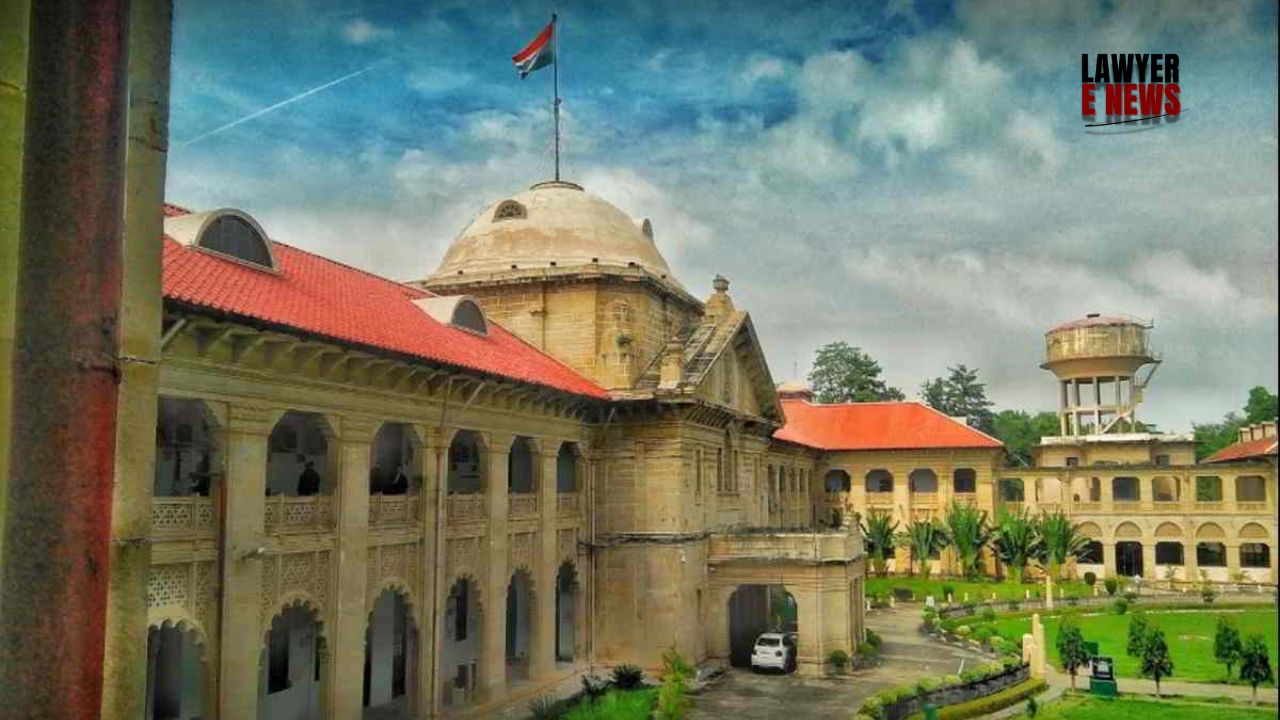
“Judicial Review Cannot Become a Tool to Re-Evaluate Exams in the Absence of Blatant Errors” — In a significant decision impacting thousands of teaching aspirants in Uttar Pradesh, the Allahabad High Court declined to interfere with the evaluation and selection process in the Assistant Teacher Recruitment Examination (ATRE), 2018, reaffirming that judicial review in academic assessments is strictly limited. The Court, speaking through Justice Saurabh Shyam Shamshery, held that unless there is a “demonstrable and patent error” in the answer key or the evaluation process, the Court cannot act as an appellate authority over expert decisions.
“This Court is not inclined to enter into the issue of correctness of answer and the evaluation would be confined to correct answer key already uploaded by the authorities.” [Para 4, quoting Aniruddh Narayan Shukla]
While dismissing a majority of the petitions, the Court directed limited relief in three cases where petitioners appeared to have qualified upon rectification of identified errors and ordered the Examination Regulatory Authority to verify and act accordingly, subject to vacancy availability.
The batch of writ petitions stemmed from grievances raised by Assistant Teacher aspirants who appeared in the ATRE-2018, conducted under the U.P. Basic Education (Teachers) Service Rules, 1981, and governed by Government Order dated 05.10.2018. The petitioners alleged that errors in answer key evaluation, disregard of minor grammatical or unit-related omissions, and disparities in treatment led to their exclusion from the final selection list.
The High Court had, in an earlier judgment in Aniruddh Narayan Shukla & 118 Ors. v. State of U.P. (W.P. No. 18235/2018), issued detailed guidelines for re-evaluation, specifically addressing errors in marking, the treatment of unit omissions, overwriting, and incorrect model answers.
“The Examination Regulatory Authority would not give precedence to form over substance... omission of units like ‘Rs.’ or ‘cm²’ should not result in denial of marks in mathematical questions.” [Aniruddh Narayan Shukla, Para V]
Despite that, several candidates approached the Court asserting that their grievances remained unaddressed or were not duly considered during re-evaluation.
The central legal issue revolved around the scope of judicial review under Article 226 in matters of academic evaluation. The Court relied on a consistent line of judgments, notably:
Ran Vijay Singh v. State of U.P. (2018) 2 SCC 357
U.P. Public Service Commission v. Rahul Singh (2018) 7 SCC 254
Vikesh Kumar Gupta v. State of Rajasthan (2021) 2 SCC 309
The Court reiterated the principle that judges are not subject-matter experts, and evaluation committees, having subject-specific knowledge, must be shown deference, unless answers are “patently wrong on the face of it”.
“Judicial review in evaluation processes is not to supplant the wisdom of subject experts unless the error is glaring and does not require any inferential reasoning.” [Para 12]
On the issue of units or minor grammatical omissions, the Court distinguished between general language-based questions and subject-specific queries like mathematics or science, where accuracy of unit is integral to correctness.
“In mathematical or physics-related questions, unit omission can alter the answer’s correctness; hence, such omissions are not condonable.” [Para 5, 14–16]
The Court scrutinized individual petitions to assess if rectification of alleged errors would help petitioners meet the qualifying marks (67 for General category, 60 for SC). Out of 15 shortlisted petitions, only three—Writ A No. 917/2021, 12467/2020, and 13506/2020—were found potentially meritorious, warranting re-examination by the Examination Authority.
“In the interest of justice... case of the petitioner be re-examined by the Examination Regulatory Authority to clear the position.” [W.P. 13506/2020]
For the rest, even after taking a liberal view, the Court found the petitioners short of qualifying marks, or wrong in their objections, particularly where units were wrong, answer formats flawed, or questions had already been evaluated under prior orders.
For instance, in Writ A No. 13075/2020 (Sandeep Singh), the petitioner gained marks after re-evaluation but still fell short. The Court noted: “Correct unit for ‘Power’ is Watt or Joule/Second; ‘vidyut urja’ is not a unit, hence answer is incorrect.”
Similarly, in Writ A No. 12239/2020 (Shivram Chaturvedi), earlier granted marks were deducted upon discovery of reversed algebraic expressions in answers—highlighting the importance of precision in technical subjects.
The Court issued a general caution to all stakeholders: “Courts must not become alternate examining bodies. Academic integrity rests on deference to domain experts.”
On inconsistencies and variation in marking schemes, it stressed that:
“Sympathy or compassion does not play any role in the matter of directing re-evaluation... the examination process should not be derailed due to disappointment of few candidates.” [Ran Vijay Singh, quoted at Para 12]
Further, the Court reaffirmed that once re-evaluation has been done per judicial directions, further claims cannot be entertained unless new and clear errors are shown.
The High Court’s judgment acts as a reaffirmation of judicial restraint in academic matters, balancing individual fairness with systemic efficiency.
Writ-A Nos. 917/2021, 12467/2020, and 13506/2020 were disposed of with directions to the Examination Regulatory Authority to verify claims and update scores if warranted, subject to availability of vacancies.
Remaining writ petitions (Writ-A Nos. 13075/2020, 12239/2020, 1628/2021, and others) were dismissed, as candidates failed to cross the qualifying mark even after possible re-evaluation.
“This Court finds no justifiable reason to re-evaluate or interfere further. The petitions lacking merit or falling short of cut-off even on liberal assessment are dismissed.”
The judgment provides finality to a long-pending recruitment dispute and guides future legal challenges in similar exams.
Date of Decision: 20 May 2025