-
by sayum
28 August 2026 10:07 AM







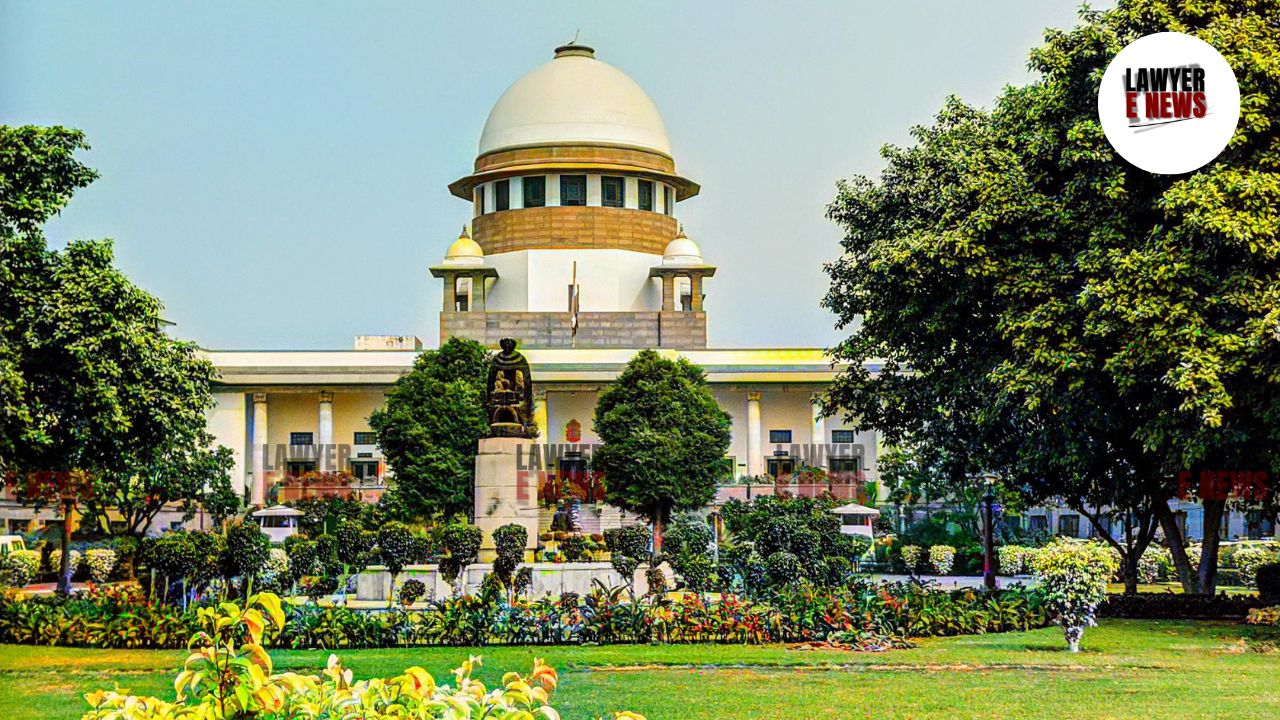
“To accept such a construction would be to ignore the legislative exemption and retroactively enlarge the liability” - In a significant ruling on land development law and the limits of regulatory imposition, the Supreme Court of India, on October 8, 2025, dismissed an appeal filed by the Chennai Metropolitan Development Authority (CMDA) challenging a High Court direction to refund ₹1.64 crore collected towards Open Space Reservation (OSR) charges from Dr. Kamala Selvaraj, a Chennai-based doctor who had purchased a 2229 sq. m. plot in 2008 to construct a hospital.
The Court held that the respondent’s landholding was part of a distinct, lawfully subdivided property traceable to a 1949 partition and two registered gift deeds of 1972 and 1973, and thus, it could not be treated as part of a larger 21-ground “parent estate” for purposes of calculating OSR liability. It found that the CMDA’s claim that the 2008 purchase amounted to a fresh sub-division was factually and legally untenable.
Rejecting the CMDA’s argument that the land must be notionally aggregated with its original holding, the Court said:
“To accept such a construction would be to ignore the legislative exemption and retroactively enlarge the liability.”
“Once Registered Instruments and Pattas Establish a Separate Holding Pre-1975, Burden Shifts — Authority’s Bald Assertions Cannot Override Public Records”
The central issue before the Court was whether the 2008 purchase by Dr. Selvaraj attracted OSR liability under Regulation 29 of the Chennai Development Regulations, on the theory that it was a “fresh sub-division” of a larger parent property measuring 21 grounds. The CMDA had demanded ₹1,64,50,000 as OSR charges, claiming the exemption under Annexure XX—which waives OSR for the first 3000 sq. m.—did not apply.
The Court, however, found that a chain of registered documents, starting with a partition deed in 1949, followed by two gift deeds in 1972 and 1973, and corroborated by the issuance of separate pattas in the name of Syed Ali Ispahani, demonstrated beyond doubt that the property had already been lawfully subdivided well before August 5, 1975, the date when the First Master Plan came into force.
Referring to the evidentiary burden, the Bench comprising Justice Aravind Kumar and Justice N.V. Anjaria held:
“Once this series of registered deeds and pattas were produced and the initial evidentiary burden was discharged, the same shifted to the appellant–Authority… The appellant’s bald assertion that sub-division occurred in 2008 is a mere ipse dixit, devoid of proof, and cannot prevail over contemporaneous registered instruments.”
The Court emphasised that pattas, while not constituting title, are public documents that “evidence official acknowledgment of an independent parcel”, and when read with unimpeached conveyances, they clearly establish separate identity and possession.
“Hospital Site of 2229 sq. m. Clearly Falls Within Annexure XX Exemption — OSR Levy Illegal and Unsustainable”
The CMDA had attempted to deny the exemption under Annexure XX, which provides that “for the first 3000 square metres — Nil” OSR charges are payable. The Authority argued that since the respondent’s land was part of a larger 21-ground estate, the threshold had been breached.
The Court rejected this approach as both factually erroneous and legally flawed:
“The respondent’s holding being 2229 square metres falls squarely within the Nil slab. The attempt to recombine it notionally with the erstwhile 21-ground parent estate is contrary both to fact and to the text of the regulation.”
It further found that there was no evidence of layout formation by the respondent, and therefore the OSR levy provisions meant for layout promoters could not be invoked.
“The respondent merely sought to develop her site by constructing a hospital.”The Court thus agreed with the findings of both the Single Judge and the Division Bench of the Madras High Court, which had quashed the demand and ordered a refund of the entire amount with 8% interest per annum.
“Article 136 Interference Not Warranted — Findings Based on Public Documents and Sound Legal Reasoning”
Reiterating the limited scope of appellate interference under Article 136 of the Constitution, the Court noted that the findings of the High Court were concurrent, supported by official records, and free from perversity or legal error.
“This Court has consistently held that in the exercise of jurisdiction under Article 136, interference is warranted only where manifest illegality, perversity, or grave miscarriage of justice is demonstrated. No such infirmity is made out here.”
On this basis, the Supreme Court refused to reappreciate the evidence, particularly when the underlying documents—partition deed, gift deeds, pattas, and sale deed—were admitted and undisputed.
CMDA’s Appeal Dismissed — ₹1.64 Crore Refund to Be Made in 6 Weeks
Affirming the High Court’s order in full, the Supreme Court held:
“In the result, the appeal being bereft of merit is accordingly dismissed. The direction of the High Court to refund the sum of ₹1,64,50,000 with interest at 8% per annum, to the extent not already complied with, shall stand affirmed.”
The Court directed the CMDA to refund the remaining amount, if any, within six weeks. No order as to costs was made, and all pending applications stood disposed.
This judgment marks a critical reaffirmation of citizen protection against unjustified fiscal impositions, especially where statutory exemptions and documentary histories are clearly established. It also underscores the limits of planning authorities’ discretion in interpreting development regulations beyond their textual and historical intent.
Date of Decision: October 8, 2025