-
by sayum
24 August 2026 11:13 AM







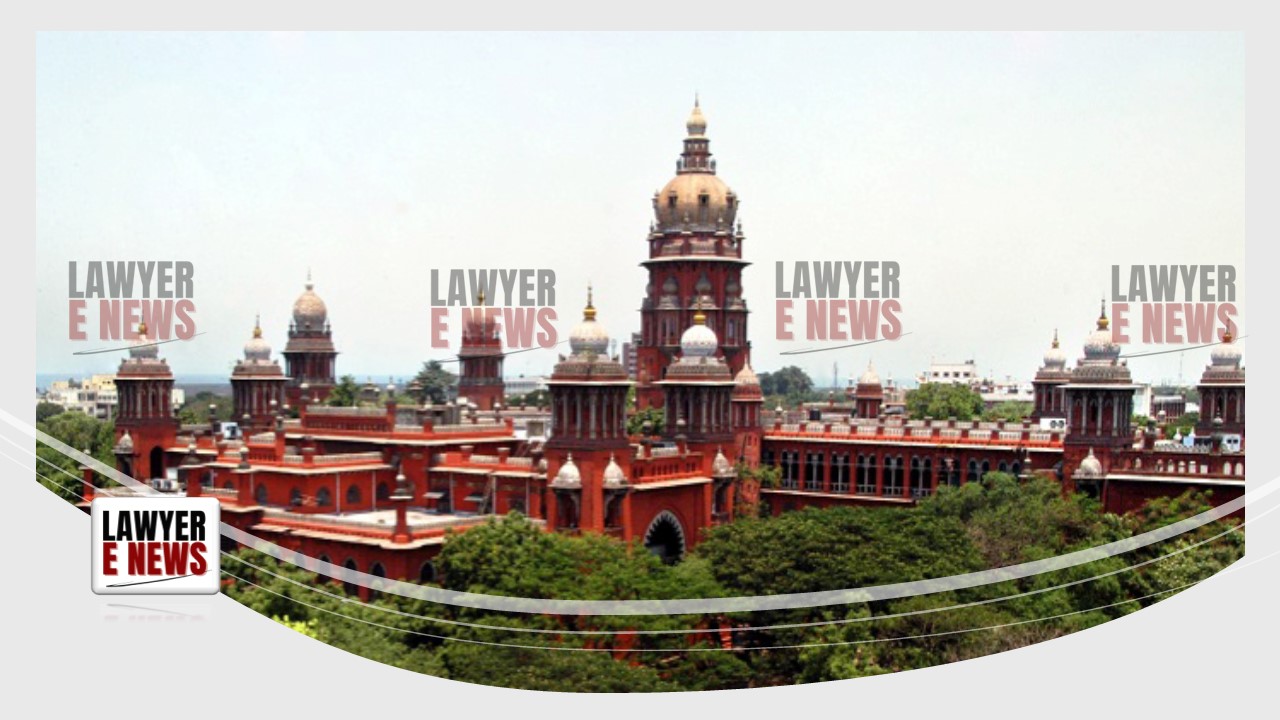
"A witness cannot be held to the contents of an FIR when he categorically disowns them in court" – Madras High Court, in a significant ruling on motor accident liability, dismissed the appeal filed by Shri Ram General Insurance Company Ltd. against the award passed by the Motor Accident Claims Tribunal, Krishnagiri. Division Bench comprising Justice C.V. Karthikeyan and Justice K. Kumaresh Babu upheld the Tribunal’s conclusion that the accident which killed a young software professional was solely attributable to the rash and negligent driving of a Swaraj Mazda goods vehicle, and not the car in which the deceased was travelling.
The appeal under Section 173 of the Motor Vehicles Act, 1988, challenged both the finding of negligence and the quantum of compensation awarded to the family of the deceased Nishadh, a 25-year-old software engineer working at JSLAN Technologies Pvt. Ltd., Bangalore.
"Mere mention in FIR is not enough; insurer must bring police on record to substantiate negligence"
At the core of the dispute was the insurer’s reliance on the FIR registered after the accident, which named the driver of the TATA Indigo car (in which Nishadh was a passenger) as the one responsible. The High Court, however, gave short shrift to this argument. It agreed with the Tribunal's finding that “the complainant (PW-4), who lodged the FIR, had clearly disowned the contents of the complaint, stating that he had merely signed where the police asked him to.”
Importantly, the court held that “no police officer was examined by the insurance company to prove how the complaint was recorded or why the car driver was named as the tortfeasor.” In the absence of such corroboration, the High Court ruled that the Tribunal was justified in “discarding the FIR as a reliable piece of evidence.”
Sudden Entry of Goods Vehicle Held as Sole Cause of Accident
The Court reiterated the Tribunal’s factual finding that the accident occurred due to the sudden and negligent crossing of the National Highway by the Swaraj Mazda vehicle. The vehicle turned right from Ashok Leyland Unit-II and entered the path of the TATA Indigo, leading to a fatal collision. “It is quite evident that the car collided with the rear right wheel of the Swaraj Mazda. Such impact points to an abrupt entry onto the highway,” the Bench noted.
Rejecting the insurer's plea for contributory negligence, the High Court observed: “This is a matter of fact, and we are of the firm opinion that the Tribunal had correctly fixed the liability solely on the goods vehicle.”
Compensation for Software Engineer Justified; Tribunal Applied Multiplier and Future Prospects Correctly
Addressing the challenge to the quantum of compensation, the High Court held that the Tribunal had adopted a legally sound approach. While the claimants had relied on evidence (Ex.P-16 and P-20) to assert a monthly salary of Rs.34,102 for the deceased, the Tribunal conservatively assessed the income at Rs.17,000, considering the nascent stage of the company where he was employed. It then made the standard deductions: 50% for personal expenses and a 40% increase towards future prospects, as per established legal precedent.
Applying the appropriate multiplier of 18 (based on the deceased’s age), the Tribunal awarded Rs.25,70,400 towards loss of dependency. Additional amounts were granted under the conventional heads: Rs.20,000 for loss of estate, Rs.15,000 for funeral expenses, and Rs.30,000 for love and affection, totaling Rs.26,35,400.
“We see no perversity or error in the Tribunal’s reasoning on the quantum,” the High Court ruled.
No Grounds for Interference Under Section 173 MV Act
The Court emphasized the limited scope of appellate interference under Section 173 of the Motor Vehicles Act, reaffirming that the findings of the Tribunal on both liability and compensation were based on sound evidence and proper application of legal principles.
Ultimately, the appeal was dismissed with the following conclusion: “We find no ground to interfere with the well-considered Judgment of the Tribunal. The Appeal stands dismissed confirming the award granted by the Tribunal.”
Date of Decision: January 19, 2026