
-
by sayum
28 August 2026 10:07 AM







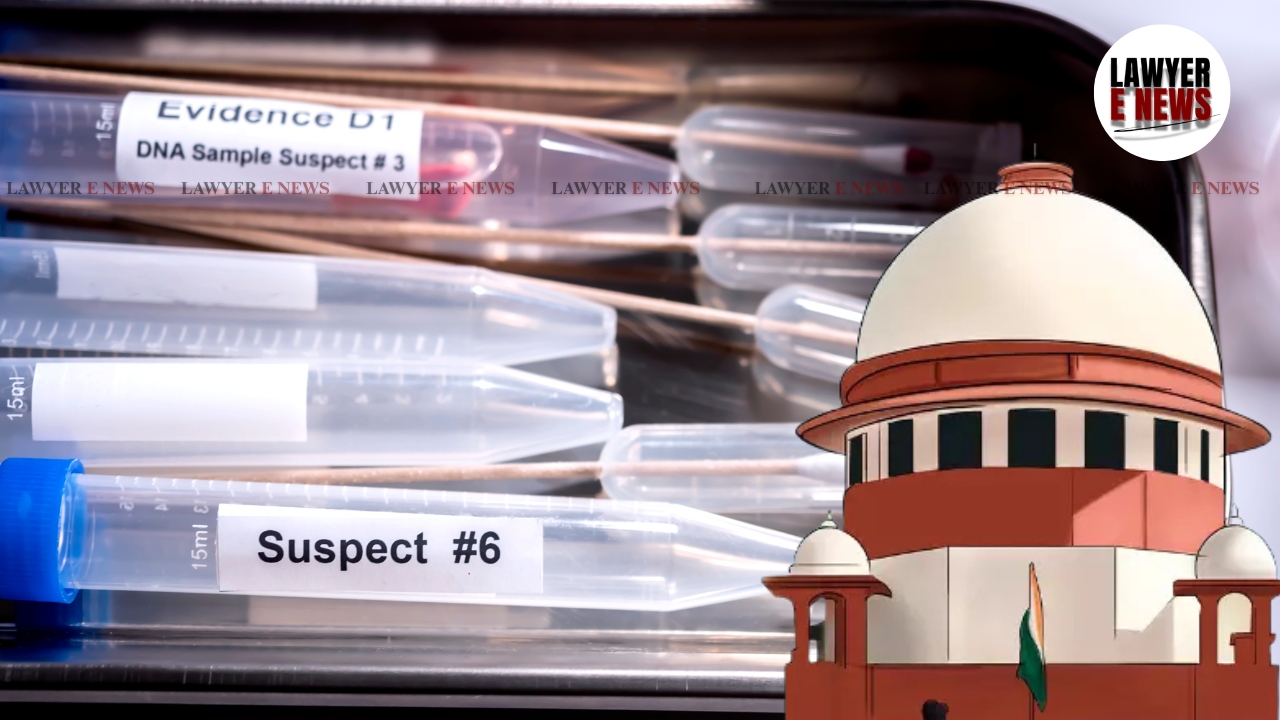
“Scientific evidence is only as reliable as the process used to collect, store and transmit it” – In a precedent-reinforcing judgment delivered on October 8, 2025, the Supreme Court of India, emphatically held that DNA evidence is inadmissible and unreliable if the chain of custody of forensic samples is not proved beyond doubt. The bench of Justices Vikram Nath, Sanjay Karol, and Sandeep Mehta concluded that grave procedural lapses and broken evidentiary chain rendered the DNA analysis reports untrustworthy, ultimately contributing to the acquittal of the death row convict.
The ruling is a landmark affirmation of the principle that even scientific evidence, including DNA, must strictly conform to evidentiary safeguards under the Indian Evidence Act, and that its mere presence cannot substitute for substantive and lawfully acquired proof.
"Chain of Custody is the Lifeline of Forensic Integrity – Its Absence is Fatal"
The apex court strongly criticised the investigation for failing to establish how the DNA samples were collected, sealed, stored, and transmitted, and whether they were protected from tampering or contamination at each stage.
“The prosecution has miserably failed to prove the chain of custody of the forensic articles/samples right from the time of seizure till they reached the FSL,” the Court held.
It was revealed during the trial that the malkhana in-charge (custodian of case properties) was not examined, and no documents were presented to prove who handled the samples, when they were sent, or whether the required sealing protocols were followed.
“Delay and Vagueness in Collection of Blood and Semen Samples Raises Serious Doubt”
The Court noted that blood samples of the accused were collected four months after his arrest, and the semen-stained undergarment of the victim — which formed the basis of the DNA match — was allegedly recovered under suspicious circumstances, with no documentation of proper sealing or storage.
“Though the scientific experts concluded that the DNA profile of the semen stain matched with the blood of the appellant, as the very factum of recovery of the undergarment has not been established beyond doubt, no sanctity whatsoever can be attached to the conclusions drawn in the Expert Report,” the Court ruled.
The Court further underlined that none of the critical links in the forensic chain were demonstrated in court, including:
Time and method of seizure
Sealing and labeling of exhibits
Custody trail of the samples
Who transported the samples to the FSL
Court orders directing such transmission
"DNA Evidence Must Be Beyond Suspicion – Otherwise, It Cannot Be Basis for Conviction"
The Court also took note of a crucial cross-examination answer given by the forensic expert (PW-28), who admitted:
“Semen biocells survive only for 48 hours after being released from the body.”
Yet, in this case, the semen-stained evidence was allegedly recovered long after the incident, without any explanation for the delay or degradation.
“There is a strong possibility that the delay may have been utilized to manipulate the samples,” the bench noted gravely.
Citing the decision in Prakash Nishad @ Kewat Zinak Nishad v. State of Maharashtra, 2023 SCC OnLine SC 666, the Court reiterated that chain of custody is essential to protect the integrity of scientific evidence, and a DNA report unsupported by custody documentation is worthless in law.
“Scientific Reports Cannot be Blindly Trusted – They Must Stand Legal Scrutiny”
Though the DNA report showed a match between the semen stain on the undergarment and the blood sample of the accused, the Court observed that this match had no probative value due to the unexplained delay, questionable origin of the undergarment, and total failure to prove the evidentiary trail.
“Even though the DNA evidence by way of a report was present, its reliability is not infallible... other cogent evidence, as seen from our discussion above, is absent almost in its entirety,” the Court quoted from Prakash Nishad.
Supreme Court Acquits, Reiterating That “Science Without Procedure Is No Evidence at All”
This case is a significant judicial statement on the limits of forensic evidence in criminal trials, particularly in capital cases, where death is irreversible. The Court’s message is unambiguous — DNA evidence must be pristine, provable, and procedurally perfect, failing which, it cannot be used to convict, let alone execute.
Accordingly, the Court set aside the judgments of both the Trial Court and the High Court, quashed the conviction and death sentence, and acquitted the appellant.
“Scientific analysis loses significance when the sanctity of the sample is not preserved. Courts cannot allow conviction merely on the strength of compromised DNA evidence.”
Date of Decision: October 08, 2025