-
by sayum
28 August 2026 2:11 PM







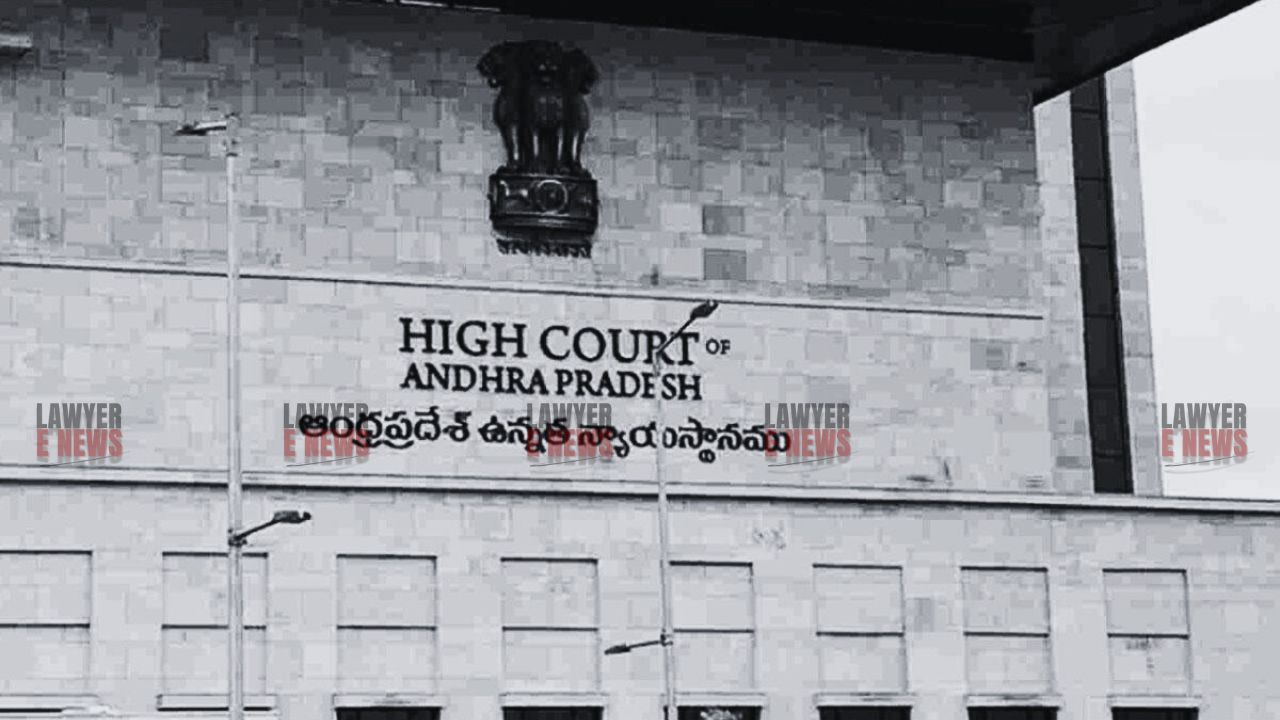
“Suspicion Cannot Replace Legal Proof—Delay in FIR, Suppression of Original Complaint, and Lack of Corroborative Evidence Fatal to Prosecution” - In a significant reaffirmation of the settled legal principles governing abetment of suicide and dowry-related offences, the Andhra Pradesh High Court upheld the acquittal of a husband accused of abetting the suicide of his wife. The Court ruled that there was no direct or proximate act of instigation or cruelty established by the prosecution to invoke Sections 306 and 498A of the IPC.
Justice T. Mallikarjuna Rao, while dismissing Criminal Revision Case No. 1570 of 2009 filed by the de facto complainant/father of the deceased, found the trial court’s judgment to be legally sound and based on careful appreciation of facts and evidence. The verdict reaffirmed the strict standards required for reversal of acquittals under the revisional jurisdiction of the High Court.
“No Direct Acts of Abetment—Merely Alleging Cruelty Doesn’t Prove Mens Rea or Instigation”
The deceased, married to the accused 12 years before her death, allegedly died by suicide (hanging) on 02.12.2007. The prosecution alleged harassment over dowry and pressure to sell one acre of land gifted as pasupu-kunkuma (customary marriage gift), following which the woman ended her life.
However, the Court noted that no proximate act of cruelty or instigation immediately before the suicide was proved. Referring to Amalendu Pal v. State of West Bengal [(2010) 1 SCC 707], the Court reiterated:
“There must be proof of direct or indirect acts of incitement... Mere allegation of harassment without there being any positive action proximate to the time of occurrence... is not sufficient.”
It further held: “There must be a clear mens rea on the part of the accused... and such act must have been intended to drive the deceased into that position.”
“Suppression of Original FIR and Delay of 33 Hours Raises Grave Doubts About Prosecution's Version”
One of the most telling deficiencies identified by the Court was the unexplained delay and contradiction in the FIR filing process. As per PW1 (father of deceased), the first report was given at 8–9 AM on 03.12.2007, but another report was taken later the same day around 3 PM allegedly on instruction from police officers. The FIR, however, is shown to have been registered at 6:00 AM — before the time the second report was given, creating a clear inconsistency.
The High Court observed: “There was an unexplained delay of approximately 33 to 36 hours... a lapse which the prosecution failed to clarify satisfactorily.”
Referring to Ramesh Kumar v. State [2010 Supreme (Mad) 2279], and State of M.P. v. Ratan Singh [(2020) 12 SCC 630], the Court held that suppression or manipulation of initial complaints damages the integrity of the prosecution case.
“There was a wilful suppression of the actual first information received... These factors together cast grave doubts on the credibility of the prosecution version.”
“Failure to Examine Neighbours and Independent Witnesses—Only Interested Witnesses Deposed”
The Court also found that the prosecution failed to examine key neighbours or disinterested witnesses. The only neighbour examined (PW6) did not support the case and instead stated that the deceased and accused had cordial relations.
This, along with the non-examination of the deceased’s mother, created significant evidentiary gaps.
The judgment quotes Ponnazhagu v. State [MANU/TN/1639/2025], wherein it was held: “Non-examination of neighbours and reliance only on interested witnesses is fatal to prosecution.”
“Property Not Registered in Deceased’s Name—Dowry Allegation Contradicted by Facts”
The prosecution alleged that the accused demanded the deceased to sell a one-acre plot given to her. But the Court noted that this land was never transferred in her name legally—undermining the entire foundation of alleged financial harassment.
“The Trial Court expressed doubt as to how the deceased could have sold the property when it was not legally registered in her name.”
Furthermore, the accused had voluntarily ensured that properties were settled in the names of their children after the wife’s death, reflecting no malice or deprivation towards the family.
“Appellate Interference in Acquittals Must Be Rare—No Perversity or Manifest Illegality Found”
Applying precedents such as Ganesha v. Sharanappa [(2014) 1 SCC 87] and Bindeshwari Prasad Singh v. State of Bihar [2002 SCC (Cri) 1448], the Court ruled that mere disagreement with the trial court’s view or potential misappreciation is not sufficient to reverse acquittals:
“Interference with acquittal in Revision is called for only in cases where there is manifest error of law or procedure... not where the trial court has taken a plausible view.”
Justice Rao concluded: “There is no material to suggest that the accused instigated or abetted the deceased to end her life... the Trial Court’s order is judicious and well-reasoned.”
Date of Decision: 19.09.2025