-
by sayum
28 August 2026 12:24 PM







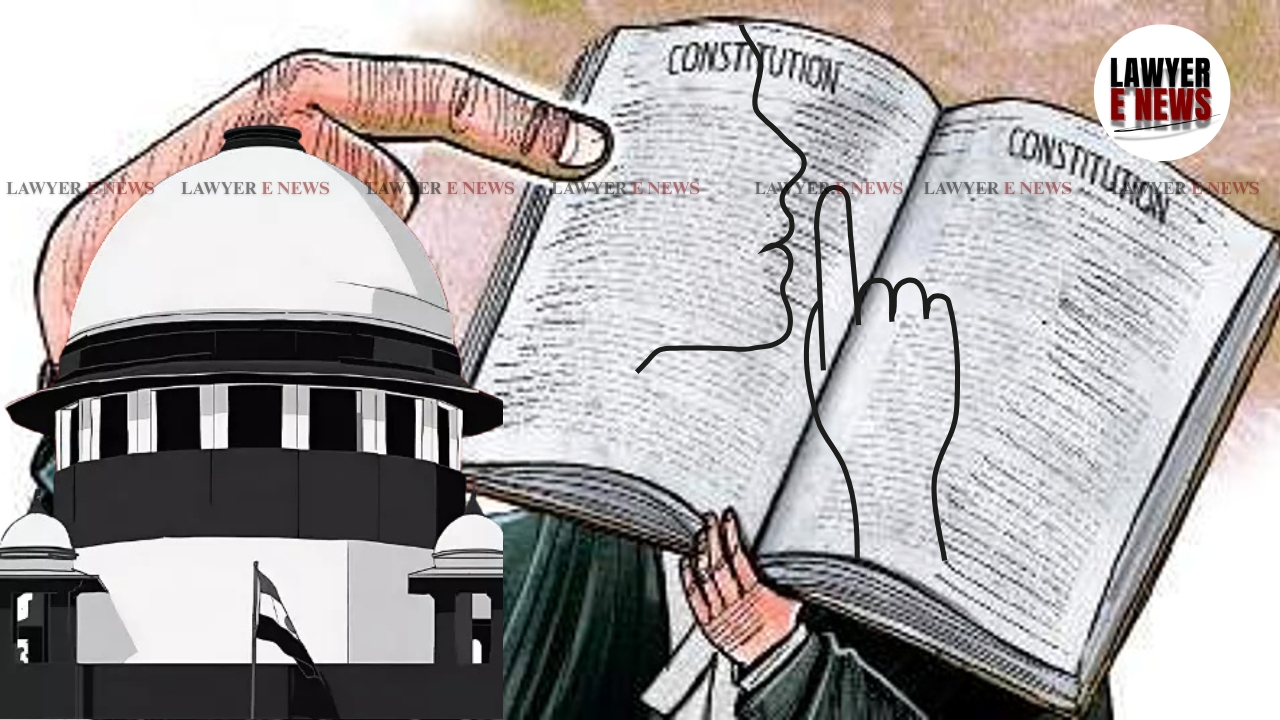
“Purposive Interpretation Must Prevail Over Literal Reading Where Rights and Institutional Integrity Are at Stake”: Five -Judge Bench Restores Equitable Access to District Judge Post In a powerful constitutional pronouncement delivered on October 9, 2025, the Supreme Court in Rejanish K.V. v. K. Deepa & Others, Civil Appeal No. 3947 of 2020, interpreted Article 233 of the Constitution through the lens of purposive construction, and held that the silence of the constitutional provision regarding in-service judicial officers applying for direct recruitment to the post of District Judge cannot be equated with an implied prohibition. The Constitution Bench declared that exclusion of such officers from the direct recruitment channel under Article 233(2) is neither mandated by the text nor supported by constitutional logic.
The Court observed that “A provision that is silent on a subject cannot be used to create an artificial disqualification,” and that “to read into Article 233(2) a prohibition that is neither expressed nor necessarily implied is contrary to the principles of constitutional interpretation.” Chief Justice B.R. Gavai, writing for the majority, noted that the rigid textualism adopted in Dheeraj Mor v. High Court of Delhi not only led to constitutional inequality but also ignored the larger institutional purpose behind Article 233 — to secure experienced, meritorious candidates in the district judiciary, regardless of their service background.
The Court emphasized that the words “a person not already in the service of the Union or of the State” in Article 233(2) are not exclusionary, but descriptive of a category. The provision is designed to ensure that advocates applying from outside the judicial service have the requisite experience of seven years, and are vetted by the High Court. It is not intended to create a bar against those who previously practiced law and subsequently joined judicial service. “There is no express language in the provision disqualifying judicial officers from applying as direct recruits,” the Court held, adding that, “a bar must be clear, unequivocal, and explicit in a constitutional scheme — not a matter of inference.”
Justice M.M. Sundresh, in his concurring opinion, brought further clarity to this principle. He stated, “Constitutional silence cannot be treated as a constitutional embargo. The makers of the Constitution have chosen not to use the words ‘only an advocate’ or ‘excluding those in service’, and that silence is deliberate. It leaves room for a broader, purposive interpretation.” He emphasized that the role of the Court in interpreting the Constitution is not limited to rigid textual parsing, but must consider institutional realities, evolving standards of equality, and the overarching goal of efficient governance.
Reinforcing the doctrine of purposive interpretation, the Court held that Article 233 must be construed not in isolation, but in harmony with Articles 14 and 50 of the Constitution. “Article 50 mandates separation of the judiciary from the executive, and Article 14 guarantees equality before law. Excluding judges with prior advocacy experience, while permitting law officers and public prosecutors to apply, upends this balance,” the Court observed. It added that interpreting Article 233(2) narrowly would result in irrational classifications, defeating both the spirit of equality and institutional independence.
Addressing the judicial duty in constitutional matters, Chief Justice Gavai observed, “A Constitution must be interpreted in a manner that furthers its principles and values, not in a way that frustrates its vision.” The Court clarified that purposive interpretation must override literalism when constitutional rights or institutional health are at stake. “The goal is not to trap interpretation in frozen meaning, but to ensure that the Constitution lives in its spirit,” the judgment declared.
The Court also held that long-standing misinterpretations must be corrected where they result in injustice, even if previously decided by larger benches. The Bench ruled that Satya Narain Singh, Chandra Mohan, and Dheeraj Mor had adopted an unduly narrow construction of Article 233(2), and therefore deserved to be overruled. The majority stated that “precedents that operate contrary to constitutional vision must be set aside to restore institutional coherence and fairness in public employment.”
This decision thus does not merely concern the eligibility criteria for a judicial post but resets the interpretive approach to constitutional silence itself. The Court made it clear that absence of express inclusion cannot automatically be read as exclusion, and where rights or access to public office are concerned, interpretive generosity must prevail over procedural rigidity.
In its final directions, the Court instructed all State Governments to align their recruitment rules with this ruling and ensure that in-service judicial officers with qualifying experience are permitted to apply for direct recruitment to the post of District Judge. The Court gave a three-month deadline for such amendments and stated that any rule inconsistent with this interpretation would stand invalidated.
Ultimately, this decision is a constitutional reaffirmation that purposive interpretation, guided by the text and spirit of the Constitution, must lead the way in matters of institutional design and equality. As Justice Sundresh remarked, “When the Constitution does not speak in the language of exclusion, the Court cannot write it in.”
Date of Decision: October 09, 2025